

You have a product, a buyer meeting and a question you cannot find a clear answer to: what does a big-box retailer actually want to see? The honest answer is that Walmart cosmetic supplier requirements, and Target’s, are not a single public checklist. What retailers publish is a handful of principles and programs, and the detailed forms arrive after you are in the onboarding process. This guide collects what the public supplier pages say, translates it into a compliance file you can prepare now, and marks every point where you must ask your buyer.
Περιεχόμενα
- The short answer
- What Walmart says publicly
- What Target says publicly
- What the law adds: MoCRA basics
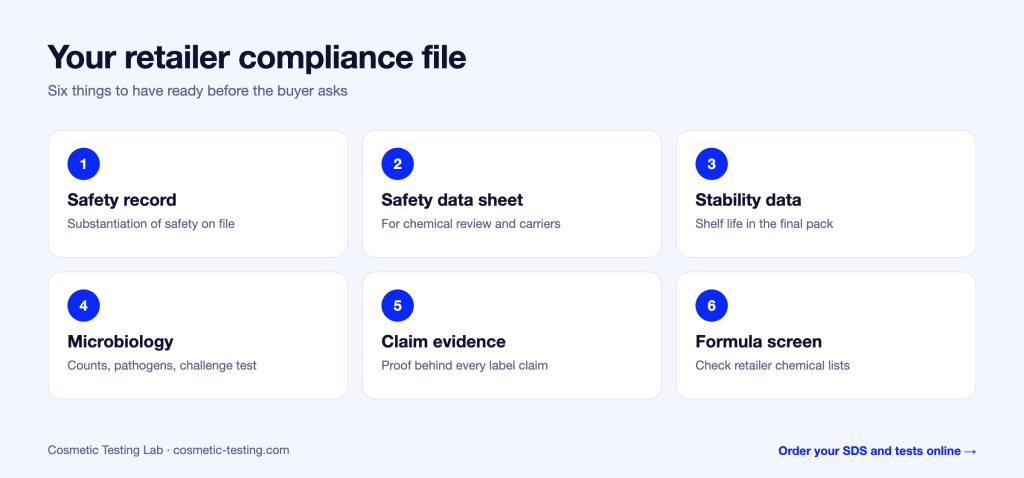
- Your compliance file: eight documents to prepare
- Screen the formula against retailer chemical lists
- Timing: when to start testing
- Questions to ask your buyer
- Common mistakes
- Frequently asked questions
- Key takeaways
The short answer
Prepare one file that proves your product is safe, stable, microbiologically controlled, truthfully labelled and free of the chemicals your retailer restricts: a safety substantiation record, a safety data sheet (SDS), stability and microbiological data, claim evidence, ingredient and formulation details, and proof of how and where it is made. Each retailer will then tell you which items it needs in which format. Everything below comes from public pages and the FDA’s description of MoCRA; retailer rules change, so treat it as a starting point and confirm with your buyer.
What Walmart says publicly
Walmart’s supplier page states that companies supplying cosmetics, along with OTC drugs, vitamins and similar products, must meet its Health & Wellness Product Safety requirements to become a supplier, and it refers to separate guides for cosmetics, beauty and personal care. The page also sets out several principles that matter for your file:
- Testing: products must be submitted for testing where required, and nobody may be pressured to withhold or alter test results.
- Documentation: you must be able to provide documented proof of compliance when asked.
- Claims: label and listing claims must be truthful and substantiated, with the substantiation provided on request.
- Audits: suppliers must disclose and schedule audits for facilities in scope, and Walmart can inspect a facility.
- Chemical items: chemical and aerosol items go through a UL WERCSmart review before an item number is created, with formulation information submitted and the data kept current.
The page does not publish a list of required cosmetic tests. The detail sits in the cosmetics guide and the supplier portal, which you can access once you are onboarding. Ask your buyer for the current version rather than relying on third-party summaries, which are often outdated.
Διαβάστε επίσης Πώς να επιλέξετε εργολάβο παραγωγής καλλυντικών
What Target says publicly
Target’s public material covers two different things, and it is worth keeping them apart.
Target Clean. This is a voluntary icon. For personal care and beauty it describes products formulated without select chemicals of concern in groups such as phthalates, propyl and butyl parabens, formaldehyde donors, musks, nonylphenol ethoxylates, ethanolamines, glycol ethers, siloxanes and PFAS, defined as less than 100 ppm in the finished product, and it asks that products be cruelty free or not tested on animals, designated and validated by each brand. The page says the list goes beyond those groups, so check the full list before you formulate or apply.
Product safety and quality. Target says its vendors must test Target-brand products at third-party laboratories throughout production, that products must pass all testing before shipment, that it expects good manufacturing practices or documented manufacturing and quality processes, and that it audits factories before production begins. That text refers to Target-brand products, so for a national brand, ask whether and how it applies to you.
What the law adds: MoCRA basics
Whatever the retailer asks, US law sets a floor. According to the FDA, MoCRA requires the responsible person to maintain records supporting adequate substantiation of safety for each cosmetic product, and to report serious adverse events within 15 business days. The law also covers facility registration and product listing, with an exemption for certain small businesses. That exemption does not apply to products that regularly contact the eye’s mucous membrane, injected products, products for internal use, or products intended to alter appearance for more than 24 hours without removal by the consumer. The law does not prescribe specific tests, so retailer requirements often define the practical minimum.
Your compliance file: eight documents to prepare
- Safety substantiation record. A documented assessment of the formula and its intended use. Many brands use a signed CPSR as the backbone, especially if the same product also goes to the EU.
- Safety data sheet. Retailers’ chemical review systems typically ask for an SDS, and carriers ask for one for flammable or aerosol items. Check whether your buyer expects the US format.
- Stability data. A stability test in the final packaging supports shelf life and shows the product does not separate, discolour or change in pH or viscosity.
- Microbiological quality. A microbiological specifications test shows counts and absence of specified organisms in the finished product; a challenge test shows the preservative works. See our challenge test.
- Claim evidence. For every claim on the label and listing, such as “hypoallergenic”, “dermatologist tested” or “non-comedogenic”, keep the study or data behind it.
- Ingredient and formulation details. A full ingredient list with percentages, supplier specifications and, where requested, declarations on restricted substance groups.
- Manufacturing evidence. Facility details, the GMP standard you follow (for example ISO 22716 or the manufacturer’s own documented system), and audit reports if you have them.
- Label, adverse event and recall procedures. The responsible person’s name and address, a contact for complaints and a written process for reporting and recall.

Διαβάστε επίσης Dropshipping καλλυντικών στην ΕΕ: νομικές παγίδες
Screen the formula against retailer chemical lists
Retailer lists are separate from legal limits. A product can be legal and still be excluded from a program. Compare your ingredient list with the groups named above: phthalates, propyl and butyl parabens, formaldehyde donors, musks, siloxanes and PFAS are the usual flags. Raw material suppliers can help with declarations, but PFAS and trace contaminants are often not on an ingredient list at all, so ask for written statements. Do this before you finalise the formula; changing a preservative later means repeating the challenge, microbiological and stability tests.
Timing: when to start testing
Tests take time. A challenge test runs 28 days, accelerated stability runs for weeks, and the microbiological test takes about five days after samples arrive. Retailer line reviews and item-setup deadlines rarely move for a lab queue. Start testing as soon as the formula and the final packaging are fixed, and order the tests in parallel rather than one after another.
Questions to ask your buyer
- Which cosmetics requirements guide or supplier portal applies to my product?
- Which documents are mandatory before the item is set up, and which only on request?
- Do you require a particular test method, such as USP 51 or ISO 11930 for preservation?
- Is a WERCSmart registration or similar chemical review needed, and in which format must the SDS be?
- Do you apply a restricted ingredient list, and does it differ for my category?
- Which facility audits are accepted, and how often must they be renewed?
Διαβάστε επίσης Συμμόρφωση μάρκας ομορφιάς influencer: τα βασικά
Common mistakes
- Waiting for the retailer’s checklist before starting any testing.
- Using reports from a lab prototype instead of the finished, packed product.
- Making marketing claims with no evidence on file.
- Assuming that meeting FDA rules means meeting a retailer’s chemical list.
- Changing the formula after the reports are done without retesting.
Frequently asked questions
Does Walmart require third-party lab tests for cosmetics?
Its public page says suppliers must submit products for testing where required and provide documented proof of compliance on request. The specific tests are set in its cosmetics requirements, so ask your buyer for the current guide.
Is Target Clean mandatory?
No. It is a voluntary icon with its own criteria. Target’s product safety and quality expectations are separate from it.
Do I need an SDS for a cosmetic sold at retail?
Not always by law, but retailer chemical review systems and carriers commonly ask for one, especially for aerosols, flammable products and perfumes. Check with your buyer and carrier.
Key takeaways
- No single public checklist: prepare a general file, then ask your buyer for the exact list.
- Core documents: safety record, SDS, stability, microbiology, claim evidence and formula details.
- Retailer lists differ from law: screen your formula early.
- Timing: start testing in parallel once formula and packaging are fixed.