
The question cosmetic vs drug FDA decides almost everything about how a US product is made, labeled and sold: which rules apply, which registrations are needed, and what you may say on the pack. The same jar can sit on one side of the line in the US and on the other side in the EU. This guide explains how sunscreens, acne products and anti-dandruff shampoos are treated in each market, and what an exporter should check before shipping.
Innhold
- The short answer
- How does FDA tell a cosmetic from a drug?
- What is a dual cosmetic/drug product?
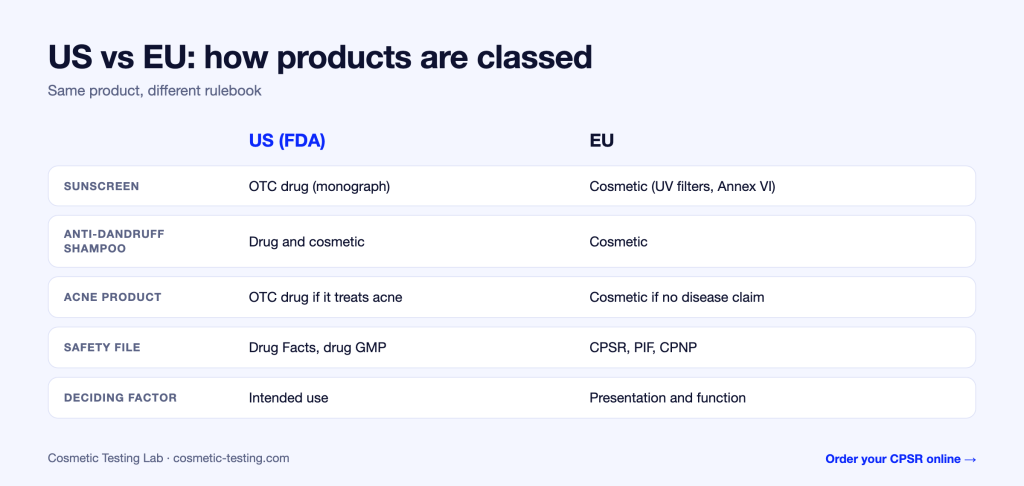
- How are US sunscreens regulated?
- How are acne and anti-dandruff products treated?
- How does MoCRA treat drug-cosmetic products?
- How does the EU draw the line?
- Sunscreens, acne and dandruff in the EU
- What changes when a US product goes to the EU?
- What tests do you need?
- Common mistakes when crossing the line
- Frequently asked questions
- Key takeaways
The short answer
In the US, FDA decides whether a product is a cosmetic or a drug by its intended use, and products that do both (a cosmetic and a drug) must meet both sets of rules. In the EU there is no “OTC drug” category for these products: sunscreens, anti-dandruff shampoos and most acne-care products are cosmetics under Regulation (EC) No 1223/2009, provided they do not claim to treat or prevent disease. That means a US sunscreen moving to the EU usually changes regulatory framework completely, and needs a CPSR instead of a Drug Facts label.
How does FDA tell a cosmetic from a drug?
Under the Federal Food, Drug, and Cosmetic Act, a cosmetic is a product applied to the body for cleansing, beautifying, promoting attractiveness or altering appearance. A drug is a product intended to diagnose, cure, mitigate, treat or prevent disease, or to affect the structure or function of the body. The deciding factor is intended use, and FDA reads it from several signals:
- claims on the label, website, social media and advertising;
- what consumers reasonably expect from the product;
- well-known therapeutic ingredients, such as salicylic acid or benzoyl peroxide used for acne.
Les også Kosmetikkregelverk i EU, Storbritannia og USA: sammenligning side om side
What is a dual cosmetic/drug product?
Some products are both at once, and FDA says they must satisfy the requirements for each category. FDA’s own examples include anti-dandruff shampoos (a cosmetic because they cleanse hair, a drug because they treat dandruff), antiperspirant deodorants, fluoride toothpastes, and moisturizers or makeup with sun protection claims. Acne cleansers are regulated as drugs, or as both. In practice, the drug side adds ingredient rules, Drug Facts labeling, manufacturing under drug GMP and drug facility registration and product listing.
How are US sunscreens regulated?
In the US, sunscreens are over-the-counter (OTC) drugs. They are covered by an OTC monograph, a kind of rulebook that lists the permitted active ingredients, concentrations, testing and labeling. Since the CARES Act of 2020, FDA changes monographs through administrative orders instead of lengthy rulemaking. FDA has also been working on updates, including the status of zinc oxide and titanium dioxide, and, more recently, a proposal to add bemotrizinol as a permitted active. This area moves, so check FDA’s current monograph and order pages before finalizing a formula.
A US sunscreen typically needs the Drug Facts panel, the listed active ingredients with percentages, SPF and broad spectrum statements that follow the monograph, and a facility registered as a drug establishment. Products with a sun protection claim, such as a foundation with SPF, are drugs as well as cosmetics.
How are acne and anti-dandruff products treated?
In the US, an acne product that treats or prevents acne is an OTC drug, and its active (for example salicylic acid or benzoyl peroxide) must fit the relevant monograph. Anti-dandruff shampoos work the same way: the active ingredient, such as pyrithione zinc or selenium sulfide, makes the shampoo a drug-cosmetic. The shampoo base and fragrance are still cosmetic ingredients, so both sets of rules apply.
A careful word: a plain cleanser that says “for oily, blemish-prone skin” or “purifying” may stay a cosmetic. Words like “treats acne”, “clears breakouts” or “eliminates dandruff” usually do not.
Les også EUs kosmetikkforordning 1223/2009 forklart på enkel norsk
How does MoCRA treat drug-cosmetic products?
The Modernization of Cosmetics Regulation Act of 2022 (MoCRA) added cosmetic facility registration, product listing, safety substantiation, adverse event reporting and GMP duties for cosmetics. FDA’s guidance indicates that products which are both cosmetics and OTC drugs are not required to be listed under the cosmetic listing system when they are already listed as drugs, and that a facility making only such products is not required to register as a cosmetic facility. A facility that also makes pure cosmetics falls under the cosmetic requirements for those products. Confirm the current wording in FDA’s registration and listing guidance, because details change as guidance is updated.
How does the EU draw the line?
Regulation (EC) No 1223/2009 defines a cosmetic by its purpose and its place of application: a substance or mixture intended to be placed in contact with the external parts of the body (or teeth and mucous membranes of the mouth) exclusively or mainly to clean, perfume, change appearance, protect, keep in good condition or correct body odours. A medicinal product, under Directive 2001/83/EC, is defined by presentation (it is presented as treating or preventing disease) or by function (it restores, corrects or modifies physiological functions through a pharmacological, immunological or metabolic action). The EU also keeps a working manual on borderline products, agreed by the Member States and the Commission, to help decide hard cases.
Sunscreens, acne and dandruff in the EU
The EU treats these as cosmetics when they claim only a cosmetic purpose:
- Sunscreens are cosmetics. UV filters must be on the permitted list in Annex VI, and the product needs a safety assessment and a PIF.
- Anti-dandruff shampoos are cosmetics. The active agents (such as pyrithione zinc, piroctone olamine or climbazole) are regulated by the annexes as ingredients, with limits.
- Acne products are cosmetics only when they present themselves as cleansing, caring or improving the look of skin. Claims to treat or cure acne as a disease move a product towards the medicinal side, and it is then a case for the national medicines authority.
What changes when a US product goes to the EU?
An exporter has to translate the product into the EU framework. A practical review covers:
- Claims. Remove disease-treatment language. Keep claims that are allowed and supported under the common criteria for cosmetic claims.
- Ingredients. Check every ingredient, especially actives, against the annexes: prohibited (II), restricted (III), colorants (IV), preservatives (V) and UV filters (VI). Some US OTC actives may be limited or not allowed in cosmetics.
- Safety file. A signed CPSR by a qualified assessor, Part A and Part B, is mandatory. Your US drug dossier does not replace it, although stability and microbial data are reusable.
- Responsible Person and notification. Appoint an EU Responsible Person and notify in the CPNP before sale.
- Label. Replace Drug Facts with an EU label: INCI list, batch, Responsible Person address, PAO or date of minimum durability, and any required warnings.

What tests do you need?
For the EU cosmetic route, the evidence behind the CPSR typically includes stability data, a microbiological quality check and, for water-containing products, a challenge test that proves the preservation works. If the product is intended for sensitive or acne-prone skin and you want to support a gentleness claim, a patch test can add to the file. We do not run SPF or clinical efficacy studies; an SPF claim needs a recognized method from a specialist lab.
Common mistakes when crossing the line
- Selling a US drug-cosmetic as a plain cosmetic because the EU category sounds simpler, without re-checking claims.
- Keeping US claims such as “treats acne” on EU packs and pages.
- Assuming the monograph active list matches the EU annexes.
Frequently asked questions
Is a sunscreen a cosmetic or a drug?
In the US, a sunscreen is an OTC drug regulated under the sunscreen monograph. In the EU, it is a cosmetic under Regulation (EC) No 1223/2009, with UV filters limited to those listed in Annex VI.
Can I sell my US anti-dandruff shampoo in the EU as it is?
Usually not without changes. The product can be placed on the EU market as a cosmetic, but its active, concentration, claims and label must be checked against the EU annexes, and it needs a CPSR, an EU Responsible Person and a CPNP notification.
Does a cosmetic with an SPF claim need drug registration in the US?
Yes, a product with a sun protection claim is treated as an OTC drug in the US, even if it is a makeup or a moisturizer. That is why SPF makeup carries a Drug Facts label.
Key takeaways
- In the US, intended use and claims decide whether a product is a cosmetic, a drug or both.
- Sunscreens, acne actives and anti-dandruff actives push US products into the OTC drug framework.
- In the EU, these products are cosmetics if they avoid disease-treatment claims, and need a CPSR, PIF and CPNP notification.
- Review claims, ingredients and labels together before exporting, and keep evidence in one file.