
If you want to sell a US sunscreen in the EU, you are not moving a drug to another drug market. You are moving from the US over-the-counter (OTC) monograph system to the EU cosmetics system, where sunscreens are ordinary cosmetic products with their own special rules for UV filters, claims and labels. This guide walks a US brand through what changes, in a realistic order of work.
Spis treści
- The short answer
- Why the legal frame changes
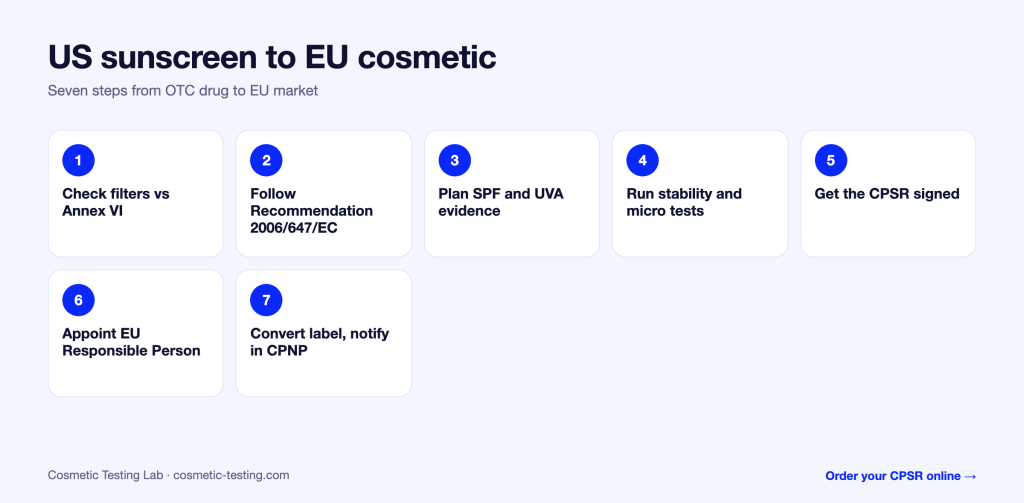
- Step 1: Check every UV filter against Annex VI
- Step 2: Understand the EU sunscreen recommendation
- Step 3: Plan the efficacy evidence
- Step 4: Build the safety assessment
- Step 5: Gather stability, microbiology and compatibility data
- Step 6: Appoint an EU Responsible Person and notify
- Step 7: Convert the label
- What about makeup and moisturizers with SPF?
- Common mistakes
- Frequently asked questions
- Key takeaways
The short answer
In the EU, a sunscreen is a cosmetic under Regulation (EC) No 1223/2009. To sell yours, you need only UV filters allowed in Annex VI, a signed CPSR, a product information file (PIF), an EU Responsible Person, a CPNP notification and an EU label that follows the Commission’s sunscreen recommendation (2006/647/EC). Your US Drug Facts label, monograph compliance and drug facility registration do not carry over. Some of your data, especially stability and microbiology, can be reused in the CPSR.
Why the legal frame changes
In the US, FDA regulates sunscreens as OTC drugs under a monograph, because they are intended to prevent sunburn. In the EU, the same function is treated as a cosmetic purpose: protecting the skin. Medicines law applies only when a product is presented as treating or preventing a disease, for example skin cancer. That is why EU sunscreens cannot claim to prevent skin cancer, and why your US-specific health statements need a careful look before you ship.
Przeczytaj też Przepisy kosmetyczne UE, Wielkiej Brytanii i USA: porównanie
Step 1: Check every UV filter against Annex VI
Annex VI of Regulation 1223/2009 is a positive list: only the UV filters listed there may be used in the EU, within the maximum concentrations and conditions shown. Your US actives and the EU list overlap but are not the same. Typical issues:
- a filter that is allowed in the US monograph but absent from Annex VI, or the other way round;
- a different maximum concentration, or extra conditions, for the same filter;
- nano-form filters, which have their own conditions and must be marked [nano] in the ingredient list;
- other ingredients in the formula (preservatives, colorants, fragrance) that are separately regulated in Annexes II to V.
The annexes change by amendments, so verify each filter against the consolidated current text before you finalize the formula.
Step 2: Understand the EU sunscreen recommendation
Commission Recommendation 2006/647/EC on the efficacy of sunscreen products and the claims made relating thereto is not a law, but authorities and retailers treat it as the standard. In summary, it says that:
- the SPF should be shown with one of four categories: low, medium, high or very high;
- the label should not claim more than “50+”;
- UVA protection should be at least one third of the labeled SPF, with a critical wavelength of 370 nm;
- products that meet the UVA minimum often carry the standard UVA logo in a circle;
- claims such as “sunblock”, “total protection” or “100% protection” are not acceptable.
Check the recommendation itself for the exact SPF-to-category bands, as they are a table in the annex. If your US label says “SPF 70” or you rely on a different sun-protection claim, you will need a different EU label, even if the formula stays the same.
Step 3: Plan the efficacy evidence
EU authorities expect claimed protection to be supported by test data using recognized methods. In practice, SPF is determined in vivo on volunteers, UVA protection by in vitro or in vivo methods, and critical wavelength by an in vitro measurement. These are performed by specialist photobiology laboratories; we do not run SPF or UVA tests. If your US file already includes an SPF test, ask your lab whether the method matches what the EU recommendation points to (typically the ISO methods for SPF and UVA) and whether a bridging test is needed.
Przeczytaj też Sprzedaż kosmetyków w Słowenii: zasady, organy i etykiety
Step 4: Build the safety assessment
A CPSR signed by a qualified safety assessor is mandatory before the product reaches the market. For a sunscreen, the assessor looks at the exposure of a product used in large amounts on large body areas, the safety of each UV filter (often using the SCCS opinions), possible nano-ingredients, and impurities. A US drug dossier is useful background but does not replace Part A and Part B of the report.

Step 5: Gather stability, microbiology and compatibility data
The CPSR depends on data about the finished product. For sunscreens, this typically means stability testing, because emulsions with high filter loads can separate or lose consistency at elevated temperatures, and packaging compatibility, because filters and solvents can interact with plastics. A microbiological check and, for water-containing formulas, a challenge test show that the preservative system works. Sunscreens are often used outdoors and in heat, so realistic storage conditions matter.
Step 6: Appoint an EU Responsible Person and notify
Every cosmetic on the EU market needs a Responsible Person established in the EU. They hold the PIF, ensure compliance, handle serious undesirable effect reports and complete the CPNP notification before the product is sold. A US brand cannot be its own Responsible Person without an EU establishment, so appoint an importer or a service in writing.
Przeczytaj też Sprzedaż kosmetyków w USA: MoCRA krok po kroku
Step 7: Convert the label
Replace the Drug Facts panel with the EU label elements. These typically include:
- the name and address of the Responsible Person, and the country of origin for imports;
- nominal content;
- date of minimum durability, or the period-after-opening symbol where it applies;
- precautions and warnings (for sunscreens, usually those suited to sun use);
- batch number;
- the function of the product;
- the INCI ingredient list, with “[nano]” where relevant;
- the SPF with its category and the UVA statement or logo, if the product meets the criteria.
Label languages are set nationally, so check each target country.
What about makeup and moisturizers with SPF?
In the US, a foundation or daily moisturizer with an SPF claim is a drug as well as a cosmetic. In the EU, it is simply a cosmetic with a sun-protection claim, and the same rules apply: only Annex VI filters, evidence for the claimed SPF, and a label that follows the recommendation. This often makes the EU route simpler for products of this kind, because you maintain one regulatory file instead of two. The claim must still be supported, and the safety assessor will look at the filters in the same way as for a classic sunscreen.
Common mistakes
- Shipping the US label and Drug Facts panel to EU customers.
- Keeping an SPF above 50+ or a “sunblock” claim on EU packaging.
- Assuming a US-approved active is allowed in the EU at the same level.
- Listing nano-sized filters without the [nano] marking.
- Forgetting that Amazon and other marketplaces ask for the EU label and the Responsible Person details.
Frequently asked questions
Is a sunscreen a drug in the EU?
No. Under Regulation (EC) No 1223/2009 a sunscreen is a cosmetic, as long as it does not claim to treat or prevent a disease. It does not need a drug licence.
Can I use my US SPF test in the EU?
Possibly, if the method and results match what the recommendation expects. Ask the test laboratory whether the report is suitable for the EU file, and whether a UVA or critical wavelength result is also needed.
Do I need a CPSR for a sunscreen?
Yes. Every cosmetic placed on the EU market needs a CPSR in its PIF, and sunscreens get a particularly careful review because of the UV filters and the large exposure.
Key takeaways
- A US OTC sunscreen becomes an EU cosmetic: monograph and Drug Facts are replaced by Annex VI, a CPSR, a PIF and a CPNP notification.
- Check each UV filter, concentration and nano status against the current annexes.
- Follow Recommendation 2006/647/EC for SPF categories, the UVA minimum and the claims you may make.
- Use specialist labs for SPF and UVA, and build the stability and microbiology data behind the CPSR early.