
Brands searching for FDA cosmetic GMP under MoCRA usually want to know one thing: what will inspectors expect, and how much batch testing is enough? The honest answer is that FDA has not yet finalised its cosmetic good manufacturing practice rule, but the direction is clear, and the habits it will reward are worth building now. This guide explains where the rule stands, how it relates to ISO 22716, and what practical batch testing looks like for a growing brand.
Obsah
- The short answer
- What does MoCRA require on GMP?
- Where does the rule stand now?
- How does ISO 22716 fit in?
- What GMP means for batch testing
- Microbial testing is the core of release
- Stability testing supports GMP decisions
- A practical GMP starter checklist
- What if you use a contract manufacturer?
- Frequently asked questions
- Key takeaways
The short answer
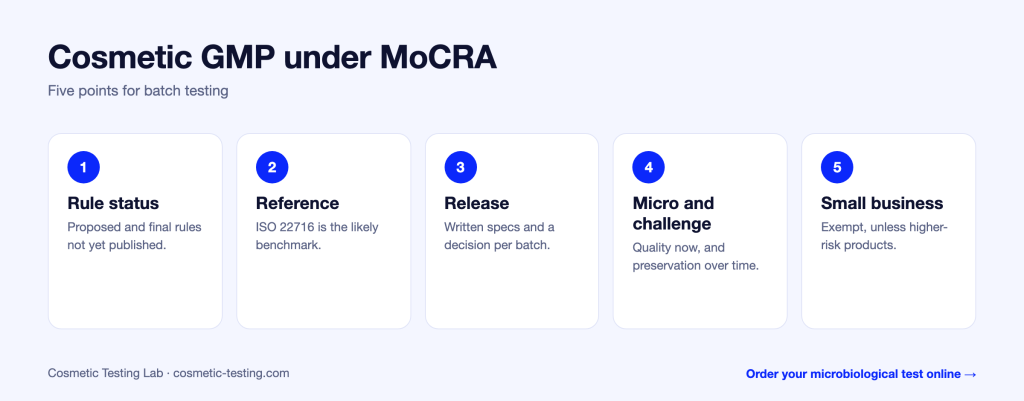
MoCRA told FDA to publish a proposed cosmetic GMP rule and then a final rule, and to align with international standards where practical, but the rule is not final yet. The law set deadlines of two and three years from December 2022, and FDA has not met them, according to recent industry commentary. Until a rule exists, FDA can still act against products made in insanitary conditions under the older adulteration provisions. The sensible approach is to follow a recognised system such as ISO 22716 and to keep evidence from microbiological testing and stability testing on file for every batch family.
What does MoCRA require on GMP?
The statute directs FDA to establish GMP regulations for cosmetic facilities. Three features of the law matter most:
- Alignment with standards. FDA should consider national and international standards where practicable and appropriate, and consult manufacturers, including smaller ones.
- Proportionality. The rule must reflect the size and scope of businesses and the health risks of their products, with simplified requirements for smaller businesses where appropriate and possible longer compliance times.
- Records. The rule may allow FDA to inspect records needed to show GMP compliance during an inspection.
The statute also says that small businesses meeting the sales test are not subject to the GMP section, unless they make certain higher-risk products. FDA has published a draft guidance on cosmetic GMP and held a public meeting on the topic in 2023, which are good signals of its thinking, but neither is a binding rule.
Čtěte také ISO 22716 GMP pro kosmetiku: potřebujete ji?
Where does the rule stand now?
MoCRA set a deadline for a proposed rule two years after enactment and a final rule three years after enactment, which fell at the end of 2024 and 2025. Industry commentary in 2026 reports that FDA has moved the GMP rulemaking to its long-term agenda with no proposal date, so a final rule is not expected soon. Check FDA’s cosmetics pages and the Federal Register before relying on any date, because this can change. A delay does not mean no expectations: inspectors already look at sanitation, contamination controls and records, and retailers ask for GMP evidence today.
How does ISO 22716 fit in?
ISO 22716 is the international guideline for cosmetic GMP, widely used in the EU, where good manufacturing practice is required for cosmetics and ISO 22716 is the usual way to show it. Its chapters cover personnel, premises, equipment, raw materials and packaging, production, finished products, quality control laboratory, deviations, complaints and recalls, change control, and documentation. MoCRA tells FDA to consider international standards, so ISO 22716 is the most likely reference, but the final US rule may differ in detail. A brand that already follows ISO 22716 will probably need only a gap check. Our guide to ISO 22716 cosmetics GMP explains the standard in more depth, and a certificate is not required by law in the EU either.
What GMP means for batch testing
GMP does not prescribe one list of tests, but a documented quality system normally expects the following, and these are the checks inspectors and retailers recognise:
- Incoming materials. Identity and quality checks or supplier certificates for raw materials and packaging, with lot numbers recorded.
- In-process checks. Appearance, pH, viscosity and weight or fill checks, recorded against specifications.
- Finished product release. Appearance, odour, colour and key physical parameters, plus microbial quality, compared with written specifications before the batch is released.
- Retained samples. Samples from each batch kept under defined conditions to investigate complaints.
- Deviations. A written route for out-of-specification results: investigate, decide, document.
You do not have to run every test on every batch. A risk-based plan works: full testing on the first batches and any change, routine release checks on every batch, and periodic microbial checks scaled to the product’s risk.
Čtěte také Nařízení EU o kosmetice 1223/2009 srozumitelně
Microbial testing is the core of release
Water-containing products are the main contamination risk. A microbiological specifications test shows the quality of the finished product at release, while a challenge test proves the preservative system works for the product’s life. The two answer different questions: one says what is in this batch today, the other says will the product protect itself in use. Run the challenge test at development and after formula or packaging changes, and use microbiological testing at release according to your risk plan. Record the specification, the method and the result for each lot.
Stability testing supports GMP decisions
A stability and compatibility test supports your shelf life, your packaging choices and your storage and transport instructions. It also feeds change control: if you change a supplier, a preservative or the pack, the stability file tells you whether a new study is needed. Keep reports with batch records so that the link between a formula, its pack and its evidence is clear.
A practical GMP starter checklist
- Define responsibilities. Name who approves materials, releases batches and handles complaints.
- Write simple procedures. Cleaning, production steps, labelling checks and release, each one page.
- Keep batch records. Materials used, lot numbers, quantities, dates, signatures.
- Control hygiene. Clean areas, hand hygiene, water quality and pest control, with logs.
- Qualify suppliers. Specifications, certificates and a record of approval.
- Test and release. Written specifications and a release decision on every batch.
- Retain samples and track complaints. Link every complaint to a lot and to your adverse event process.
- Audit yourself once a year. A short internal review against the checklist.
Čtěte také Odpovědná osoba pro kosmetiku (RP): kdo ji potřebuje
What if you use a contract manufacturer?
Using a contract manufacturer does not remove your responsibility as the brand. Ask for evidence of their GMP system, agree release specifications in a quality agreement, and decide who keeps retained samples and who investigates complaints. Request batch records and test reports with each lot. A manufacturer that can show an ISO 22716-style system saves you time when retailers or authorities ask questions.
Frequently asked questions
Is cosmetic GMP mandatory in the US today?
There is no final cosmetic GMP rule yet. FDA can still act against adulterated products, for example those prepared under insanitary conditions, and a rule is expected later. Small businesses meeting the sales test are exempt from the GMP section, except for certain higher-risk product types.
Do I need ISO 22716 certification?
Not by law, in the US or the EU. Certification is voluntary, but following the standard is a practical way to show GMP, and some retailers ask for it.
How often should I test finished batches?
There is no fixed rule. Base the frequency on product risk: higher for water-based and low-preservative products, lower for anhydrous ones, with extra testing after any change.
Key takeaways
- FDA has not finalised the cosmetic GMP rule, but it is expected to follow international practice.
- ISO 22716 is the most useful framework to follow now, and small businesses under the sales threshold are exempt from the GMP section.
- Batch release should rest on written specifications, microbial quality and retained samples.
- Challenge and stability testing support the decisions GMP asks you to document.