

Open any safety data sheet for a cosmetic raw material and you will meet small red-framed diamonds: flames, exclamation marks, skulls. Brands often ask whether their own products must carry these symbols. This guide explains GHS pictograms for cosmetics: what each symbol and hazard statement means, why a finished consumer cosmetic usually does not carry them, and where they still appear in your supply chain.
Contents
- The short answer
- What GHS and CLP are
- The nine GHS pictograms
- Signal words and hazard statements in plain language
- Why finished cosmetics are usually exempt
- Where pictograms still appear
- Typical ingredients and their symbols
- Why a concentrated raw material looks scarier than your product
- How to read section 2 of an SDS
- Common mistakes
- A quick checklist
- Frequently asked questions
- Key takeaways
The short answer
GHS pictograms are hazard symbols from the EU’s CLP Regulation. A finished cosmetic sold to consumers is generally exempt from CLP labelling, but the raw materials you buy, bulk product you supply to other businesses and the safety data sheet still use them. You therefore need to read them correctly, even if they never appear on your retail label. As always, confirm how the exemption applies to your exact product with a qualified professional.
What GHS and CLP are
GHS is the Globally Harmonised System, a United Nations framework for classifying and communicating chemical hazards. The EU applies it through Regulation (EC) No 1272/2008, known as CLP (Classification, Labelling and Packaging). CLP sets out how a substance or mixture is classified and which label elements follow from that classification:
- Hazard pictograms: black symbol on white, in a red diamond frame.
- Signal word: “Danger” for the more severe categories, “Warning” for the less severe ones.
- Hazard statements (H): standard sentences such as H315, “Causes skin irritation”.
- Precautionary statements (P): advice on prevention, response, storage and disposal.
- EUH statements: additional EU-specific phrases, for example EUH208 about allergenic components.
Read also Patch Test Results Explained: Irritation Scores and What They Mean
The nine GHS pictograms
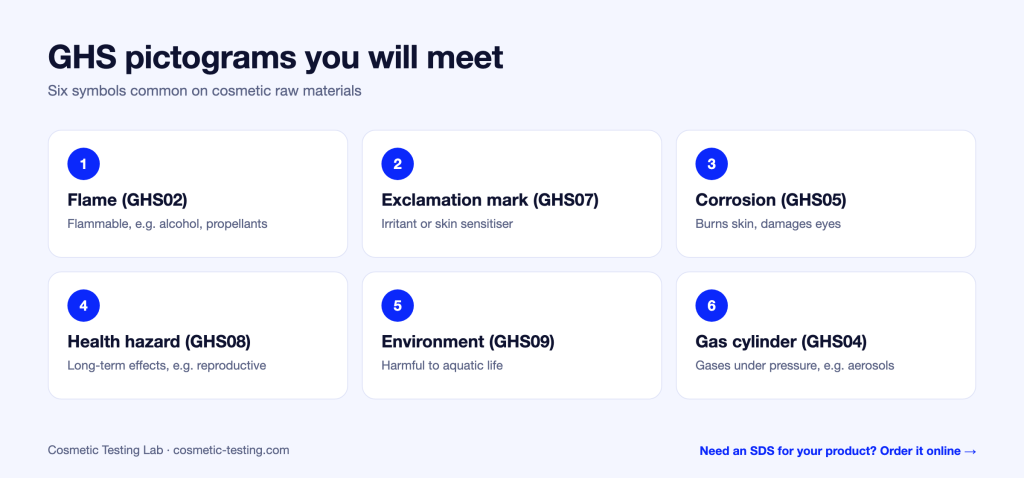
CLP uses nine pictograms. In brief: GHS01 exploding bomb (explosives), GHS02 flame (flammables), GHS03 flame over circle (oxidisers), GHS04 gas cylinder (gases under pressure), GHS05 corrosion (skin burns, serious eye damage, corrosive to metals), GHS06 skull and crossbones (acute toxicity, severe categories), GHS07 exclamation mark (irritation, sensitisation, lower acute toxicity), GHS08 health hazard (long-term effects such as carcinogenicity or reproductive toxicity) and GHS09 environment (aquatic toxicity). Only a handful matter for everyday cosmetic raw materials.
Signal words and hazard statements in plain language
Hazard statements are numbered by type. H2xx statements describe physical hazards, such as H225, “Highly flammable liquid and vapour”. H3xx statements describe health hazards, such as H317, “May cause an allergic skin reaction”, or H318, “Causes serious eye damage”. H4xx statements describe environmental hazards, such as H410, “Very toxic to aquatic life with long lasting effects”. Only one signal word appears on a label: if “Danger” applies, “Warning” is left out.
Always read the statement, not only the symbol. The exclamation mark covers everything from mild irritation to skin sensitisation, and the statement tells you which.
Why finished cosmetics are usually exempt
CLP contains an article that takes certain products out of its labelling and packaging rules when they are in their finished state and intended for the final user. Cosmetic products as defined in Regulation (EC) No 1223/2009 are on that list, alongside medicines and food. In practice, a moisturiser or a perfume in its consumer pack follows cosmetic labelling rules instead: the function, ingredients (INCI), batch, responsible person and any warnings and precautions of use required by the Cosmetics Regulation.
The exemption is tied to the product being a finished cosmetic for the end user. It is not a general waiver for everything a cosmetic company handles. Because the details can matter, treat this as a starting point and check borderline cases with your safety assessor or regulatory adviser.
Read also How Much Does a CPSR Cost in 2026? Price Factors Explained
Where pictograms still appear
- Raw materials and ingredients. Every supplier of a hazardous substance or mixture labels the container and supplies an SDS.
- Bulk and intermediate products. A bulk base supplied to a filler or another manufacturer is not yet a finished product for the final user, so classification and labelling duties may apply to it.
- The SDS. Section 2 (hazard identification) and section 3 (composition) carry the classification, pictograms and statements.
- Your workplace. Workers who weigh, heat and mix raw materials rely on these labels for safe handling.
- Transport. The classification feeds the transport entries in section 14.
Typical ingredients and their symbols
Classifications belong to the specific substance and supplier data, so always use your own SDS. As examples of what you often see:
- Ethanol: usually a flame (flammable liquid) and exclamation mark (eye irritation).
- Sodium hydroxide, used to adjust pH: corrosion, because it burns skin and damages eyes.
- Citrus-derived fragrance components such as limonene: often flame, exclamation mark and environment (flammable, sensitising, aquatic hazard).
- Propellants in aerosols: flame and gas cylinder.
- Some preservatives and actives: often an exclamation mark or corrosion at the concentrated raw-material stage, even if the diluted product is mild.

Why a concentrated raw material looks scarier than your product
Hazard classification depends on concentration. A strong acid at 100% is corrosive, while the same acid at a fraction of a percent in a lotion may not be classified at all. CLP uses generic concentration limits and calculation methods for mixtures, so the pictograms on a raw material do not automatically transfer to your formula. The reverse also holds: a mixture can need a pictogram even though no single ingredient does, for example because of its flash point.
Read also What Is a CPSR? Cosmetic Product Safety Report Explained
How to read section 2 of an SDS
- Classification lists the hazard classes and categories, such as Flam. Liq. 2 or Skin Sens. 1.
- Label elements lists the pictograms, signal word, H and P statements that would appear on the label.
- Other hazards covers things not classified, such as PBT or vPvB properties or endocrine-disrupting properties.
Then check section 3 for the hazardous components and their concentrations, and section 9 for data such as flash point that explain a physical hazard.
Common mistakes
- Putting CLP pictograms on a consumer label out of habit. This can confuse shoppers and mix two labelling systems. Follow cosmetic labelling rules, and use any warnings required there.
- Assuming “natural” means no hazard. Essential oils are often flammable, sensitising and hazardous to aquatic life.
- Ignoring pictograms in the workshop. Safe storage, ventilation and protective equipment depend on them.
- Using outdated symbols. The old orange squares of the earlier system have been replaced by the diamonds.
- Copying a raw-material classification onto the mixture. Classify the mixture itself.
A quick checklist
- Collect the current SDS of every raw material.
- Note classifications and statements, especially flammability and sensitisation.
- Decide whether each product is a finished cosmetic for the final user or bulk for businesses.
- Classify bulk mixtures from the formula and measured data.
- Prepare an SDS where one is needed and keep it current.
Frequently asked questions
Does my cosmetic need a hazard pictogram on the label?
A finished cosmetic for consumers generally follows cosmetic labelling rules instead of CLP hazard labelling. Check any flammability or precaution wording that applies to your category, and ask your assessor about borderline cases.
Does my perfume or aerosol need a flame symbol?
Aerosol dispensers and some flammable products carry flammability warnings under separate product and transport rules. That is a different system from CLP labelling, so confirm the requirements for your product type.
Do I need an SDS if my product has no pictograms?
A finished consumer cosmetic usually does not need one, but customers, salons and carriers often ask for one, and bulk products classified as hazardous require one. Your CPSR remains the document that proves consumer safety.
Key takeaways
- GHS pictograms, signal words and H and P statements come from CLP, the EU hazard communication system.
- Finished cosmetics for consumers are generally exempt from CLP labelling; raw materials, bulk and SDS are not.
- Read the hazard statement, not only the symbol, and classify your own mixture rather than copying an ingredient.
- Keep SDS documents current and request a REACH-compliant one for your product when customers need it.