
Most cosmetic products need more than one test, and the tests depend on each other. That is why brands look for a cosmetic testing package: a sensible set of tests ordered together, sampled once and reported in time for the safety assessment. This guide explains which tests belong together, how to build a package for your product type, and where bundling saves effort.
Contents
- The short answer
- What is a testing package?
- Why tests belong together
- The building blocks
- Package for water-based leave-on products
- Package for rinse-off products
- Package for anhydrous products
- Package for sun care, baby and sensitive-skin ranges
- Package for a first product versus a whole range
- How to choose the tiers
- A worked example
- Timeline of a combined order
- Common mistakes when building a package
- Frequently asked questions
- Key takeaways
The short answer
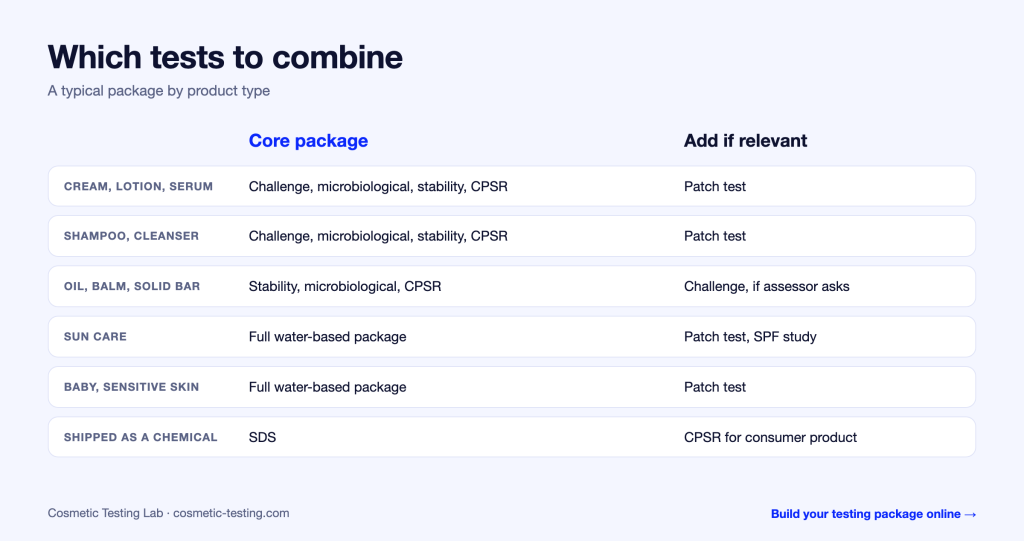
For a typical water-based product such as a cream, lotion, serum or shampoo, combine the challenge test, the microbiological specifications test and the stability and compatibility test, then add the CPSR that uses their results. Add a patch test for sensitive-skin or tolerance claims, and an SDS only if you ship the formula as a chemical. Anhydrous and low-risk products can use a lighter package.
What is a testing package?
A package is not a special kind of test. It is a deliberate combination of services ordered at the same time for the same product, so that samples, timing and documents fit together. Bundles on the website group services in this way. Create a free account to unlock 10% off your first order and 20% on bundles. The real savings, though, come from the planning: one parcel, one pickup, one reference and no gaps in the safety file.
Read also Advantages of testing cosmetics with us
Why tests belong together
- The CPSR needs them. The safety assessor weighs stability, microbiological quality and preservation efficacy when judging a formula. A missing piece delays the signature.
- They interact. A stability test can reveal a pH drift that weakens preservation, and a challenge test on an unstable formula is hard to interpret.
- They share samples. One production batch, one set of labelled units, one courier pickup.
- They share a timeline. Running tests in parallel lets you plan the whole file instead of waiting for each result.
The building blocks
- Challenge test: shows the preservation system works. Five reference microorganisms, 28 days, ISO 11930:2019 or USP 51.
- Microbiological specifications test: checks the quality of the finished product, about 5 days after we receive the samples.
- Stability and compatibility test: Basic, Standard or Full accelerated plans that support shelf life, PAO and packaging compatibility.
- Patch test: a single 48-hour occlusive patch test, about two weeks in total.
- CPSR: Part A and Part B signed by a qualified safety assessor, about 10 business days after complete data, in Simple, Standard or Complex tiers.
- SDS: a REACH-compliant 16-section safety data sheet in 30+ languages.
Package for water-based leave-on products
Creams, lotions, serums and gels stay on the skin and contain water, so they are the products where all the pieces matter. A strong package is challenge test, microbiological test, stability test and CPSR. If you advertise gentleness or suitability for sensitive skin, add the patch test. This is the most common package we see, and it is the safest default for a new brand.
Read also Cosmetic testing process in Cosmetic Testing Lab (from start to finish)
Package for rinse-off products
Shampoos, shower gels and cleansers are water-based too, but they contain surfactants and are rinsed off. The preservation need is still real, because the product sits in a bathroom for months and gets opened with wet hands. Challenge, microbiological and stability tests plus a CPSR are the usual core. The patch test is optional unless you make a tolerance claim.
Package for anhydrous products
Oils, butters, balms and solid bars contain little or no water, so microorganisms struggle to grow. Many such products can be supported by a documented risk assessment instead of a challenge test, but this decision belongs to your safety assessor. A lighter package of stability test, microbiological test and CPSR is common. Confirm with your assessor before you leave anything out.

Package for sun care, baby and sensitive-skin ranges
These categories attract more scrutiny. Combine the full water-based package with the patch test, and choose a more extensive stability plan if the pack is complex or the product is exposed to heat and light. Evidence for sun protection factor claims and similar studies is outside our scope and must come from specialised laboratories, so plan their timelines separately.
Read also Outsource Cosmetic Testing or Test In-House? A Practical Guide
Package for a first product versus a whole range
For a first product, order the complete package in one go. It forces you to finalise the formula and pack, and you learn early where problems are. For a range, think about what actually differs. Variants that change only a colour or a fragrance may not need every test repeated, but the assessor must justify it, and a Complex CPSR tier applies when a fragrance is involved. Ask your safety assessor which variants can share data before ordering for each one.
How to choose the tiers
- CPSR tier: count the ingredients. Up to 10 is Simple, 11–25 is Standard, and 26 or more, or any fragrance, is Complex.
- Stability plan: Basic for early development, Standard for most launches, Full when the product is high-risk or the pack is complex.
- Challenge standard: ISO 11930:2019 for cosmetics sold in the EU and UK, USP 51 when a US partner asks for it.
A worked example
A brand launches a body lotion with 18 ingredients and no fragrance. It is water-based and leave-on, so the package is challenge test, microbiological test, a Standard stability plan and a CPSR in the Standard tier, because 18 ingredients fall in the 11–25 range. The brand adds a patch test because the packaging says “suitable for sensitive skin”. It sends one parcel from one batch, and every report lands in the same product file. A second lotion with a fragrance would move to the Complex tier, so the brand budgets time for that before choosing the scent.
Timeline of a combined order
Because the services run in parallel, the whole package is not the sum of its parts. The microbiological test is back in about 5 days after we receive the samples, the patch test after about two weeks, and the challenge test completes after its 28 days. Stability follows the plan you chose. The CPSR starts when your data are complete and takes about 10 business days. Order everything together and the longest test, not the number of tests, sets your launch date.
Common mistakes when building a package
- Skipping the stability test because it takes the longest, then discovering a packaging problem late.
- Ordering the CPSR before the supporting data exist.
- Treating the patch test as a replacement for the safety assessment. It is one piece of evidence.
- Testing different batches for different tests.
- Assuming that all variants of a range can share data without asking the assessor.
- Picking a CPSR tier by guesswork instead of counting the ingredients.
- Sending a different pack from the one you will sell, so the stability result does not apply.
Frequently asked questions
Is a package cheaper than separate orders?
Bundles come with the account discount described above. Beyond that, the package saves effort: one set of samples, one pickup and a file that is complete the first time.
Can I add a test later?
Yes, you can order a test whenever you need it. Keep the batch and formula the same, otherwise the new result will not match the earlier ones.
Do I need the SDS in my package?
Only if you supply the formula or a raw material as a chemical to others. For a finished consumer product, the CPSR is the required safety document in the EU.
Key takeaways
- Water-based products usually need challenge, microbiological and stability data, then a CPSR.
- Anhydrous and low-risk products can use a lighter package once the assessor agrees.
- Order together: one batch, one pickup, parallel timelines.
- Your safety assessor decides what is enough; we supply the signed reports.