

A cosmetic recall is the moment every brand fears: a product that has already reached customers has to be pulled back. It damages trust, sales and sometimes the whole business, yet most recalls follow a small number of preventable causes. This guide explains what a cosmetic product recall is, why products are recalled, what the EU rules expect from you, and which tests and habits make a recall far less likely.
Contents
- The short answer
- Withdrawal or recall: what is the difference?
- The main causes of cosmetic recalls
- What do EU rules expect from the responsible person?
- How the US handles recalls
- How to prevent a recall: the evidence chain
- Traceability and a recall plan
- Complaints and early warning signs
- What to do if you suspect a problem
- Frequently asked questions
- Key takeaways
The short answer
A cosmetic product recall is an action to get a product back from consumers because it is unsafe or does not comply with the law. The most common causes are microbial contamination, banned or over-limit ingredients, labelling errors and manufacturing faults. In the EU, the responsible person must act immediately when a product does not conform: correct it, withdraw it or recall it, and inform the authorities if there is a risk to health. Prevention is mostly about evidence: a safety assessment, stability, microbiological and preservation testing, good manufacturing practice and batch traceability.
Withdrawal or recall: what is the difference?
The two words are often mixed up. A withdrawal aims to stop a product in the supply chain from reaching the consumer: stock is pulled from warehouses, distributors and shop shelves. A recall goes further and aims to get products back from consumers who already have them. Which one applies depends on the risk and on how widely the product has been sold. Authorities can also order either measure if the responsible person does not act. In practice, a recall involves public notices, customer contact and returns, so it is the heavier and more expensive of the two.
Read also How to Choose a Cosmetic Contract Manufacturer
The main causes of cosmetic recalls
- Microbial contamination. Bacteria, yeast or mould in water-based products, often with Pseudomonas, Burkholderia or Staphylococcus species. Eye-area and baby products are the most sensitive.
- Prohibited or restricted ingredients. A substance on the banned list, or a restricted substance above its permitted level, including through raw-material contamination.
- Undeclared ingredients and wrong labels. Missing allergen declarations, wrong ingredient lists, wrong batch or shelf-life information, or missing warnings.
- Manufacturing faults. Wrong dosing of an ingredient, cross-contamination, foreign particles, or a formula that separates or degrades.
- Packaging problems. Leaking closures, broken pumps, packaging that reacts with the formula, or child-safety failures.
- Customer harm. A pattern of reports of burns, rashes or eye injuries that point to a product defect.
What do EU rules expect from the responsible person?
Regulation (EC) No 1223/2009 puts the duty on the responsible person. If you have reason to believe that a product you placed on the market does not conform, you must immediately take the corrective measures needed to bring it into conformity, or withdraw or recall it as appropriate. If the product presents a risk to human health, you must also inform the competent authorities of the Member States where it was made available, and where it was notified, giving details of the non-compliance and the measures taken. You must cooperate with the authorities on any action to remove the risk. Alongside this, serious undesirable effects reported to you must be passed on to the authority of the Member State where they occurred. Authorities can also order a recall themselves, and serious cases are shared across Europe through the Safety Gate rapid alert system.
How the US handles recalls
In the US, cosmetic recalls have traditionally been voluntary, run by the company with FDA oversight. Under the Modernization of Cosmetics Regulation Act (MoCRA), the FDA also has authority to order a mandatory recall when there is a reasonable probability that a cosmetic is adulterated or misbranded and its use could cause serious health consequences or death, if the responsible person does not recall voluntarily. Responsible persons must also report serious adverse events to the FDA within 15 business days. Details depend on the product and your business size, so confirm your situation with a qualified adviser.
Read also Dropshipping Cosmetics in the EU: Legal Pitfalls
How to prevent a recall: the evidence chain
Most recalls could have been avoided with a handful of well-known controls. Together they form a chain of evidence that you can also show an authority:
- Safety assessment. A signed CPSR checks every ingredient and its level, the exposure and the intended use before launch. It is the main defence against prohibited and over-limit ingredients.
- Preservation. A challenge test shows whether the preservative system keeps a water-based product safe through repeated use.
- Finished product quality. A microbiological specifications test checks that a batch is free of harmful microorganisms. SCCS guidance usually sets stricter limits for eye-area products, products for children under three and products on mucous membranes than for other cosmetics.
- Stability and packaging. A stability and compatibility test shows that the formula survives heat, cold and light, and that the pack does not fail or react.
- Good manufacturing practice. ISO 22716 sets expectations for hygiene, equipment, raw materials, batch records and complaints. The EU regulation presumes conformity with GMP when the relevant harmonised standard is applied.
Traceability and a recall plan
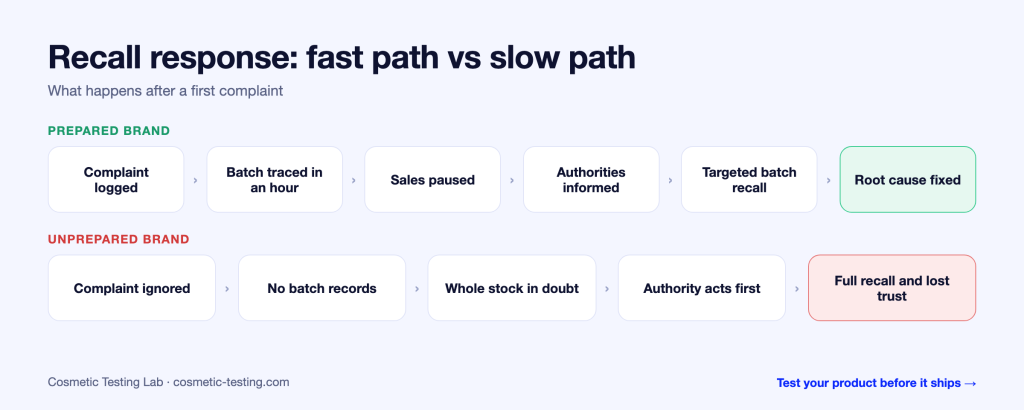
When something goes wrong, speed depends on what you recorded earlier. Every unit needs a batch number, and each batch needs a record of raw-material lots, production date, equipment and quality checks. Keep retained samples, so you can retest a batch if a complaint arrives. Write a simple recall plan before you need one: who decides, who contacts retailers and customers, how stock is quarantined, which authorities are informed and how you document the outcome. Test the plan once with a mock recall. Brands that can identify the affected batches in an hour usually recall a small part of the stock instead of everything.

Complaints and early warning signs
A recall rarely starts from nothing. Early signs include a pattern of reviews about smell, colour or texture change, reports of swelling jars or separated formulas, skin reactions after a certain batch or returns from one retailer. Set up a simple complaint log and read it regularly. Treat two or three similar reports as a signal, test retained samples from the affected batches and decide quickly whether to pause sales. Acting early often turns a possible recall into a contained batch withdrawal.
Read also Influencer Beauty Brand Compliance: The Basics
What to do if you suspect a problem
- Stop selling and shipping the affected batches immediately.
- Identify the batches and the markets involved from your records.
- Test retained samples and, if needed, new samples, and ask your safety assessor to review the risk.
- Decide on withdrawal or recall and tell the competent authorities if there is a risk to health.
- Inform retailers and customers clearly: what is wrong, which batches, what to do.
- Find the root cause, fix it, update the safety file and document everything.
Frequently asked questions
Who pays for a cosmetic recall?
Costs usually fall on the company that placed the product on the market, with possible recovery from suppliers or manufacturers depending on contracts and the cause. Insurance may cover part of it, so check your policy.
Does testing guarantee that I will never have a recall?
No test can guarantee that, but good testing, safety assessment and manufacturing control greatly reduce the chance and show authorities that you acted responsibly.
Do small and handmade brands face recalls?
Yes. Small brands are often hit hard because they lack batch records and testing data. The rules apply to all sizes.
Key takeaways
- Most cosmetic recalls come from contamination, ingredient breaches, label errors or manufacturing faults.
- In the EU the responsible person must act immediately and inform authorities when health is at risk.
- A CPSR, challenge, microbiological and stability testing and GMP form the best prevention.
- Batch traceability and a written recall plan turn a crisis into a manageable event.