
Brands often ask whether they need an SDS for cosmetics in the USA, and the honest answer is: it depends on who is asking and what for. A shopper buying your lipstick at a store does not need one, but your employees, a salon, a freight carrier or an online marketplace might. This guide separates the situations in which OSHA, shippers and retailers expect a safety data sheet, and explains what a US-ready sheet looks like.
Indice
- The short answer
- What an SDS is in the US
- Does OSHA require an SDS for finished cosmetics?
- Where the exemption stops: salons, spas and factories
- Raw materials: the SDSs you receive
- Shippers and carriers
- Marketplaces and retailers
- Is an EU SDS valid in the US?
- SDS is not the same as safety substantiation
- A checklist for US SDS requests
- Frequently asked questions
- Key takeaways
The short answer
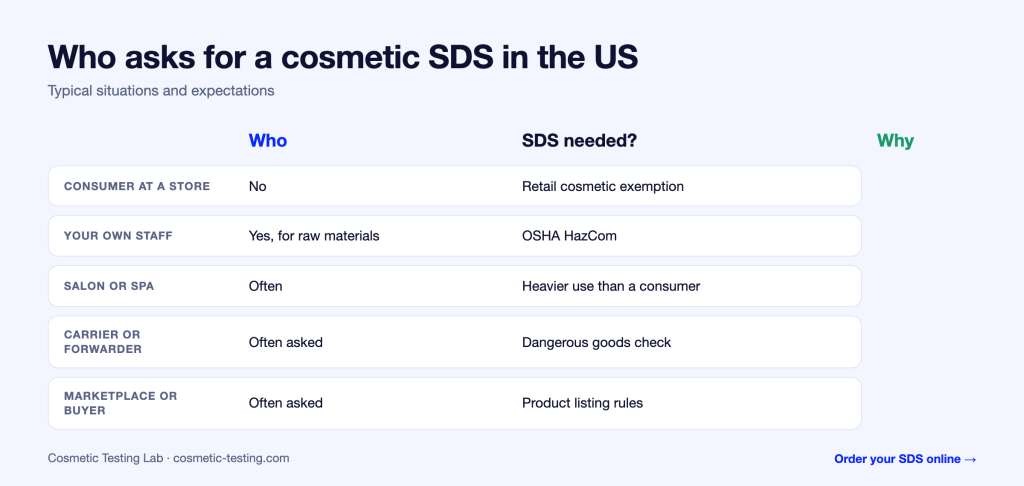
US law does not require a safety data sheet for a finished cosmetic sold to consumers, but OSHA’s Hazard Communication Standard (HazCom) requires an SDS for hazardous chemicals used in workplaces, including raw materials, professional salon products and cosmetics used far more intensively than a consumer would, and carriers, marketplaces and wholesale buyers frequently ask for one for aerosols, alcohol-based products, nail products and fragrances. MoCRA, the federal cosmetics law, does not create an SDS duty. This article is general information, not legal advice, so confirm details on the OSHA and DOT pages listed in the sources.
What an SDS is in the US
Under OSHA’s 29 CFR 1910.1200, an SDS is a 16-section document, in a fixed order, aligned with the Globally Harmonized System (GHS). Chemical manufacturers and importers must classify the hazards of what they make or import and send an SDS to downstream customers. Employers must keep an SDS in the workplace for each hazardous chemical they use and train workers. OSHA enforces sections 1 to 11 and 16 as mandatory; sections 12 to 15 (ecological, disposal, transport and regulatory information) are required to appear in the sheet but are not enforced by OSHA, as the agency itself explains. A REACH-compliant SDS from us follows the same 16 headings.
OSHA published a revised HazCom standard in 2024, aligned with a later GHS revision, and its compliance dates are phased over several years, as we understand it. Manufacturers and importers should check the current dates on the OSHA website, because they decide when sheets and labels must be updated.
Leggi anche SDS o CPSR: quale Le serve?
Does OSHA require an SDS for finished cosmetics?
Mostly no, thanks to two exemptions in the HazCom standard. Paragraph (b)(6)(viii) exempts cosmetics packaged for sale to consumers in a retail establishment, and cosmetics for personal use by employees. Paragraph (b)(6)(ix) exempts consumer products used in the workplace for the purpose intended by the manufacturer, where the duration and frequency of exposure is no greater than what a consumer would reasonably experience. In its inspection directive, OSHA says it generally does not cite employers over consumer products unless they are used in a way the maker did not intend, or exposures are significantly greater than a normal consumer’s.
Where the exemption stops: salons, spas and factories
The exemption is about how the product is used, not what it is. A hair stylist who applies the same smoothing treatment to many clients each day is not a typical consumer. OSHA’s directive even gives the example of a hair smoothing product used in professional salons, where the intended use created formaldehyde through a chemical reaction; the manufacturer must provide hazard information for that known use. So if you sell professional or salon-size products, expect customers to need an SDS to meet their own HazCom duties. The same applies in your own facility: your employees handle raw materials, concentrated fragrances and cleaning chemicals in quantities no consumer would, so you need SDSs for them, and your suppliers must provide them.
Raw materials: the SDSs you receive
As a cosmetic manufacturer, you are an employer. Each raw material classified as hazardous should come with an SDS: surfactants, solvents, preservatives, fragrance compounds and colourants. Keep them accessible to staff, label secondary containers, and train people. A fragrance house usually supplies an SDS for each fragrance oil; keep the current version in your file, because it also feeds your own sheet and your safety documentation.
Leggi anche I cosmetici hanno bisogno di una scheda di dati di sicurezza (SDS)?
Shippers and carriers
US hazmat transport rules are set by the Department of Transportation (49 CFR), not by OSHA, and they do not require an SDS to move a product. In practice, carriers and freight forwarders often ask for one to decide whether a flammable perfume, an aerosol or a nail polish counts as dangerous goods, and air carriers are especially strict. Section 14 of the SDS carries the transport classification. Limited-quantity and consumer-commodity provisions can reduce the paperwork for small consumer packs, but the SDS is usually how the carrier checks eligibility. Air freight is the strictest case, so ask the carrier early which documents it needs.
Marketplaces and retailers
Online marketplaces review beauty products for dangerous-goods status. According to seller guides, Amazon asks sellers to upload an SDS or an exemption sheet for products flagged as potentially hazardous, which often include perfumes, nail polish, hairspray and aerosols. We could not confirm Amazon’s exact current rules from its own pages, so check Seller Central. Big retailers may add their own supplier requirements: ask your buyer which documents they need before onboarding, and keep your SDS, ingredient list and test reports ready.
Is an EU SDS valid in the US?
A REACH-compliant sheet is a strong base, but it is not automatically a US HazCom sheet. The 16 headings match, yet the classification rules differ in some details, the US sheet must be in English, and OSHA has hazard classes that the EU does not use in the same way, such as combustible dust. If you sell in both markets, ask for a sheet that states both the CLP and the OSHA classification, or two region-specific versions. Our SDS service produces REACH-compliant sheets, so tell us in advance if you need US-specific content reviewed.
Leggi anche SDS per le materie prime cosmetiche: cosa devono fornire i fornitori
SDS is not the same as safety substantiation
An SDS tells handlers about hazards of the product as a chemical. It does not show that the cosmetic is safe for consumers. Under MoCRA, you must hold adequate substantiation of safety, which in practice means a documented assessment of ingredients and testing. In the EU, the equivalent is the CPSR. Do not offer an SDS where a buyer asks for proof of consumer safety, and do not use a safety assessment where a carrier asks for the SDS.
A checklist for US SDS requests
- Decide who asked: employee, salon, carrier, marketplace or buyer.
- Check whether the product is a consumer cosmetic or a professional or bulk product.
- Classify the product from its formula, including flash point for alcohol and propellants.
- Prepare a 16-section sheet in English, with the date and revision number.
- Add transport data in section 14 and match it to the carrier’s rules.
- Review the sheet when the formula, supplier or regulations change.
Frequently asked questions
Do I need an SDS to sell lotion online in the US?
Not by US law for a typical non-flammable lotion sold to consumers. A marketplace or carrier can still ask for one, so having a sheet ready avoids delays.
Does a salon need an SDS for the products it buys?
Often yes. Salon staff use products repeatedly and in volume, so the consumer exemption may not apply. Salon owners should ask suppliers for current sheets.
How often should the SDS be updated?
Update it when you learn of new hazard information or change the formula, and review it periodically. OSHA rules also set timelines for manufacturers to update sheets after new information; check the current standard.
Key takeaways
- No SDS duty for finished consumer cosmetics, but OSHA requires SDSs for workplace chemicals and professional use.
- Carriers, marketplaces and buyers often ask for one for perfumes, aerosols and nail products.
- An SDS is not safety substantiation; you need both kinds of document for different questions.
- Keep a current English 16-section sheet ready for every product with a hazard flag.