
Every brand that orders a skin study asks the same thing sooner or later: how many people must take part? The patch test volunteers number decides how much the result can tell you, how long the study takes and which claims you can later make. This guide explains how panel size is usually chosen for a cosmetic patch test, and what a small or large panel really proves.
Contents
- The short answer
- Why a patch test is done at all
- What guidance says about panel size
- What a number of volunteers can prove
- Which factors change the panel size?
- Who can be a volunteer?
- Why panels are usually recruited above the target
- How the result is read
- Our patch test in short
- Common mistakes when choosing a panel
- A simple planning checklist
- Frequently asked questions
- Key takeaways
The short answer
There is no single number written into the EU Cosmetics Regulation. Panels for cosmetic skin compatibility studies are usually a few dozen volunteers, and larger when the product is aimed at sensitive skin or when the claim is strong. The right number is the one your safety assessor can defend in the CPSR: large enough to detect a meaningful irritation rate, and small enough to stay ethical and practical.
Why a patch test is done at all
Regulation (EC) No 1223/2009 requires a cosmetic product to be safe under normal or reasonably foreseeable use. The safety assessor looks at the ingredients, their exposure and the toxicological profile. Human skin compatibility data are an additional layer: they confirm, on real skin, that the finished formula does not cause irritation under the test conditions. Such data are usually included in the Product Information File, and many assessors expect them for leave-on products, products for sensitive skin and products for babies.
Read also What Is a Cosmetic Patch Test (and Is It Required)?
What guidance says about panel size
Industry guidelines for human skin compatibility testing, published by Cosmetics Europe (formerly Colipa), describe how volunteers should be selected, informed and examined. They deal with the number of subjects as a matter of study design rather than a fixed legal rule. In practice, laboratories and assessors settle on a panel that fits the objective: a single-application test of a finished product often uses a panel of a few dozen subjects, while repeat-insult studies and claim-driven studies commonly use more. Treat any exact figure quoted online as a typical practice, not a legal minimum, and confirm it with your assessor.
What a number of volunteers can prove
Statistics set a hard limit. If nobody in a panel reacts, you still cannot say that nobody ever will. A common rule of thumb, sometimes called the rule of three, says that when zero reactions are seen in n subjects, the true reaction rate is, with about 95% confidence, no higher than roughly 3 divided by n.
- With 25 volunteers and no reactions, the true rate could still be about 12%.
- With 50 volunteers, about 6%.
- With 100 volunteers, about 3%.
So doubling the panel roughly halves the uncertainty. A small panel is good at catching a product that irritates many people. It is not good at finding a rare reaction.
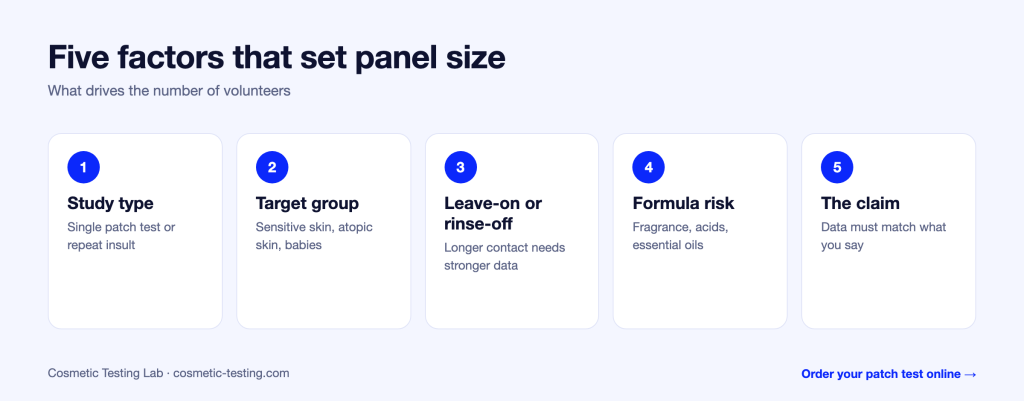
Which factors change the panel size?
- Type of study. A single 48-hour occlusive patch test answers a different question than a repeat-insult study over several weeks.
- Target group. Products for sensitive skin, atopic skin or babies call for a more careful design and, where the claim requires it, volunteers who really belong to that group.
- Leave-on or rinse-off. Leave-on products stay on the skin longer, so assessors tend to want stronger data.
- Risk profile of the formula. Fragrance, essential oils, acids and known irritants raise the need for evidence.
- The claim. “Dermatologically tested” or “suitable for sensitive skin” must match what the study actually covered.
Read also Patch Test Cost for Cosmetics and How Long It Takes
Who can be a volunteer?
Volunteers are healthy adults who give informed consent. Typical exclusion criteria are skin disease at the test site, known allergy to cosmetic ingredients, pregnancy or breastfeeding, and certain medicines such as systemic corticosteroids or antihistamines. The study follows ethical principles such as the Declaration of Helsinki, and a dermatologist or a qualified investigator examines the skin. The laboratory recruits the panel; you do not need to find volunteers yourself.
Why panels are usually recruited above the target
People drop out. Someone gets ill, travels or removes a patch too early. Laboratories therefore often recruit a few more volunteers than the number needed for the evaluation, so that the final number of completed subjects still meets the plan. When you compare offers, ask for the number of completed subjects, not only enrolled ones.
How the result is read
At the end of the contact period, the patch is removed and the skin is scored by a trained examiner after a defined waiting time. Scores range from no reaction to clear erythema with oedema. The report lists how many volunteers showed a reaction and how strong it was, and it states the conclusion, for example that the product was well tolerated under the conditions of the test. A signed PDF report can go straight into the PIF.
Read also Patch Test Results Explained: Irritation Scores and What They Mean
Our patch test in short
At Cosmetic Testing Lab you order a single 48-hour occlusive patch test online. We collect your samples free of charge with DHL from your door, the study takes about two weeks in total, and you receive a signed PDF report you can use in the CPSR and the PIF. If your claim or target group needs a different design, discuss it with your safety assessor before you order.
Common mistakes when choosing a panel
- Choosing the cheapest option first. A panel that is too small to support your claim may have to be repeated.
- Testing a prototype. Test the final formula in its final form. A later change can make the report obsolete.
- Making claims the study does not cover. A test on healthy adults does not prove suitability for babies or atopic skin.
- Ignoring the assessor. Ask early which data the CPSR needs.
- Confusing patch tests with allergy diagnosis. A cosmetic compatibility study is not a medical allergy test and cannot exclude every individual reaction.
A simple planning checklist
- Write down the claim you want to make and the target group.
- Ask your safety assessor which data they expect for this product type.
- Finalise the formula and the packaging.
- Choose the study design and ask for the number of completed subjects in the offer.
- Order, send samples, and file the signed report in the PIF.
Frequently asked questions
Is there a legal minimum number of volunteers?
The EU Cosmetics Regulation does not fix one. The panel has to be adequate for the question and the claim, and your safety assessor judges whether the data are sufficient.
Does a bigger panel always mean a better test?
Not automatically. A larger panel lowers statistical uncertainty, but a well-designed study on the right population with a correct protocol is worth more than a large badly designed one.
Can a patch test guarantee that nobody will react?
No. It shows good tolerance in the tested group under the test conditions. Rare individual reactions can still happen, which is why labelling, warnings and post-market monitoring matter.
Key takeaways
- No fixed legal number exists; the panel must fit the product, the target group and the claim.
- Zero reactions in a small panel still leaves uncertainty, roughly 3 divided by the number of volunteers.
- Ask for completed subjects, and test the final formula in its final packaging.
- Agree the design with your safety assessor before ordering.