

Talc is a common powder in blush, eyeshadow, face powder and baby products, and talc asbestos testing for cosmetics is one of the most watched parts of the Modernization of Cosmetics Regulation Act (MoCRA). The law told the FDA to set standard test methods, the agency proposed a rule at the end of 2024, and then withdrew it a year later. This guide explains where things stand, what the withdrawn proposal would have required, and what a careful brand should do while the rule is rewritten.
Índice
The short answer
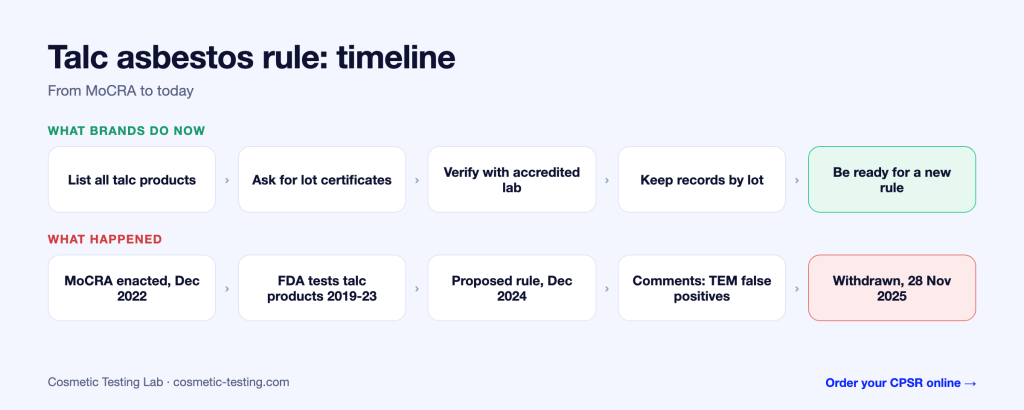
MoCRA requires the FDA to issue regulations that set standardized methods for detecting and identifying asbestos in talc-containing cosmetics. The FDA proposed such a rule in December 2024, but withdrew it on 28 November 2025 to reconsider it after public comments. Today there is no FDA-mandated test method, so testing is a matter of your own safety substantiation, supplier controls and risk management, and a reissued rule is expected but has no published date. We do not run asbestos tests ourselves; asbestos analysis is specialised electron microscopy work done by dedicated laboratories.
Why is asbestos a concern in talc?
Talc and asbestos are both naturally occurring minerals, and they can occur close together in the ground. The FDA states that talc can be contaminated with asbestos, which is why mining sites must be chosen carefully and the ore tested sufficiently. The agency has run several surveys. A 2009–2010 survey, using polarized light microscopy (PLM) and transmission electron microscopy (TEM), found no asbestos in the products tested, but the FDA noted its limits: only four of nine talc suppliers sent samples and few products were tested, so it did not prove that most talc is free of asbestos. In 2019 and 2020 the FDA tested products after reports of contamination; in October 2019 it issued a safety alert about certain products that tested positive, and one baby powder was voluntarily recalled. The FDA also tested talc-containing cosmetics in 2021, 2022 and 2023.
Leia também Regulamento dos cosméticos sobre nanomateriais: regras e notificação
What does MoCRA require?
MoCRA includes a section directing the FDA to establish and require standardized testing methods for detecting and identifying asbestos in talc-containing cosmetic products. The statutory deadline was about a year after the law was enacted in December 2022, and it was missed. The law asks the FDA to set the test methods; it does not itself name the methods, which is why the content of the rule matters so much.
What did the December 2024 proposal say?
The FDA announced the proposed rule on 26 December 2024. In summary, it would have:
- applied to manufacturers of talc-containing cosmetic products and to the talc ingredient used in them;
- required testing of representative samples from each batch or lot, either of the finished product or of the talc ingredient;
- required two methods run together: PLM with dispersion staining, and TEM with energy-dispersive spectroscopy and selected area electron diffraction (TEM/EDS/SAED);
- allowed a manufacturer to rely on a talc supplier’s certificate of analysis if it qualified the supplier through verification testing;
- included recordkeeping provisions;
- made a product adulterated if it failed the testing or recordkeeping provisions, or if asbestos was found.
The FDA also said that methods such as X-ray diffraction and infrared spectroscopy were not sensitive enough.
Why was the proposal withdrawn?
The FDA withdrew the proposal on 28 November 2025, stating that the comments warranted further consideration and assessment before issuing final regulations. According to legal commentary, commenters including the United States Pharmacopeia argued mainly that the proposed TEM method may not reliably distinguish asbestiform from non-asbestiform particles, which could produce many false positives; the USP approach uses PLM with X-ray diffraction. Others raised concerns about a broad definition of asbestos that differs from the ones used by other federal agencies. The withdrawal is described as a reconsideration of how to test, not as the end of testing. Because the mandate stays in the statute, a new proposal should follow, with another chance for public comment. No timeline has been published.
Leia também Substâncias CMR nos cosméticos explicadas: o que está proibido
What should brands do now?
With no mandated method, the sensible path is to behave as if a rule is coming, without locking into details that may change:
- List every product containing talc. Check powders, blushers, eyeshadows, bronzers, baby products and anything with “talc”, “magnesium silicate” or “hydrated magnesium silicate” in the ingredient list.
- Ask the supplier for the full picture. Request a lot-specific certificate of analysis that states the test method (PLM, TEM, XRD or a combination), the laboratory, the detection limit and the result for asbestos. Ask about the mine source and whether it changes between lots.
- Verify independently. A periodic check by an independent, accredited laboratory with electron microscopy capability gives you data that does not depend only on the supplier’s paperwork.
- Keep records by lot. Link each finished batch to the talc lot and its certificate. If a rule requires lot-level records, you already have them.
- Decide on talc-free. For some products a talc-free formula (for example with mica, silica or starch-based powders) avoids the issue, but each alternative has its own safety and performance profile and still needs assessment.
How does this connect to safety substantiation?
MoCRA requires the responsible person to keep records supporting adequate safety substantiation for each product. The FDA says neither the law nor its regulations require specific tests, so the brand decides what is adequate. For a talc product, a documented asbestos-control approach is a natural part of that file: supplier specification, certificates, independent verification and your decision logic. If an authority, retailer or customer asks, a clear file is far better than a verbal assurance. Our overview of what a CPSR contains shows how this kind of evidence is organised in the EU.

What about the EU?
The EU has no asbestos test standard written into its cosmetics law, but it handles the question through the safety assessment. As we understand the annexes of Regulation (EC) No 1223/2009, asbestos is prohibited in cosmetics, and talc is listed as a restricted substance with a warning for powders intended for young children; check the current consolidated text before relying on this. The CPSR must also address impurities and traces in the ingredients. Part A of Annex I asks for information on purity, impurities and traces, so a safety assessor will expect a talc specification and asbestos-free evidence from the supplier, and a record of how the supplier’s claim was verified. If you sell in both markets, one well-built talc dossier can serve both. The assessor also relies on stability and microbiological data for the same product, but purity and impurity evidence is a separate item that only the talc supplier and a specialised laboratory can provide.
Leia também Margem de segurança (MoS) em cosméticos: como se calcula
Common mistakes
- Relying on a generic “asbestos-free” statement without a method, laboratory or lot number.
- Accepting a certificate that only used a method with a high detection limit.
- Qualifying the supplier once and never checking again as lots change.
- Ignoring talc that arrives inside a bought-in blend or colour premix.
- Assuming the withdrawal means testing is no longer needed.
Frequently asked questions
Is asbestos testing of talc cosmetics mandatory in the US right now?
There is no FDA rule that prescribes a method or frequency at the moment. The mandate to create one remains in MoCRA. Brands remain responsible for the safety of their products, and many already test or require certificates.
Which method is best, PLM, TEM or XRD?
That is exactly what the FDA is reconsidering. The proposal chose PLM plus TEM; critics prefer approaches such as PLM with XRD. Ask your laboratory which method fits the talc source and why, and keep the method name in your records.
Can you test my talc for asbestos?
No. We do not run asbestos tests. We can help you build the safety documentation around the data, including the CPSR, and you can obtain asbestos analysis from a specialised laboratory.
Key takeaways
- Status: MoCRA requires standard talc asbestos test methods, but the December 2024 proposal was withdrawn on 28 November 2025.
- Today: no FDA-mandated method, so supplier controls and your own substantiation carry the weight.
- Prepare: lot-level certificates, independent verification and traceability from talc lot to finished batch.
- EU: the safety assessment expects purity and impurity data for talc in the CPSR.