

If you sell cosmetics in the United States, MoCRA safety substantiation is now a legal duty, but the law tells you what you must have, not exactly which tests to run. This guide explains what the requirement means in practice, which evidence US brands typically keep, and how the same data can also serve an EU safety report.
Cuprins
- The short answer
- What MoCRA actually requires
- What FDA has said, and what is still open
- What evidence do brands typically keep?
- Why the product type changes the file
- Is a literature review enough?
- Who should sign off on the safety?
- How the same data serves an EU CPSR
- A practical checklist for a US brand
- Common mistakes
- How long to keep records and when to update them
- Frequently asked questions
- Key takeaways
The short answer
Under MoCRA, the responsible person must ensure and keep records that show adequate substantiation of the safety of each cosmetic product. FDA states that neither the law nor its regulations require specific tests. In practice, brands build a file from ingredient safety data, stability, microbiology, preservation efficacy and, where relevant, human skin tolerance data, reviewed by a qualified expert. That is also the core of an EU CPSR, so one data set can often support both markets.
What MoCRA actually requires
The Modernization of Cosmetics Regulation Act of 2022 (MoCRA) amended the Federal Food, Drug, and Cosmetic Act. Among other things it added a safety substantiation requirement, usually cited as section 608 of the Act. It sits next to facility registration, product listing, adverse event reporting, record keeping and mandatory recalls. The safety duty applies to the “responsible person”, the manufacturer, packer or distributor whose name appears on the label.
The Act describes adequate substantiation as tests, studies, research, analyses or other evidence that qualified experts would consider sufficient to support a reasonable certainty that the product is safe. Treat that wording as a standard to meet, and check the current text of the Act and the FDA website when you build your file. If FDA finds a product lacks adequate substantiation, the product may be considered adulterated.
Citiți și Reglementări cosmetice UE, Regatul Unit și SUA: comparație
What FDA has said, and what is still open
On its MoCRA page FDA says the responsible person must maintain records supporting adequate safety substantiation, and that neither the law nor FDA regulations require specific tests. Animal testing is not required either. FDA also has draft guidance on how it may access safety records.
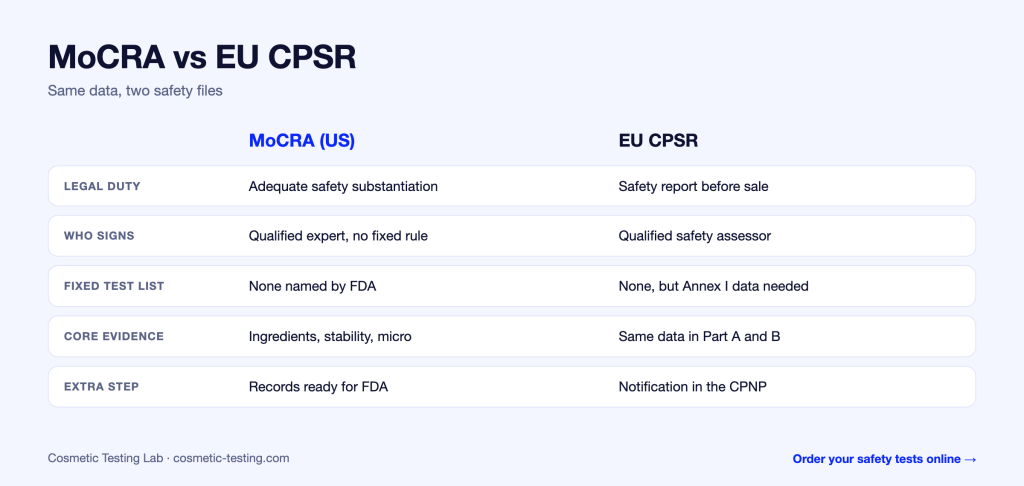
What is not defined in detail, as far as we could verify, is a fixed list of studies, a required format, or a formal qualification for the expert. FDA good manufacturing practice rules for cosmetics are, at the time of writing, still at draft guidance stage rather than a final rule. Requirements can change, so treat this article as a practical overview, not legal advice, and check fda.gov and your own advisers before relying on it.
What evidence do brands typically keep?
Because the law is flexible, a good file is built around your product’s real risks. Most brands keep the following:
- Formula and ingredient safety data: a full ingredient list with concentrations, supplier specifications, and toxicological information for each ingredient, including impurities and known restrictions.
- Stability and compatibility: evidence that the product stays safe and unchanged over its shelf life and does not react with its packaging. See our stability test.
- Microbiological quality: counts and absence of specified organisms in the finished product. See the microbiological specifications test.
- Preservative efficacy: proof that the preservation system protects a water-containing product against contamination in use. See the challenge test, which can follow ISO 11930 or USP 51.
- Human skin tolerance: for leave-on products, new actives or “sensitive skin” positioning, data such as a patch test.
- Safety assessment and sign-off: a written conclusion by a person with suitable training and experience, with the reasoning and the date.
Why the product type changes the file
A water-free lip balm needs a different file from a water-based serum. Products used near the eyes, on babies, on broken skin or on large body areas call for deeper evidence. Fragrance, colourants, UV filters and botanical extracts each bring their own questions. A simple rule helps: the more exposure and the more vulnerable the user, the stronger the evidence should be.
Is a literature review enough?
Sometimes published data on well-known ingredients can carry much of the weight, particularly for simple formulas. But literature rarely tells you how your finished product behaves. Stability, microbiology and preservation are properties of the whole formula in its packaging, so they usually need product-specific testing. Many brands combine both: literature for ingredients, laboratory data for the finished product.
Who should sign off on the safety?
The Act points to experts qualified by training and experience. It does not name a diploma or a register. In practice, brands often use a toxicologist or cosmetic safety assessor, and keep the assessor’s CV and the reasoning with the file. In the EU the position is stricter: the CPSR must be signed by a safety assessor with specific qualifications under Regulation (EC) No 1223/2009.
How the same data serves an EU CPSR
If you also sell in the EU, the Cosmetic Product Safety Report has two parts. Part A collects product information and test data; Part B is the safety assessment and conclusion. The inputs overlap strongly with a US file: formula, ingredient toxicology, stability, microbiology, preservation efficacy and, where relevant, skin tolerance data. A CPSR is not automatically accepted as US substantiation, and a US file does not replace a CPSR, but a well-organised data set saves repeating laboratory work. Differences remain, for example in the list of banned and restricted substances, the role of the EU responsible person and notification in the CPNP. Our guide on what a CPSR is shows the structure.

A practical checklist for a US brand
- Name your responsible person and confirm your name is on the label.
- Collect the full formula, ingredient specifications and supplier safety data.
- Decide which risks apply: water content, preservatives, exposure area, user group.
- Run stability, microbiological and preservation tests on the finished product in final packaging.
- Add human skin tolerance data when the claim or risk calls for it.
- Have a qualified expert review everything and write a dated conclusion.
- Store the records so they can be produced quickly, and update them when the formula, supplier or packaging changes.
Common mistakes
- Relying on a supplier’s generic statement instead of data on your own product.
- Testing a lab sample, then changing the formula or packaging without retesting.
- Keeping reports without a written safety conclusion.
- Assuming that claiming “natural” or “hypoallergenic” reduces the need for evidence; such claims usually need more.
How long to keep records and when to update them
Treat the safety file as a living document. Update it whenever the formula, a supplier, the packaging or the intended use changes, and whenever you receive adverse event reports that point to a problem. Keep dated versions so you can show what was known when the product was placed on the market. Records should be easy to retrieve, because FDA may ask to see them. Check current FDA guidance for retention details, as these may be refined over time.
Frequently asked questions
Does MoCRA tell me which tests to run?
No. FDA says neither the law nor its regulations require specific tests. You choose evidence that fits your product and that a qualified expert would accept.
Do I need a challenge test for MoCRA?
The Act does not name it, but for water-containing products preservation efficacy is among the most common pieces of evidence, because contamination is a real safety risk.
Can my EU CPSR count as US safety substantiation?
It can supply much of the underlying data, but it is not automatically accepted. Check with your US adviser how to present it for your products.
Key takeaways
- Duty: the responsible person must hold records showing adequate safety substantiation for each product.
- Flexible: no fixed list of tests, so build the file around your product’s real risks.
- Typical evidence: ingredient data, stability, microbiology, preservation efficacy, skin tolerance and an expert sign-off.
- Two markets: the same data underpins an EU CPSR, but neither document replaces the other.