

If you export a US cosmetic, the shade list needs a check of its own. This guide to FDA color additives vs EU CI numbers explains how the two systems approve colours, what changes on your formula and label, and how to avoid surprises when a shade that is fine in the US is limited or missing in Europe. It is general information, not legal advice.
Cuprins
- The short answer
- How the FDA regulates colour additives
- How the EU regulates colourants
- Mapping US names to CI numbers
- Batch certification versus EU purity checks
- Special cases to flag early
- What changes on the label
- Example: reading an Annex IV entry
- Stability and compatibility of colours
- A practical export checklist for colours
- Frequently asked questions
- Key takeaways
The short answer
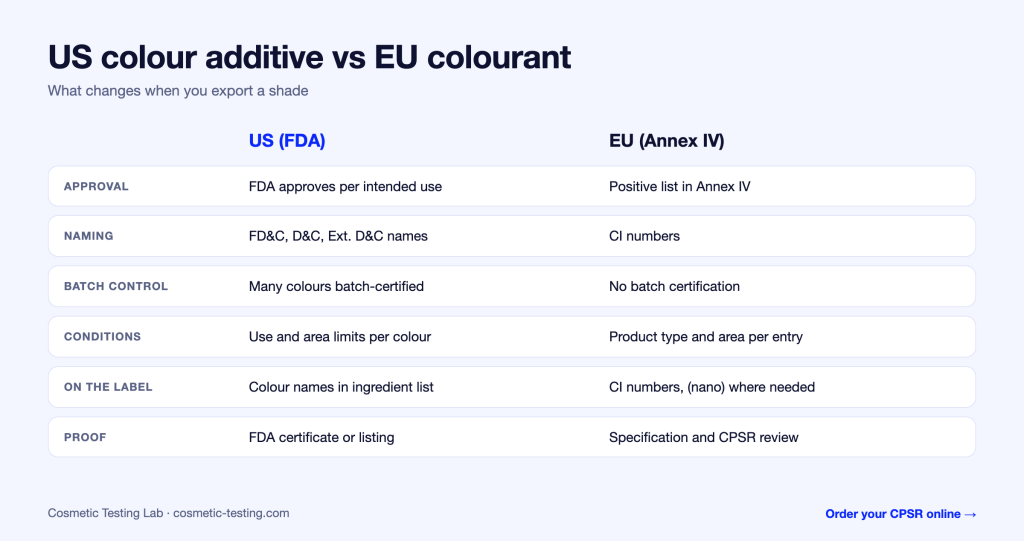
In the US, colour additives need FDA approval for their intended use and many are batch-certified by the FDA; in the EU, colourants must be listed in Annex IV of Regulation (EC) No 1223/2009, are identified by Colour Index (CI) numbers, and carry conditions on the type of product or area of use. There is no EU batch certification. Instead, the Responsible Person and the safety assessor must be satisfied that each colourant is listed, used within its conditions and sufficiently pure, which is documented in the CPSR. Check every shade before you reprint labels or ship.
How the FDA regulates colour additives
In the US, a colour additive may not be used in a cosmetic unless the FDA has approved it for that intended use. The approved colours fall into two groups. Certifiable colours (listed in 21 CFR Parts 74 and 82) have names such as FD&C Blue No. 1, D&C Red No. 7 or Ext. D&C Violet No. 2. Each batch must be certified by the FDA before it is used. Exempt colours (21 CFR Part 73) include many mineral and natural colours, such as iron oxides, titanium dioxide, mica and carmine, and do not need batch certification. Both groups come with identity, purity and use limits, for example colours permitted for external use only or not for use near the eye.
The FDA also notes that a CI or E number does not indicate FDA certification. A shade can have a CI number and still not be allowed for your product in the US.
Citiți și Reglementarea nanomaterialelor în cosmetice: reguli și notificare
How the EU regulates colourants
Annex IV of Regulation (EC) No 1223/2009 is the positive list of colourants allowed in cosmetics. Each entry gives the CI number, the colour name and a field of application. Typical conditions are “all cosmetic products”, “not to be used in eye products” or “not to be used in products applied on mucous membranes”, and some entries set a maximum concentration or require a specific purity or label wording. Colourants intended only to colour hair are handled under a different part of the regulation (the hair dye rules), not Annex IV.
The result: a US shade can be fully legal at home and still be limited, restricted to certain product types, or absent from the EU list.
Mapping US names to CI numbers
Many FDA certifiable colours have a matching CI number, but the name and the legal status must both be checked. Use this process:
- Take each colourant from your formula, with the supplier’s INCI name and CI number.
- Find the CI number in Annex IV, for example in the Commission’s CosIng database or the consolidated regulation.
- Read the conditions: product type, area of use, maximum concentration, label text.
- Compare with your product. A lipstick, a mascara and a body wash may meet very different conditions with the same shade.
- Note lakes and pigments. A lake has its own CI number, often with a suffix after the colon, and must be listed too.
Ask your supplier for a specification stating the CI number, the purity and the compliance with the EU list. A US-only certificate is not enough for the safety file.
Batch certification versus EU purity checks
US batch certification does not travel to the EU. The EU does not certify batches, and the Responsible Person remains responsible for ensuring that the colourants in each batch meet the requirements. In practice, this means supplier specifications, certificates of analysis and, where the formula calls for it, the impurity review that the safety assessor performs. Heavy metals and other impurities in pigments need particular attention.
Citiți și Substanțe CMR în cosmetice explicate: ce este interzis
Special cases to flag early
- Titanium dioxide (CI 77891). It remains listed for cosmetics, but its classification for inhalation in powder form has led to extra rules and scrutiny. Check the current text for loose powders and sprays.
- Nanomaterials. Nano-form pigments need separate notification and labelling in the EU.
- Eye-area products. Some colourants are allowed in the US eye area only if specifically approved, and the EU has its own conditions. Check both.
- Natural colours. Plant extracts such as annatto or beta-carotene may be exempt in the US and be listed by CI numbers in the EU, but only the entries on Annex IV count. A natural origin does not exempt a colourant from the list.
- Hair colours. These follow different rules in both systems and need their own review.
What changes on the label
The EU ingredient list shows colourants by CI number, using the CI prefix, and not by FD&C or D&C names. Decorative products sold in several shades may list all colourants of the range with “may contain” (or +/−). A nano colourant is followed by “(nano)”. Warnings tied to specific colourants must appear when the annex requires them. Update the INCI declaration together with the rest of the label and check it against the CPSR.

Example: reading an Annex IV entry
Take a shade that you sell in a lipstick and in a body wash. Annex IV may allow one colourant in all cosmetic products, a second one only in products that are not applied near the eye, and a third one only in products that stay briefly on the skin. If your range uses the same pigment in a mascara, a lip product and a shower gel, you may have to check three different conditions. Write the result in a simple table per product, and give it to the safety assessor with the supplier data.
Citiți și Marja de siguranță (MoS) în cosmetice: cum se calculează
Stability and compatibility of colours
Changing a colourant can alter the look, the pH and the stability of the product. Pigments can fade, bleed or react with the preservative system or packaging. Run a stability test on the new shade, and where you also adapt the preservative system, repeat the challenge test. Colour change is one of the first visible signs of an unstable formula.
A practical export checklist for colours
- List every colourant with INCI name, US name and CI number.
- Check each CI number in Annex IV, including product type and area of use.
- Collect supplier specifications and purity data for the EU.
- Replace or reformulate any unlisted or restricted shade.
- Update the ingredient list with CI numbers and any nano marks.
- Retest stability for changed shades.
- Give the final list to the safety assessor for the CPSR.
Frequently asked questions
Does my FDA certification count in the EU?
No. The EU has no equivalent batch certification and does not recognise it as proof of compliance. The EU test is whether the colourant is on Annex IV, used within its conditions and sufficiently pure.
Can I keep the US colour names on the label?
No. EU ingredient lists use CI numbers for colourants. You can keep US names on the US version of the label.
Is a natural colour automatically allowed?
No. A natural colourant must be on Annex IV like any other, and some natural extracts are treated as ordinary ingredients rather than colourants, depending on their use.
Key takeaways
- The US uses FDA approval and batch certification; the EU uses a positive list in Annex IV.
- Check each CI number for product type, area of use and concentration.
- Show colourants by CI number on the EU label.
- Retest stability after a shade change and document it in the CPSR.