

Parents read labels carefully, regulators look even closer, and a product sold for infants must withstand both. If you plan a baby shampoo, a nappy cream or a body lotion for toddlers, baby cosmetics safety testing is more than a formality. This guide explains why baby products are assessed more strictly in the EU, which tests and documents usually belong in the file, and which claims need care.
Contents
- The short answer
- Why babies are different
- What the safety assessment must cover
- Microbiological quality matters more
- Preservation is a balancing act
- Skin compatibility testing
- Stability and packaging
- Claims that need care
- Fragrance and essential oils
- A practical checklist
- Common mistakes
- Frequently asked questions
- Key takeaways
The short answer
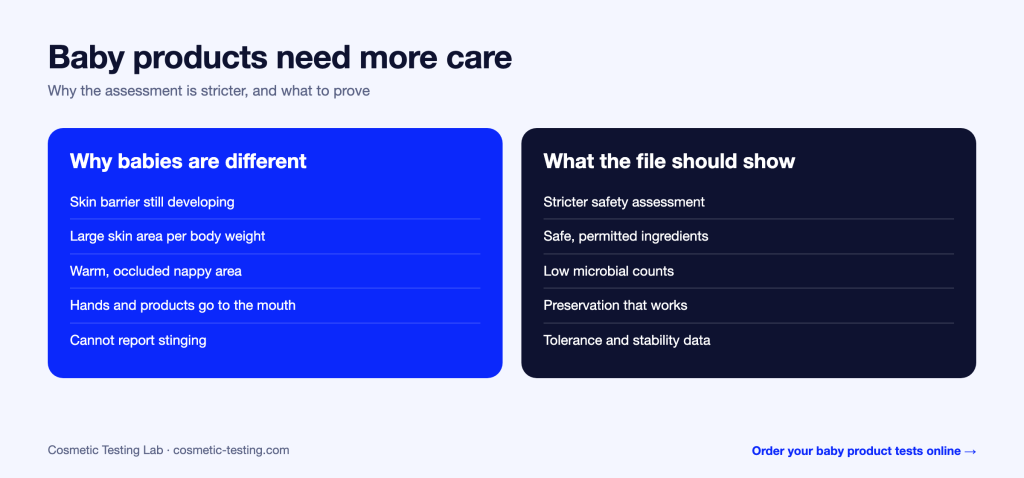
There is no separate “baby cosmetics law” in the EU. Regulation (EC) No 1223/2009 applies, and it asks the safety assessor to take particular account of products intended for children under three years of age. In practice this means a stricter safety assessment in the CPSR, careful choice of ingredients and preservatives, stricter microbiological quality, and evidence that matches every claim you make. Which tests are needed depends on the product, and your assessor decides.
Why babies are different
An infant is not a small adult. The skin barrier is still developing, the skin surface is large in relation to body weight, and the nappy area is warm, moist and occluded. Babies put their hands and products in their mouth, rub their eyes, and cannot tell you when something stings. Assessors therefore use specific exposure assumptions for children. The SCCS Notes of Guidance include age-related considerations and information on typical product use by children of different ages, and the margin of safety for ingredients must be calculated with that exposure in mind.
Read also Lip Balm Safety Testing: What Lip Products Need Before Sale
What the safety assessment must cover
- Every ingredient. Toxicological profile, impurities and exposure for the age group the product is meant for, including leave-on versus rinse-off use.
- Restrictions in the annexes. Some substances are banned or limited in products for children, for example certain preservatives that may not be used in leave-on products for the nappy area. Check the current annexes before you finalise the formula.
- The finished product. Stability, packaging, microbiological quality and the effect of how the product is used.
- Warnings and directions. Instructions such as keeping the product out of the eyes and out of reach of children, and any mandatory warnings.
Microbiological quality matters more
Infants have an immature immune system and, in the nappy area, damaged skin is common. Cosmetic microbiology guidance such as the SCCS Notes and ISO 17516 set stricter limits for products intended for children under three, for the eye area and for mucous membranes than for other cosmetics. Typically these products are expected to stay below 100 colony-forming units per gram or millilitre of aerobic mesophilic bacteria, and free of specified pathogens. A microbiological specifications test shows the quality of the finished product, and a challenge test shows the preservative system keeps it that way during use.
Preservation is a balancing act
Baby products often contain water, so they need protection, but the preservative choice is narrow. Some preservatives are limited for the nappy area or for children, and parents may avoid others. A system that is too weak fails the challenge test; one that is too strong can irritate. Test the final formula in its final packaging, and keep the preservative level only as high as needed. Water-based baby wipes, lotions and shampoos almost always need the challenge test.
Read also Perfume Safety Testing: What Fragrances Need Before Launch
Skin compatibility testing
Human skin compatibility data are widely expected for baby products, because they show that the finished formula is well tolerated under test conditions. A patch test in adult volunteers, such as our single 48-hour occlusive test, gives useful tolerance data for the formula, but it does not by itself prove suitability for infants. Studies on babies and children are ethically sensitive and must follow strict rules, including parental consent and paediatric supervision. Ask your safety assessor which combination of adult tolerance data, ingredient assessment and, where justified, a paediatric use study is appropriate.

Stability and packaging
Baby products are often kept in warm bathrooms and used for months. A stability test checks that the formula stays within specification over its shelf life, and that the packaging does not interact with it. Pay attention to pumps, droppers and wipes packs that are opened many times a day. Instability can alter pH or preservative efficacy, which are exactly the parameters that protect sensitive skin.
Claims that need care
- “Hypoallergenic”, “gentle” or “for sensitive skin”. These are claims under Regulation (EU) No 655/2013 and need evidence that fits the wording and the age group.
- “Tear-free”. Needs data on eye tolerance, not just skin tests.
- “Natural” or “pure”. These are not safety guarantees, and essential oils or botanical extracts can irritate infants.
- “Dermatologically tested” or “paediatrician tested”. State only what was done, on which group, and under whose supervision.
- Medical claims. Treating or preventing nappy rash or eczema is a medical claim and is risky for a cosmetic.
Read also Bath Bomb Regulations in the EU: Testing and Safety Rules
Fragrance and essential oils
Many brands avoid fragrance for the youngest children. Where you use it, remember that listed fragrance allergens must be declared on the label above set thresholds, and that Regulation (EU) 2023/1545 extends the list. Essential oils such as peppermint or eucalyptus can be unsuitable for babies because of their strong effects, so ask your safety assessor before using them.
A practical checklist
- Define the age group and the use: rinse-off, leave-on, nappy area, wipes.
- Design the formula with a short, mild ingredient list and check the annexes.
- Test preservation, microbiological quality and stability on the final product.
- Collect tolerance data and agree the right design with your assessor.
- Obtain the signed CPSR, notify the product in CPNP and file everything in the PIF.
Common mistakes
- Reusing an adult formula and simply renaming it as a baby product.
- Using a preservative that is restricted for the nappy area or for children.
- Skipping the microbiological test because the challenge test passed.
- Making a “tear-free” claim without eye tolerance evidence.
- Describing a mild cream as a treatment for nappy rash.
Frequently asked questions
Do baby cosmetics need a CPSR?
Yes. Every cosmetic product placed on the EU market needs a CPSR, and for baby products the assessor takes extra account of children under three.
At what age does the stricter assessment stop?
The Regulation refers specifically to children under three. Beyond that age, the assessment uses the exposure data for the age group the product targets, so state the target group clearly.
Can I use a patch test on babies?
Not in the way you test adults. Studies on infants are ethically restricted and follow special rules, so safety assessors rely mainly on ingredient assessment, adult tolerance data and, where needed, supervised paediatric use studies.
Key takeaways
- The same EU regulation applies, but products for children under three need a stricter safety assessment.
- Microbiological quality, preservation and stability deserve extra attention.
- Tolerance data from adult volunteers help but do not prove suitability for infants on their own.
- Keep claims precise, and avoid medical promises.