
Few cosmetic actives are as popular, and as temperamental, as ascorbic acid. If you are developing a vitamin C serum, stability is the first question: a formula can look perfect on day one and turn yellow or brown within weeks. This guide explains why that happens, how to formulate and package against it, and which tests show whether your serum is stable and safe enough to launch. Vitamin C serum stability depends on the form of vitamin C, the pH, protection from oxygen, light and metals, and the packaging, and it has to be shown with stability data, not assumed.
Contents
- The short answer
- Why does vitamin C turn brown?
- Which form of vitamin C are you using?
- How does pH affect stability and skin tolerance?
- Formulation levers that slow oxidation
- Packaging: the second half of stability
- What should a stability study check?
- What will the safety assessor ask?
- Does a vitamin C serum need a challenge test?
- Which claims can you make?
- Pre-launch checklist
- Frequently asked questions
- Key takeaways
The short answer
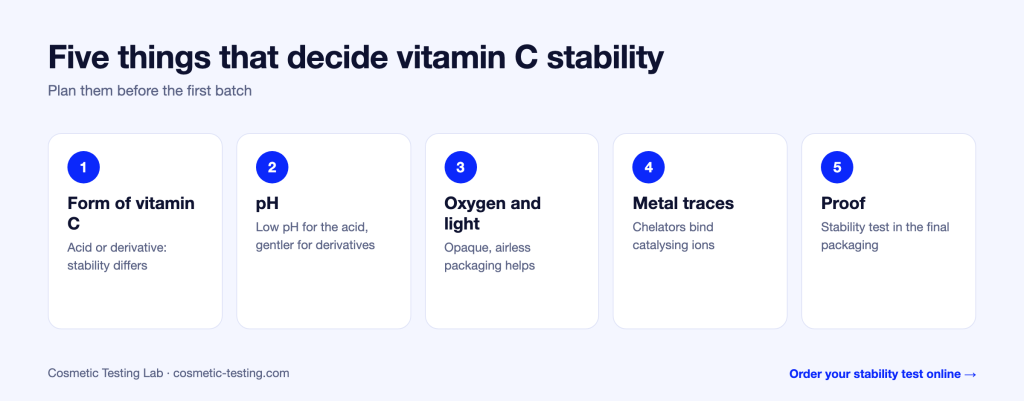
Pure L-ascorbic acid oxidises easily when it meets air, light, heat and traces of metals, and the oxidised products cause the colour change. Brands slow this down with a low pH, protective ingredients, chelating agents and packaging that keeps oxygen and light out. Derivatives such as sodium ascorbyl phosphate or ascorbyl glucoside are more stable but behave differently. Whatever you choose, an accelerated stability test, a packaging compatibility check and a safety assessment show whether the serum holds up for its intended shelf life.
Why does vitamin C turn brown?
L-ascorbic acid is an antioxidant, which means it sacrifices itself to oxygen. In a water-based serum it oxidises first to dehydroascorbic acid and then breaks down further into products that are often yellow or brown. Several things speed this up:
- Oxygen in the headspace of the bottle and dissolved in the water phase.
- Heat, which is why warm storage and shipping matter.
- Light, especially in clear or translucent containers.
- Metal ions such as iron or copper, which can come from raw materials, water or equipment and act as catalysts.
- pH and water content, because the reaction runs differently under different conditions.
A colour change is not automatically a safety problem, but it is a quality signal and usually means the active is being lost.
Read also Hyaluronic Acid Cosmetics: Safety, Claims and Testing
Which form of vitamin C are you using?
The INCI name tells you what is in the bottle. L-ascorbic acid (INCI: ascorbic acid) is the best-known form and the least stable in water. Derivatives are chemically modified to resist oxidation, for example sodium ascorbyl phosphate, magnesium ascorbyl phosphate, ascorbyl glucoside, ascorbyl palmitate and tetrahexyldecyl ascorbate. They are usually easier to formulate, but they have to be converted in or on the skin to act as vitamin C, and published evidence on how well this works differs from one derivative to another. Claims should therefore match what you can support. A serum labelled “vitamin C” is not automatically equivalent to one containing pure L-ascorbic acid, and your documentation should state exactly which form and which level you use.
How does pH affect stability and skin tolerance?
pH matters twice. Serums with L-ascorbic acid are typically acidic, because the acid form is the one reported to enter the skin. One often-cited study on pig skin found that the acid needed a pH below about 3.5 to be taken up. That is animal data and a formulation hint, not proof of an effect in people, so do not turn it into a claim. At the same time, a low pH is more likely to cause stinging or redness on sensitive skin, particularly at higher levels of the active. Derivatives work at a less acidic pH, which is gentler but changes the choice of preservatives and thickeners. Your safety assessor looks at pH, level of the active and intended use together, and you should record the measured pH at the start and during the stability study.
Formulation levers that slow oxidation
- Chelating agents bind the metal ions that catalyse oxidation.
- Other antioxidants such as tocopherol or ferulic acid are widely used alongside vitamin C. Agree their level and purpose with your assessor.
- Low-water or anhydrous systems, for instance silicone- or oil-based serums, can protect the active but need a different manufacturing approach.
- Oxygen control in production: avoid whipping air in, deaerate if you can, and add the active late and at a low temperature.
- Raw material quality: ask suppliers for specifications, including metal content.
Read also Margin of Safety (MoS) in Cosmetics: How It Is Calculated
Packaging: the second half of stability
Even a strong formula degrades in the wrong container. Opaque or dark glass, airless pumps and small fill volumes limit oxygen and light. A dropper bottle lets in fresh air each time it is opened, so a dropper serum may darken faster in use than an airless one, even if both are identical when sealed. Packaging can also interact with the formula, for example when plastics absorb actives or metal parts introduce ions. That is why a stability and compatibility test is run in the final packaging and not only in a laboratory jar.
What should a stability study check?
For a vitamin C serum the plan typically covers:
- Appearance, colour and odour, compared with a reference kept cold and dark.
- pH, viscosity, and any separation, crystals or sediment.
- Behaviour at elevated temperature (accelerated study), in light, and with temperature cycling where relevant.
- Packaging compatibility: leakage, deformation, pump function, label and print resistance.
- Microbiological quality at the end of the study.
The result is a documented basis for the shelf life or the period-after-opening (PAO) symbol. How much active remains is a separate analytical question, so clarify with the laboratory what is included and whether you need a content assay for your own quality specification.

What will the safety assessor ask?
Ascorbic acid and its derivatives are long-established cosmetic ingredients, and as far as we are aware they are not banned or restricted in Annexes II to VI of the EU Cosmetics Regulation. Check the current annexes and the CosIng entry for the exact form you use. The assessor still evaluates the whole formula: concentration, pH, the other ingredients, exposure (daily use on the face, near the eyes), irritation potential, impurities and your stability data. Because oxidation products form over time, a shelf life is difficult to accept without stability results. All of this is documented in the CPSR, which has to be in place before the product is placed on the market.
Read also Water Activity and pH: Formulating for Microbial Safety
Does a vitamin C serum need a challenge test?
A low pH helps against microbes, but it is not a substitute for proof. The preservatives you add may also work only in a certain pH range. A risk assessment may exempt some very low-risk formulas, but that decision belongs to the safety assessor. A water-based serum normally needs a challenge test to show the preservation works, and a microbiological specifications test shows the quality of the finished product. Repeat the challenge test if you change the pH, the preservative or the packaging in a meaningful way.
Which claims can you make?
Claims for cosmetics must follow the common criteria of Regulation (EU) 655/2013: legal compliance, truthfulness, evidential support, honesty, fairness and informed decision-making. For a vitamin C serum that means:
- “Antioxidant” or “brightening” claims need evidence that fits the actual formula, not only a study on another vitamin C form.
- “Stabilised” or “fresh for months” claims need your own stability data.
- Avoid medical language such as “treats” or “heals” pigmentation or sun damage.
Pre-launch checklist
- Write down the exact vitamin C form, level, pH and the other antioxidants.
- Choose packaging that limits air and light, and test in that packaging.
- Run an accelerated stability study and keep a cold, dark reference.
- Prove preservation with a challenge test, then check the finished product.
- Give the data to your safety assessor for the CPSR and fix shelf life or PAO accordingly.
- Match each claim to a piece of evidence in your product information file.
Frequently asked questions
Is a yellow vitamin C serum unsafe?
Not necessarily, but colour change signals oxidation and loss of the active. Treat it as a quality failure and check the stability data.
Are vitamin C derivatives always better?
They are usually more stable, but they act differently on the skin. Choose by the claim you want to make and the evidence you have.
How long does a vitamin C serum last?
It depends on the formula, the pH and the packaging. Only stability data can support a shelf life or PAO.
Key takeaways
- L-ascorbic acid oxidises with air, light, heat and metals, which causes browning.
- Form, pH, antioxidants, chelators and packaging decide how stable the serum is.
- Stability, challenge and safety data in the final packaging support shelf life and claims.
- Make only claims that match the actual vitamin C form and your evidence.