

When a safety assessor signs off an ingredient, the decision rests on one number more than any other: the margin of safety cosmetics assessors calculate, usually shortened to MoS. If you have ever received a CPSR query asking for a NOAEL or a dermal absorption value, this is the reason. This guide explains the calculation step by step, with a worked example and the data you can prepare in advance.
Contents
- The short answer
- Where does the margin of safety fit in the safety assessment?
- Step 1: find the NOAEL
- Step 2: calculate the systemic exposure dose
- Step 3: divide NOAEL by SED
- A worked example (illustrative numbers)
- What if the MoS is below 100?
- Aggregate exposure and special cases
- Which data can you prepare before ordering a CPSR?
- Common mistakes
- Frequently asked questions
- Key takeaways
The short answer
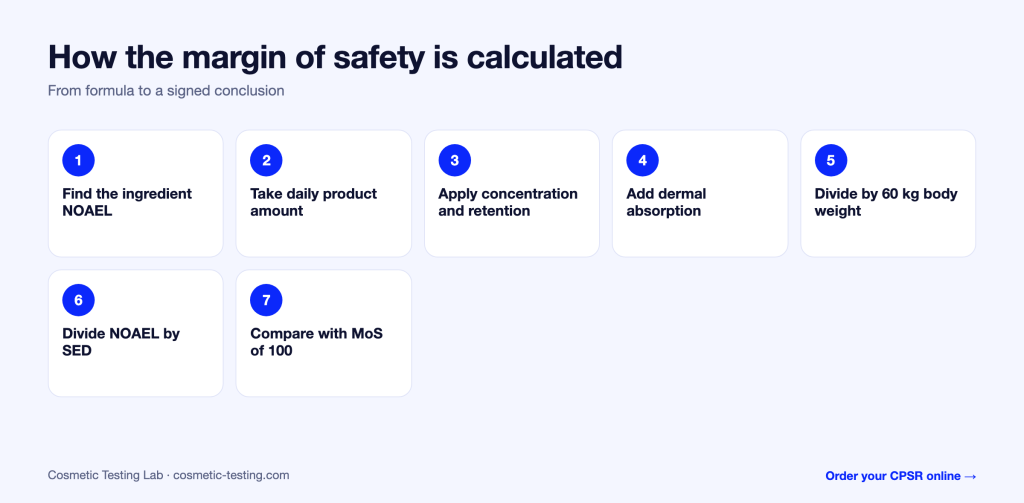
The margin of safety is the NOAEL (the highest dose with no observed adverse effect in animal or other toxicity studies) divided by the systemic exposure dose (SED), which is the amount of the ingredient that reaches the bloodstream per kilogram of body weight per day from using the product. A MoS of at least 100 is generally considered acceptable by the EU scientific committee (SCCS). It is calculated per ingredient and product type, and it is one of the central elements of Part B of the cosmetic product safety report.
Where does the margin of safety fit in the safety assessment?
The EU cosmetics regulation requires every product to be safe, and the CPSR is the document that proves it. Part A collects data, Part B contains the assessment and conclusion. For the toxicological profile of each ingredient, the assessor compares how much of the ingredient the consumer takes up with how much has been shown to cause no harm in studies. The MoS is the ratio of the two. It does not replace judgement, but it gives the assessor a transparent, repeatable calculation that others can check.
Read also Water Activity and pH: Formulating for Microbial Safety
Step 1: find the NOAEL
The NOAEL, no observed adverse effect level, comes from toxicity studies, normally repeated-dose studies lasting 28 or 90 days or longer, expressed in milligrams of ingredient per kilogram of body weight per day (mg/kg bw/day). Because animal testing for cosmetic ingredients is banned in the EU, the assessor relies on existing studies, often done for other sectors under chemicals law, on data published by the SCCS or in dossiers for the ingredient, and on newer non-animal methods where they are accepted. If only a LOAEL (lowest observed adverse effect level) or a benchmark dose is available, additional uncertainty factors may be applied, and the assessor must justify them.
Step 2: calculate the systemic exposure dose
The SED translates your formula into a daily amount that is absorbed. It depends on four inputs:
- Amount of product used per day. The SCCS publishes default values per product type, for example about 7.8 grams per day for a body lotion, much less for a lipstick or a face cream applied only on the face. Check the current Notes of Guidance for the exact figure.
- Concentration of the ingredient in the finished product, as a percentage.
- Retention factor. Leave-on products stay on the skin; rinse-off products such as shampoo are mostly washed away, so a retention factor lowers the dose.
- Dermal absorption. The share of the ingredient that passes through the skin. If no data exist, the assessor must assume a cautious default, up to 100%.
The result is divided by a standard body weight of 60 kg, giving the SED in mg/kg bw/day.
Step 3: divide NOAEL by SED
MoS = NOAEL / SED. The higher the number, the larger the gap between consumer exposure and the dose that caused no effect. The SCCS uses a default of 100 as the minimum acceptable value. That figure comes from two factors of ten: one for differences between test animals and humans, and one for differences between individual people. If the data are weak, the assessor may ask for a larger margin.
Read also Vitamin C Serum Stability and Safety: Testing Ascorbic Acid
A worked example (illustrative numbers)
Imagine an ingredient used at 1% in a body lotion, with a NOAEL of 50 mg/kg bw/day from a 90-day study:
- Daily amount of lotion: about 7.82 g.
- Ingredient applied: 1% of 7.82 g = 0.0782 g = 78.2 mg per day.
- With a measured dermal absorption of 20%, the absorbed dose is 15.6 mg per day.
- Divide by 60 kg: SED = 0.26 mg/kg bw/day.
- MoS = 50 / 0.26, which is about 190. That is above 100, so the use is acceptable on this criterion.
Now the same formula without absorption data. The assessor must assume 100% absorption: SED is about 1.3 mg/kg bw/day and the MoS falls to about 38, below 100. The ingredient has not changed, only the missing data. This is why a dermal absorption study or a good literature value can save a formula.
What if the MoS is below 100?
There are several honest ways forward, and an assessor will normally discuss them with you:
- lower the concentration of the ingredient;
- provide measured absorption instead of the worst-case default;
- provide a better or longer toxicity study, which may change the NOAEL;
- change the product type, for example from leave-on to rinse-off;
- replace the ingredient.
Hiding the problem is not an option. A CPSR with an unexplained low margin will not be signed.
Aggregate exposure and special cases
The same ingredient may appear in several products used by one person, for example a preservative in a cream, a serum and a cleanser. The SCCS expects the assessor to consider this aggregate exposure where it is relevant. Some ingredient groups are not handled with a simple MoS at all. For skin sensitisers, such as many fragrance allergens, assessors use a quantitative risk assessment based on the sensitisation threshold. For substances without a threshold, special rules apply, and for nanomaterials additional data are needed. Colourants, UV filters and preservatives that are in the annexes have their own maximum levels, which still have to be shown to be safe in your finished product.

Read also Hyaluronic Acid Cosmetics: Safety, Claims and Testing
Which data can you prepare before ordering a CPSR?
You can shorten the process by sending a complete package to your assessor:
- The full formula with percentages, INCI names and CAS numbers.
- Supplier safety data sheets and, where available, specifications, impurity profiles and toxicology summaries.
- The intended use: product type, area of application, frequency, target group such as children.
- Stability and microbiological results, which feed Part A. Our stability test and microbiological test reports are signed PDFs that the assessor can use directly.
- For skin tolerance, a patch test can support the conclusion on the finished product, in addition to the ingredient-level MoS.
Our CPSR is signed by a qualified safety assessor and delivered in about 10 business days after complete data.
Common mistakes
- Using the wrong product type. A hand cream and a body lotion have different default amounts. Use the category that matches how your customers actually use it.
- Ignoring the retention factor. Rinse-off products need it, but it must not be applied to leave-on products.
- Assuming a NOAEL from a different route. An oral NOAEL needs to be adjusted for absorption when it is compared with dermal exposure.
- Using supplier marketing data in place of study reports. The assessor needs verifiable data.
- Forgetting that the formula changes. A new concentration means a new calculation.
Frequently asked questions
Is a margin of safety of 100 a legal limit?
No. It is the value that the SCCS commonly uses as the minimum for an acceptable margin. The assessor can justify a different value with scientific arguments, and the final conclusion is a professional judgement.
Do I have to calculate the MoS myself?
No. A qualified safety assessor does it as part of the CPSR. You supply the formula, the intended use and any data you have, and the assessor reports what is missing.
Does every ingredient need a MoS?
The assessor evaluates every ingredient, but the depth varies. Well-characterised, low-concern ingredients may be covered by existing opinions, while new or high-concern ones need full calculations.
Key takeaways
- MoS = NOAEL divided by the systemic exposure dose; 100 is the usual minimum.
- The exposure depends on product type, concentration, retention and dermal absorption.
- Missing absorption data push the assessor to a worst-case assumption that can fail a safe formula.
- Prepare formula, supplier data and test reports before ordering your CPSR.