

You open a jar of cream and find a pool of oil on top, or a lotion that has split into a watery layer and a thick layer. Customers read that as “spoiled”, even when the product is safe. Emulsion separation in cosmetics is one of the most common stability failures, and it is also one of the easiest to catch early. This guide explains why emulsions separate, the different types of breakdown and how stability tests find the problem before your customers do.
Contents
- The short answer
- What is an emulsion?
- The main types of emulsion breakdown
- Why do emulsions separate?
- Is a separated product unsafe?
- How stability tests catch separation
- What to look for at each check
- Test in the real packaging
- How to fix and prevent separation
- Why it matters for your regulatory file
- Frequently asked questions
- Key takeaways
The short answer
Emulsions separate because oil and water do not mix on their own, and the droplets of one liquid dispersed in the other slowly come together and rise, sink or merge over time. Poor emulsifier choice, large droplets, low viscosity, the wrong pH or salt level, ingredient interactions and temperature swings all speed it up. Stability tests, such as accelerated storage, freeze-thaw cycling, centrifugation and viscosity and droplet checks, make the weakness visible in weeks instead of months.
What is an emulsion?
An emulsion is a mixture of two liquids that normally do not blend, usually oil and water, where one is spread as tiny droplets through the other. Most creams and lotions are oil-in-water emulsions (oil droplets in water), while richer products such as cold creams and some sunscreens are water-in-oil. An emulsifier sits at the boundary of each droplet and keeps it from merging with its neighbours. A thickener slows the movement of droplets. Take away enough of either and the system drifts back to two layers, because that is its lowest-energy state.
Read also Centrifuge Test for Cosmetics: Fast Screening of Emulsion Stability
The main types of emulsion breakdown
- Creaming or sedimentation: droplets rise (or sink) because their density differs from the surrounding liquid. The product looks uneven, but the droplets are still intact, so gentle shaking can often restore it. It is the early warning.
- Flocculation: droplets clump together without merging. Viscosity may increase or the texture turn lumpy.
- Coalescence: droplets merge into larger ones. This is irreversible and leads to visible oil or water layers.
- Phase inversion: an oil-in-water emulsion flips into water-in-oil (or the reverse), changing the feel of the product completely.
- Bleeding or syneresis: watery or oily liquid is pushed out of the surface of a thick cream or gel.
Why do emulsions separate?
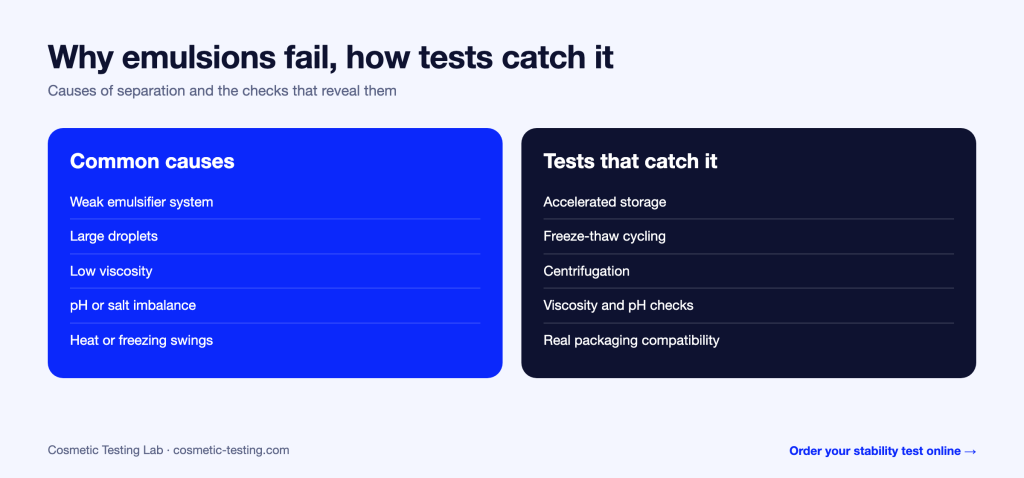
Most failures trace back to a handful of causes:
- The wrong emulsifier or too little of it. The emulsifier system must match the oil phase. A system chosen for one oil can fail when you swap in a different oil or add a heavy butter.
- Droplets that are too large. Insufficient mixing or homogenisation leaves big droplets, which rise and merge faster than small ones.
- Low viscosity of the outer phase. Without a thickener or structurant, droplets move freely.
- Electrolytes and pH. Salts, acids and some actives and plant extracts can disturb the stability of many emulsifiers and polymers, especially anionic ones.
- Ingredient interactions. Alcohol, high levels of UV filters, fragrance, essential oils or clays can weaken the interface.
- Temperature. Heat lowers viscosity and speeds droplet movement, and freezing can disrupt the structure. Waxes that melt and recrystallise can change the texture.
- Process errors. Wrong temperatures, order of addition, cooling rate or mixing speed.
- Packaging and storage. Air, light and long storage can change the formula over time.
Is a separated product unsafe?
Not necessarily, but you should not assume it is safe. Separation is a physical failure, yet it can also reduce the preservative in the water phase and let microbes grow, or leave an uneven dose of active ingredients and UV filters. A sunscreen that separates may not give the declared protection. So any separation should trigger an investigation, including a microbiological check, before the batch is released.
Read also Natural Cosmetics Stability: Special Challenges and Solutions
How stability tests catch separation
A stability programme puts the product under stress and compares it with a control. For emulsions, the most useful checks are:
- Accelerated storage at elevated temperature. Warm storage, commonly around 40 to 45 °C, speeds up droplet movement, and the results help predict shelf life. The ISO technical report ISO/TR 18811 gives a framework for choosing conditions, and the manufacturer justifies them.
- Freeze-thaw and temperature cycling. Alternating cold and warm conditions attack the structure of the emulsion and reveal weak ones quickly.
- Centrifugation. Spinning a sample, often at a few thousand revolutions per minute for about half an hour, mimics long storage by accelerating gravity. A stable emulsion stays uniform; a weak one splits.
- Room temperature and cool storage. Slower, real-time observation, which confirms the accelerated findings.
- Measurements. Appearance, colour, odour, pH, viscosity and, in a development lab, droplet size by microscope, tracked over time.

What to look for at each check
At every time point, compare with the control sample and record the results the same way each time. Look at the surface and the cut section for oil spots, watery pockets or a skin. Check colour, scent and texture, and measure pH and viscosity. A small drop in viscosity or a drift in pH can be the first sign of breakdown before anything is visible. Keep photos with the dates. Define in advance what counts as a pass, for example no visible separation and a viscosity within an agreed range.
Test in the real packaging
The pack changes the outcome. A pump bottle, a tube, an airless container and a glass jar expose the product to different air, light and temperature conditions, and some plastics absorb oils or preservatives. For that reason a stability and compatibility test should be run in the final container, and results from a different pack cannot be assumed to apply. Our accelerated plans (Basic, Standard and Full) end with a signed PDF you can use in your safety file.
Read also What Is Cosmetic Stability Testing? A Plain-English Guide
How to fix and prevent separation
- Adjust the emulsifier system: change the type, the ratio of emulsifiers or the level, and match it to the oil phase.
- Strengthen the structure: add or adjust a thickener, a gelling polymer or a co-emulsifier such as a fatty alcohol.
- Reduce droplet size: improve homogenisation, mixing speed or time.
- Check pH and electrolytes: make sure each ingredient works in your final pH and salt level.
- Review the process: temperatures, order of addition and cooling.
- Retest: repeat the stability study after every change, because a fix for one problem can create another.
Why it matters for your regulatory file
The EU Cosmetics Regulation requires the safety assessment to consider the stability of the finished product, and stability is part of the physical and chemical characteristics described in the CPSR guidance. A stability report is therefore a core document for the CPSR. Preservation is closely linked, so water-based emulsions also need a challenge test to show that the preservative works in the formula and, for finished-batch quality, a microbiological specifications test.
Frequently asked questions
Can I fix a separated cream by stirring or shaking?
Sometimes, if it was only creaming, but a coalesced emulsion will not return to its original state. Do not sell a product that needs fixing by the customer unless the label directs it and the product has passed tests in that condition.
How long does it take to see separation in a test?
Centrifugation shows weaknesses within hours, freeze-thaw within days and accelerated storage within weeks. Real-time studies take months. A weak emulsion usually shows itself early.
Are natural emulsifiers less stable?
Not by nature, but natural and plant-based systems can be more sensitive to pH, salts and temperature, and the choice of ingredients is narrower. They need the same stability testing as any other formula.
Key takeaways
- Emulsions separate through creaming, flocculation, coalescence or inversion, driven by formula, process and temperature.
- Separation can affect preservation and dose, so it is a safety question as well as a looks question.
- Accelerated storage, freeze-thaw, centrifugation and measurements reveal weakness early.
- Test in the final packaging and retest after every change.