

“Paraben-free” is one of the most common badges on cosmetic packaging, yet many brands cannot say exactly what parabens are, what the law allows or what happens when they are removed. If you plan a paraben free cosmetics line, this guide separates regulation from marketing and shows what you must still prove.
Contents
- The short answer
- What are parabens?
- What does EU law say about parabens?
- Why did regulators tighten the rules?
- Are parabens really unsafe?
- What replaces parabens?
- Why you must test again after removing parabens
- What does “paraben-free” mean on a label?
- What does the safety assessor need to see?
- Common mistakes
- Frequently asked questions
- Key takeaways
The short answer
Parabens are not banned in the EU. Methylparaben and ethylparaben are permitted preservatives, propylparaben and butylparaben are permitted at lower limits, and five other parabens are prohibited. Scientific committees have found the permitted ones safe at the authorised levels, but regulators tightened the rules for the more potent ones. Going paraben-free is a business choice, not a legal duty, and it only works if the replacement preservative system is tested and proven.
What are parabens?
Parabens are esters of 4-hydroxybenzoic acid. They have been used since the 1920s because they are cheap, stable, effective at low levels and work across a wide pH range. The family includes methyl-, ethyl-, propyl- and butylparaben, among others. Some also occur naturally in small amounts, for example in certain fruits and vegetables, but the ones used in cosmetics are synthetic.
Read also Nanomaterials Cosmetics Regulation: Rules and Notification
What does EU law say about parabens?
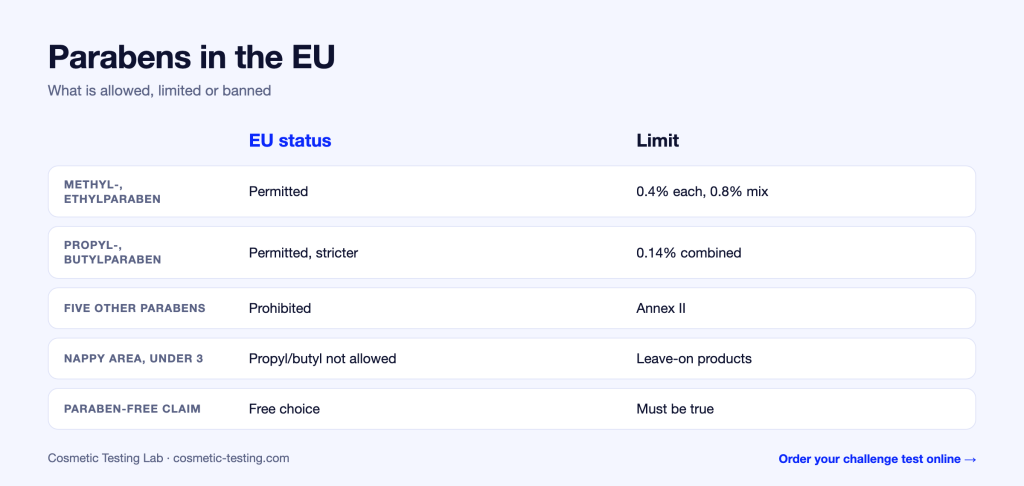
Preservatives are governed by Annex V of Regulation (EC) No 1223/2009, and prohibited substances by Annex II. Over the last decade, the EU has adjusted the position on parabens in two steps:
- Methylparaben and ethylparaben: permitted up to 0.4% each, and 0.8% when used as a mixture of esters.
- Propylparaben and butylparaben (and their salts and esters): permitted at a combined maximum of 0.14% as acid, with a total of 0.8% for all parabens together. They are not allowed in leave-on products designed for the nappy area of children under three years.
- Isopropyl-, isobutyl-, phenyl-, benzyl- and pentylparaben: prohibited in cosmetics.
These changes came through Commission Regulations (EU) No 358/2014 and 1004/2014. Check Annexes II and V of the consolidated regulation for the current exact wording before you finalise a formula.
Why did regulators tighten the rules?
The concern was not that parabens are acutely toxic. It was that propyl- and butylparaben showed weak hormone-like activity in laboratory studies, and that young children might absorb more through the skin relative to their body weight. The SCCS reviewed the evidence and concluded that the lower limits were safe for the general population, but that data were insufficient to confirm safety for the nappy area of very young children, hence the specific exclusion. Methyl- and ethylparaben were considered the best studied and had no change in their limits.
This shows how the system works: the rules respond to evidence, adjust by substance and apply the precautionary principle where data are incomplete.
Are parabens really unsafe?
The honest answer is: not at the permitted levels, according to the scientific committees reviewing the EU data, and with one nuance for very young children. Claims that parabens are proven to cause cancer or harm health at cosmetic concentrations are not supported by the regulatory assessments. At the same time, consumers’ discomfort is understandable, and the market responded. Avoiding parabens is a legitimate positioning, provided you do not mislead people about the safety of competitors’ legal ingredients. If a customer asks, the accurate message is that the permitted parabens are regulated and assessed, and that your brand simply chose a different preservation approach.
Read also CMR Substances in Cosmetics Explained: What Is Banned
What replaces parabens?
Alternatives are not automatically gentler. Each option has its own limits and trade-offs:
- Phenoxyethanol: permitted up to 1.0%. Often combined with a booster for yeasts and moulds.
- Organic acids such as sorbic, benzoic and dehydroacetic acid and their salts: effective mainly at low pH, so they suit acidic formulas.
- Glycols and similar multifunctional ingredients: support the system but rarely preserve on their own.
- Others from Annex V: each with specific conditions, restrictions and allergy profiles.
Some alternatives are more frequent causes of contact allergy than parabens, and some need a lower pH or a higher dose that can affect the feel of the product. Swapping a preservative is a reformulation, not a label change.
Why you must test again after removing parabens
Parabens are strong against moulds and yeasts. When you remove them, those organisms are often the first to survive. A new system can fail even if every ingredient is legal and each is within its limit.
A challenge test contaminates the finished product with five reference microorganisms and follows their decline for 28 days, according to ISO 11930:2019 or USP 51. Run it on the final formula in its final packaging, not on a lab prototype. If the system is borderline, the report shows which organism is the problem and on which day.
Then check that preservation holds over time. Heat, light and pH drift can weaken a system after months. Our stability test checks the formula and packaging at accelerated conditions, and a microbiological specifications test confirms that the finished product meets quality limits.
What does “paraben-free” mean on a label?
There is no specific EU definition of “paraben-free”. It is a free-from claim, so general claim rules apply: it must be truthful, supported by evidence and not misleading. Practical points:
- It must be true for the whole product, including raw materials, blends and fragrances that might carry parabens as a carrier preservative. Ask suppliers for written declarations.
- It must not imply that the product is safer than others just because of this one absence.
- Parabens still appear in the ingredient list when present, with INCI names ending in “-paraben”. A quick scan of the list is the easiest check.
Authorities have pushed back on free-from claims that denigrate legal ingredients. Keep the wording neutral and factual, for example “formulated without parabens”.

Read also Margin of Safety (MoS) in Cosmetics: How It Is Calculated
What does the safety assessor need to see?
A CPSR assesses the whole formula, so the assessor will want to know:
- Which preservatives are in the formula, at what level and for what function.
- Whether the limits of Annex V are respected, including total amounts from blends.
- Evidence that the preservation works, normally the challenge test report.
- The intended user group, including whether the product could be used on children or the nappy area.
- Stability data across the claimed shelf life and the period after opening.
If you already hold a CPSR for a product with parabens, reformulating to be paraben-free means the report has to be updated. A changed preservative is a changed formula.
Common mistakes
- Believing that “paraben-free” automatically means safer or better tolerated.
- Replacing parabens one for one without checking pH compatibility.
- Reusing the old challenge test report after the switch.
- Forgetting parabens that arrive through raw materials such as plant extracts or colours.
- Using the claim to criticise competitors’ products.
Frequently asked questions
Are parabens banned in Europe?
No. Several are permitted with limits, and five specific parabens are prohibited. Propylparaben and butylparaben have a lower maximum and are not allowed in leave-on nappy-area products for children under three.
Can I label my product “paraben-free” if it contains none?
Yes, if it is true for the whole formula and supported by supplier declarations, and if it does not imply that other legal products are unsafe. Keep the evidence in the product information file.
Does a paraben-free product need less testing?
No, it usually needs more attention. Because the preservation system is new, a challenge test on the final formula and a stability check are essential.
Key takeaways
- Parabens are regulated, not banned: some are allowed with limits, five are prohibited.
- Going paraben-free is a marketing decision, not a legal requirement.
- Replacing a preservative means reformulating and re-testing preservation and stability.
- Back up the “paraben-free” claim with supplier declarations and a current CPSR.