
If you sell in the largest US state market, California cosmetics law is stricter than federal law in several places. Four separate rules apply: Proposition 65 warnings, the Toxic-Free Cosmetics Act, the PFAS ban and a reporting duty for fragrance and flavor ingredients. This guide explains what each one requires, which dates matter and how to check your formulas before you ship to California.
Contents
- The short answer
- Why California matters beyond California
- The Toxic-Free Cosmetics Act (AB 2762)
- The PFAS ban (AB 2771)
- The next wave: AB 496 from 2027
- Proposition 65: warnings, not bans
- California Safe Cosmetics Program and fragrance disclosure
- How MoCRA fits in
- A practical California compliance checklist
- Mistakes brands make
- Frequently asked questions
- Key takeaways
The short answer
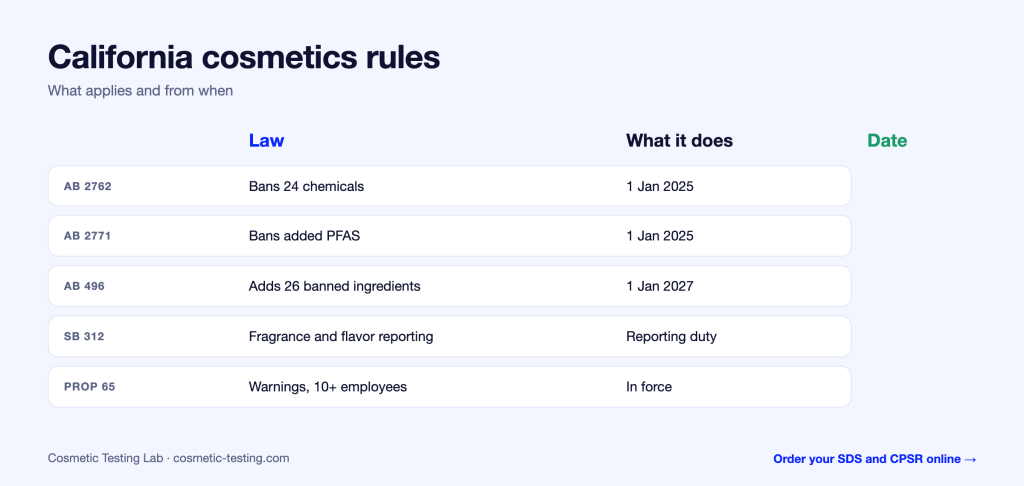
A cosmetic sold in California must avoid the ingredients banned by AB 2762 (since 1 January 2025), contain no intentionally added PFAS (AB 2771, same date), avoid the 26 further ingredients added by AB 496 (from 1 January 2027), carry a Prop 65 warning when it exposes users to a listed chemical above the safe-harbor level, and be reported to the state when it contains listed fragrance or flavor ingredients. Federal rules under MoCRA do not replace these state laws. This article is general information, not legal advice, and you should confirm details on the official pages listed in the sources.
Why California matters beyond California
California is the biggest US consumer market, and most national brands ship there. Because it is usually impractical to run one formula for California and another for the rest of the country, the California lists tend to become the de facto national standard. Retailers also copy them into their own restricted-substance lists. If you want to understand how the US and the EU approach differ, our overview of the CPSR shows how an EU safety assessment already screens formulas against the EU prohibited list, which overlaps with much of the California ban list.
Read also Cosmetic Animal Testing Ban in the EU: What Replaced It
The Toxic-Free Cosmetics Act (AB 2762)
Signed in September 2020, AB 2762 bans 24 chemicals or chemical groups in cosmetics sold in California. The ban took effect on 1 January 2025. According to the Governor’s office, all of them were already banned in the EU. The list includes, among others:
- formaldehyde, paraformaldehyde, methylene glycol and quaternium-15 (a formaldehyde releaser)
- certain phthalates, such as dibutyl phthalate and diethylhexyl phthalate
- isobutylparaben and isopropylparaben
- m-phenylenediamine and o-phenylenediamine and their salts
- mercury and mercury compounds
- 13 named PFAS
Check the bill text for the full list and the exact chemical names, because supplier trade names often hide them. The rule covers intentionally added ingredients; the law has language on technically unavoidable trace amounts, so ask your counsel how it applies to impurities.
The PFAS ban (AB 2771)
AB 2771 goes further than the 13 PFAS on the AB 2762 list. From 1 January 2025 it prohibits manufacturing, selling, delivering, holding or offering for sale in California any cosmetic product that contains intentionally added PFAS. It is a class-wide ban rather than a named list, so any fluorinated ingredient is in scope. In cosmetics, PFAS have mostly been used for water resistance and a silky feel, for example in some long-wear foundations, mascaras and sunscreens. Look for names containing “fluoro”, “perfluoro” or “PTFE” on your INCI lists, and ask each supplier for a written PFAS declaration. Our guide to safety data sheets explains why the SDS alone will not tell you, since PFAS rarely trigger hazard classification.
AB 1817, the third bill often mentioned in this context, regulates PFAS in textile articles such as apparel, not in cosmetics. It matters only if you sell items like cloth bags or reusable wipes with your products.
The next wave: AB 496 from 2027
AB 496, approved in October 2023, adds 26 further intentionally added ingredients to the ban list from 1 January 2027. Reported examples include lilial (butylphenyl methylpropional), styrene, vinyl acetate, several boron compounds such as boric acid, and a group of colorants. If you launch products now that will still be on sale in 2027, reformulate early. Replacing a banned ingredient changes the stability, the texture and sometimes the preservation system, so you will need to repeat stability tests and, for water-based products, a challenge test.
Read also Mandatory Cosmetic Tests in the EU: What the Law Requires
Proposition 65: warnings, not bans
Proposition 65 (the Safe Drinking Water and Toxic Enforcement Act of 1986) works differently. It does not ban ingredients. It requires a clear and reasonable warning before you knowingly and intentionally expose people to a chemical on the state’s list of carcinogens and reproductive toxicants, unless the exposure is below the safe-harbor level. The list is maintained by OEHHA, the state’s environmental health agency.
- Who: businesses with 10 or more employees. Smaller businesses are exempt under Health and Safety Code section 25249.11.
- Where it bites in cosmetics: examples include formaldehyde, lead (as a contaminant in colour cosmetics), and airborne, unbound titanium dioxide particles of respirable size, relevant for loose powders and sprays.
- How warnings work: OEHHA publishes safe-harbor warning wording for labels, websites and catalogues. The short-form rules were revised with effect from 1 January 2025, with a transition period for older labels. Check the official warnings site for the current text.
- Enforcement: private groups can send a 60-day notice of violation, and civil penalties are assessed per violation, per day.
A frequent mistake is to put a warning on a product “just in case”. Assess exposure first.
California Safe Cosmetics Program and fragrance disclosure
California also runs a disclosure system. Manufacturers of cosmetics sold in the state must report to the California Department of Public Health (CDPH) any ingredient that appears on certain authoritative lists of chemicals linked to cancer or reproductive harm. Since the Cosmetic Fragrance and Flavor Ingredient Right to Know Act of 2020 (SB 312), they must also report listed fragrance and flavor ingredients found in their products. CDPH publishes the data in a public database. Fragrance houses often hold the information, so ask them for it, not only for an IFRA certificate. CDPH states that it has no enforcement role for the new ingredient bans. Check the CDPH site for current reporting steps and deadlines.
How MoCRA fits in
MoCRA, the federal cosmetics law, sets national rules for facility registration, listing and safety substantiation. It generally preempts differing state requirements, but it has carve-outs that, as we read the FDA summary, leave state ingredient prohibitions and Proposition 65 in place. Treat this as a point to confirm with a US attorney. In practice, you need both: the MoCRA safety substantiation file and California compliance.
Read also Free Sale Certificate for Cosmetics: Exporting Outside the EU
A practical California compliance checklist
- Export your full ingredient list, including fragrance components, for every SKU sold or shipped to California.
- Screen it against the AB 2762 list, the AB 496 list and a PFAS keyword search.
- Collect written declarations from suppliers: no intentionally added PFAS, no banned substances, a list of known impurities.
- Screen against the Prop 65 list and decide whether exposure is above the safe-harbor level.
- Report to the CDPH Safe Cosmetics Program where required.
- Keep dated records for each batch and formula version. If you reformulate, repeat stability and microbiological testing.

Mistakes brands make
- Relying on the SDS: a safety data sheet shows classified hazards, not every restricted ingredient.
- Ignoring marketplaces: third-party sellers on Amazon and similar sites are also exposed when shipping to California addresses.
- Forgetting fragrance: a fragrance compound can contain a banned substance even when the product label looks clean.
- Replacing a preservative without testing: removing a formaldehyde releaser can leave a formula under-protected. Run a microbiological test on the new version.
- Treating 2027 as far away: reformulation, testing and stock rotation take months.
Frequently asked questions
Do small brands have to follow the California ingredient bans?
Yes. The ingredient bans in AB 2762, AB 2771 and AB 496 apply to anyone who manufactures, sells or offers cosmetics in California, whatever the size. Only Proposition 65 has a 10-employee threshold.
Does a Prop 65 warning make a banned ingredient legal?
No. A warning is only a way to comply with Proposition 65. An ingredient banned under the Toxic-Free Cosmetics Act or the PFAS law cannot be sold with a warning instead.
Do I need a safety data sheet for California?
California does not generally require a consumer SDS, but wholesale buyers, shippers and fragrance suppliers often ask for one. Our SDS service produces a 16-section sheet that you can attach to your compliance file.
Key takeaways
- AB 2762 and AB 2771 have applied since 1 January 2025; AB 496 adds 26 ingredients from 1 January 2027.
- Proposition 65 requires warnings, not bans, for businesses with 10 or more employees.
- Fragrance and flavor ingredient reporting to CDPH is a separate duty.
- Screen formulas, collect supplier declarations and re-test after any reformulation.