

The European Union was the first major market to stop animal testing for cosmetics completely. But if animals are no longer used, how do brands and regulators know a new cream or shampoo is safe? This article explains what the cosmetic animal testing ban covers, how it was phased in and what replaced animal data. In short: since March 2013 the EU bans both animal testing for cosmetics and the sale of cosmetics whose ingredients were tested on animals to meet the Regulation’s requirements; safety is now shown through existing data, validated non-animal methods and a product-specific safety assessment.
Contents
- The short answer
- How the ban was phased in
- What exactly is banned, and what is not
- What replaced animal tests
- What it means for your finished product
- The REACH grey zone
- Where the policy is heading
- “Not tested on animals” claims
- Common misunderstandings
- A worked example
- Checklist for brands
- Frequently asked questions
- Key takeaways
The short answer
Article 18 of Regulation (EC) No 1223/2009 contains two bans. The testing ban prohibits animal tests on finished cosmetic products and on cosmetic ingredients in the EU. The marketing ban prohibits placing cosmetics on the EU market if they, or their ingredients, were tested on animals to meet the requirements of the Regulation, wherever the test took place. Today a cosmetic’s safety rests on what is already known about its ingredients, on non-animal methods and on tests of the finished product that do not use animals, all brought together in the CPSR.
How the ban was phased in
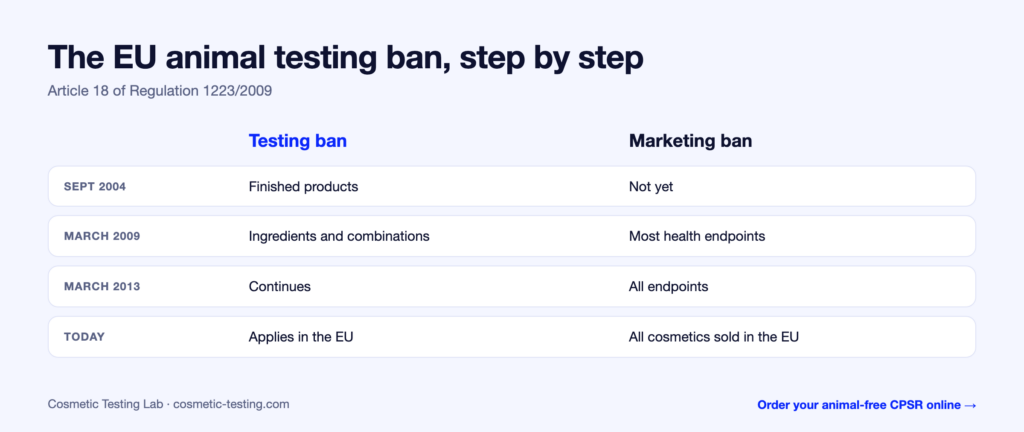
The ban was introduced by the seventh amendment of the former Cosmetics Directive in 2003 and carried over into the current Regulation. According to the European Commission it took effect in stages:
- 11 September 2004: testing ban on finished cosmetic products.
- 11 March 2009: testing ban on ingredients and combinations of ingredients, and marketing ban for most human health effects.
- 11 March 2013: marketing ban extended to the three most complex endpoints – repeated-dose toxicity, reproductive toxicity and toxicokinetics – whether or not alternative methods were available.
The 2013 date was kept even though the Commission had reported in 2011 that full replacement methods for these endpoints would not yet be ready. That decision still shapes how new cosmetic ingredients are developed today.
Read also EU Cosmetics Regulation 1223/2009 Explained in Plain English
What exactly is banned, and what is not
- Banned: animal tests on finished cosmetics and on cosmetic ingredients carried out to meet the Cosmetics Regulation.
- Banned: selling in the EU a cosmetic whose final formulation or ingredients were tested on animals for that purpose, including outside the EU.
- Not affected: data generated before the bans applied, which can still be used.
- Not affected: tests on human volunteers under ethical conditions, such as a patch test, and laboratory tests on the product itself, such as stability or microbiology.
In 2016 the Court of Justice of the EU confirmed (case C-592/14) that animal test results obtained outside the EU cannot simply be used to prove the safety of a cosmetic for the EU market when the tests were needed to meet the Regulation’s requirements.
What replaced animal tests
There is no single replacement test. Instead, safety assessors combine several types of evidence:
- Existing ingredient data. Decades of data on established ingredients, SCCS opinions, the regulated lists in the Annexes and supplier dossiers.
- Validated non-animal methods. Reconstructed human skin models for skin corrosion and irritation, cell-based and chemical tests for skin sensitisation, and in vitro tests for genotoxicity. Many are OECD test guidelines; for skin sensitisation, OECD Guideline 497 (2021) sets out defined approaches that combine several non-animal methods.
- Computational tools. Read-across from similar substances, structure-activity models and the threshold of toxicological concern.
- Next-generation risk assessment. An exposure-led approach that starts from how much of a substance actually reaches the body and uses targeted non-animal data to decide whether that exposure is safe.
The EU reference laboratory for alternatives, EURL ECVAM, plays a key role in validating such methods. The SCCS Notes of Guidance describe how they are used in safety evaluation.
What it means for your finished product
For most brands, the ban changes less than they fear. Most cosmetics are formulated from established ingredients with existing safety data. The safety assessor uses that information, the exact formula and the expected exposure to judge safety. The tests on the finished product are all animal-free:
- A stability and compatibility test on the product in its packaging.
- A microbiological specifications test and, for water-based products, a challenge test.
- Optionally, a patch test on volunteers to support skin tolerance.
Cosmetic Testing Lab does not perform animal testing or in vitro toxicology. Our tests are carried out on product samples, plus the 48-hour patch test on human volunteers.
Read also Cosmetic Responsible Person (RP): Who Needs One and What They Do
The REACH grey zone
Cosmetic ingredients are also chemicals under REACH, which protects workers and the environment as well as consumers. REACH still allows animal tests as a last resort. In 2023 the EU General Court ruled that the European Chemicals Agency could require animal tests under REACH for two UV filters used only in cosmetics. Campaigners criticised the result, and the relationship between the two laws remains debated. For a brand, the practical step is to ask suppliers how the data in their ingredient dossiers was generated.
Where the policy is heading
A European Citizens’ Initiative, “Save Cruelty Free Cosmetics”, collected over a million signatures. In its reply of July 2023, the Commission did not reopen the cosmetics ban but committed to a roadmap towards phasing out animal testing in chemical safety assessments. Expect more non-animal methods to be accepted over time.
“Not tested on animals” claims
Because every cosmetic sold in the EU must meet the ban, a claim that only restates the legal requirement may mislead consumers into thinking your product is special. The common criteria for claims require claims to be honest and not to present legal compliance as a unique benefit. Private schemes such as cruelty-free certifications go further, for example by checking suppliers; if you want such a logo, follow the scheme’s rules. When in doubt, ask your safety assessor or regulatory adviser.
Read also CPNP Notification: How to Register a Cosmetic Product
Common misunderstandings
- “New ingredients can no longer be used.” They can, but the safety data must come from non-animal sources, which can be demanding for some endpoints.
- “Patch tests on people are banned too.” No. Ethical human studies on finished products are allowed.
- “Imported products are exempt.” No. The marketing ban applies to everything sold in the EU.
A worked example
A brand plans a moisturiser with a newly developed botanical extract and a well-known preservative. For the preservative, the safety assessor relies on its entry in the Annexes and the SCCS opinion behind it. For the new extract, the supplier provides composition data, non-animal skin sensitisation results and an in vitro genotoxicity study, and the assessor uses read-across from similar extracts for the remaining questions. Because the extract is used at a low level, the margin of safety is comfortable. The brand then orders stability, microbiological and challenge tests on the finished cream and a patch test to support its skin tolerance wording. No animal is involved at any step.
Checklist for brands
- Ask each supplier for a statement on animal testing and the ban dates.
- Keep those statements with your ingredient data in the PIF.
- Check new or unusual ingredients early with your safety assessor.
- Use only animal-free tests on the finished product.
- Review any animal testing claims before you print labels.
Frequently asked questions
When did the EU ban animal testing for cosmetics?
In stages: finished products from 2004, ingredients from 2009, and the marketing ban for all endpoints from 11 March 2013.
Can I still sell a product whose ingredient was tested on animals years ago?
Data from tests carried out before the relevant ban dates can generally still be used. Ask your safety assessor about specific ingredients.
Does a CPSR involve animal testing?
No. The safety assessor works from existing data, non-animal methods and tests on the finished product.
Key takeaways
- The EU bans both animal testing for cosmetics and the sale of cosmetics tested on animals.
- The ban has applied fully since 11 March 2013.
- Existing data, validated non-animal methods and exposure-led risk assessment replaced animal tests.
- Finished product tests such as stability, microbiology and patch tests are animal-free.