

A CPSR is the last big document between your finished formula and the market. When it goes wrong, the launch slips: the assessor asks for missing data, the label has to be reprinted or the report is rejected in an inspection. Most CPSR mistakes are not complicated. They are gaps and mismatches that can be avoided with a checklist. This guide lists the most common ones, why they cause delays and how to prevent them.
Contents
- The short answer
- What does a CPSR have to contain?
- Mistake 1: an incomplete or inaccurate formula
- Mistake 2: missing supplier documents
- Mistake 3: no stability, microbiology or challenge test data
- Mistake 4: wrong product category or exposure
- Mistake 5: copying a CPSR from another product
- Mistake 6: an unqualified or unnamed assessor
- Mistake 7: mismatch with the label and claims
- Mistake 8: forgetting about changes later
- Mistake 9: starting too late
- Mistake 9: starting too late
- A quick pre-submission checklist
- Frequently asked questions
- Key takeaways
The short answer
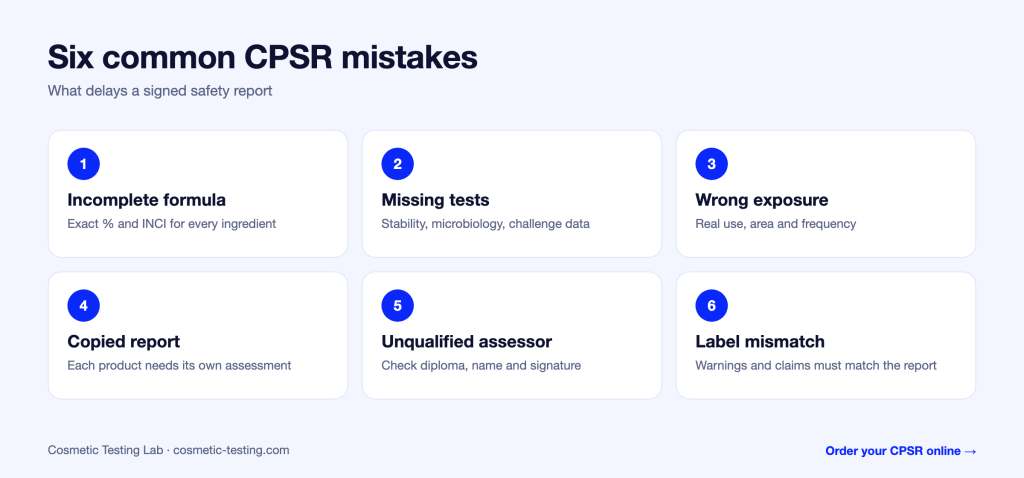
The most common CPSR mistakes are incomplete formula data, missing stability, microbiological or challenge test results, unrealistic exposure assumptions, a report copied from a similar product, an assessor who is not qualified or a report that does not match the label, packaging or claims. Each of them can stop the assessor from signing, or makes the report weak in an inspection. Preparing complete, consistent data before you submit is the fastest way to a signed CPSR. With complete data, our qualified safety assessor typically needs about ten business days.
What does a CPSR have to contain?
Under Annex I of Regulation (EC) No 1223/2009, the report has two parts. Part A collects the safety information: the quantitative and qualitative composition, physical and chemical properties and stability, microbiological quality, impurities, traces and packaging information, normal and foreseeable use, exposure, toxicological profile of the substances, undesirable effects and information on the product. Part B is the safety assessment: the assessment conclusion, the labelled warnings and instructions, the reasoning and the assessor’s credentials. Almost every mistake below is a problem in Part A that then blocks Part B.
Read also How Much Does a CPSR Cost in 2026? Price Factors Explained
Mistake 1: an incomplete or inaccurate formula
The assessor needs every ingredient with its exact percentage, its INCI name and its function, including the components of a fragrance, colourant or preservative blend. Typical problems are a supplier blend listed as one line, rounded or missing percentages, ingredients added late and not in the sheet, and different versions of the formula in circulation. If the formula in the report is not the one that is actually made, the whole assessment is void. Lock one version, give it a number and send the same version to everybody.
Mistake 2: missing supplier documents
Safety assessors rely on raw material specifications, safety data sheets, certificates of analysis and impurity information. A fragrance without allergen declaration, a botanical extract without solvent data or a colourant without purity specification stops the work. Collect these documents from suppliers early, and ask for the current version. If a supplier does not provide the data, change the supplier.
Mistake 3: no stability, microbiology or challenge test data
The report must describe the physical and chemical stability and the microbiological quality of the finished product. A report without data is difficult to defend. A stability and compatibility test gives shelf life, period-after-opening support and packaging compatibility. A microbiological specifications test shows the quality of the finished product. For water-based products, a challenge test shows that the preservation system works. Order these in parallel with the report, not after it, because the tests take time. If you only start them when the assessor asks, the launch moves by weeks.
Read also What Is a CPSR? Cosmetic Product Safety Report Explained
Mistake 4: wrong product category or exposure
Exposure calculations depend on the product type, the amount used, the frequency, the area of skin and the retention time. Declaring a leave-on face cream as a wash-off product, or ignoring that a product will be used around the eyes, on children or in a spray form, gives an unrealistic margin of safety. Describe the real use in plain words: who uses it, how, where on the body and how often. The assessor takes it from there using the recognised exposure parameters.
Mistake 5: copying a CPSR from another product
A report built from a template or from a similar product is tempting, especially for a product line. It fails when small differences matter: a different preservative level, another fragrance, a different pH or other packaging. Every product needs its own assessment. Product families can share data, but the assessor has to document why the shared data applies. Copy-and-paste text that mentions an ingredient not in your formula is an easy mistake for an inspector to find.
Mistake 6: an unqualified or unnamed assessor
Part B must be signed by a person with the qualifications required by the regulation, typically a university degree in pharmacy, toxicology, medicine or a similar discipline. The report needs the assessor’s name and address, proof of qualification and the date and signature. Reports signed by the brand owner without the right diploma, or without a clear signature, are not valid. Check credentials before you buy.

Read also SDS vs CPSR: Which One Do You Need?
Mistake 7: mismatch with the label and claims
The warnings, instructions and period after opening in the report have to match the label. If the assessor requires “avoid contact with eyes” and the label does not say so, you must print it. The same goes for claims such as “suitable for sensitive skin” or “hypoallergenic”: they need support in the product file, such as a patch test, and cannot be added after the assessment. Send the final label text to the assessor before printing, not after.
Mistake 8: forgetting about changes later
A CPSR is not a one-off. A new supplier, a formula tweak, new packaging or a new restriction in the EU annexes can make it out of date. Keep the report under version control, and trigger a review whenever the formula, packaging or law changes. See our article on when to update a CPSR for the detail.
Mistake 9: starting too late
Many brands think of the CPSR only when the packaging is ready. The report then becomes the bottleneck, because tests have to run, supplier documents have to be chased and the label may need changes. Plan the safety assessment as part of development: freeze the formula, order the tests and brief the assessor while the packaging is still in design. A short call at concept stage often saves weeks, and it allows the assessor to flag a problem ingredient while it is still cheap to replace.
A quick pre-submission checklist
- One locked formula with exact percentages and INCI names.
- Supplier specifications, safety data sheets and certificates for every raw material.
- Stability, microbiological and, where relevant, challenge test reports.
- Real use description, target group and body area.
- Packaging specification.
- Draft label with warnings, claims and period after opening.
- Complaints and undesirable effects data, if the product is already on the market.
When this set is complete, a CPSR with Part A and Part B is straightforward, and the signed report can go into your product information file.
Frequently asked questions
How long does a CPSR take?
Our signed CPSR usually takes about ten business days from the moment we have complete data. Missing data is the most common reason for delay.
Can I start the CPSR before the tests finish?
You can prepare the formula and use data, but the assessor needs the test results to finish Part A and sign Part B. Run the tests in parallel to save time.
Does a CPSR cover all products in my range?
No. Each product needs its own CPSR, although similar products may share part of the data if the assessor documents it.
Key takeaways
- Most CPSR delays come from incomplete or inconsistent data, not from the assessment itself.
- Lock one formula, collect supplier documents and order the tests early.
- Send the real use description and the draft label to the assessor before printing.
- Check the assessor’s qualification and plan for updates after launch.