

A great formula can still fail because of the bottle it sits in. Cosmetic packaging compatibility is the check that the formula and its container get along: that nothing leaks out, nothing unwanted leaches in and the pack still works at the end of the shelf life. This guide explains what is tested, what can go wrong and how to choose and test packaging before you launch.
Contents
- The short answer
- Why packaging matters for safety and quality
- What can go wrong between formula and pack?
- Which formulas are most at risk?
- How is compatibility tested?
- Do the final pack and the test pack have to match?
- Choosing packaging: a practical checklist
- Packaging and the CPSR
- Packaging, preservation and microbiology
- What about refills, samples and travel sizes?
- Common mistakes
- Frequently asked questions
- Key takeaways
The short answer
Packaging compatibility testing stores the finished product in its final pack under defined conditions and checks both sides: how the formula changes, and how the packaging changes. It shows that the container does not harm the product, the product does not damage the container and the safety assessment can rely on the data. It is usually done together with stability testing, because the same samples answer both questions. In the EU, the safety report must cover the relevant characteristics of the packaging material, in particular its purity and stability, so compatibility data belongs in the product file.
Why packaging matters for safety and quality
Packaging is not just branding. It protects the formula from air, light, moisture and microbes, and it controls how much product reaches the user. Regulation (EC) No 1223/2009 requires the responsible person to document the packaging characteristics and the stability of the product as part of the safety report, and the Commission’s CPSR guidelines follow the same logic. A pack that interacts with the formula can change its safety profile, not only its looks.
Read also Airless and Pump Packaging: What Stability Tests Should Check
What can go wrong between formula and pack?
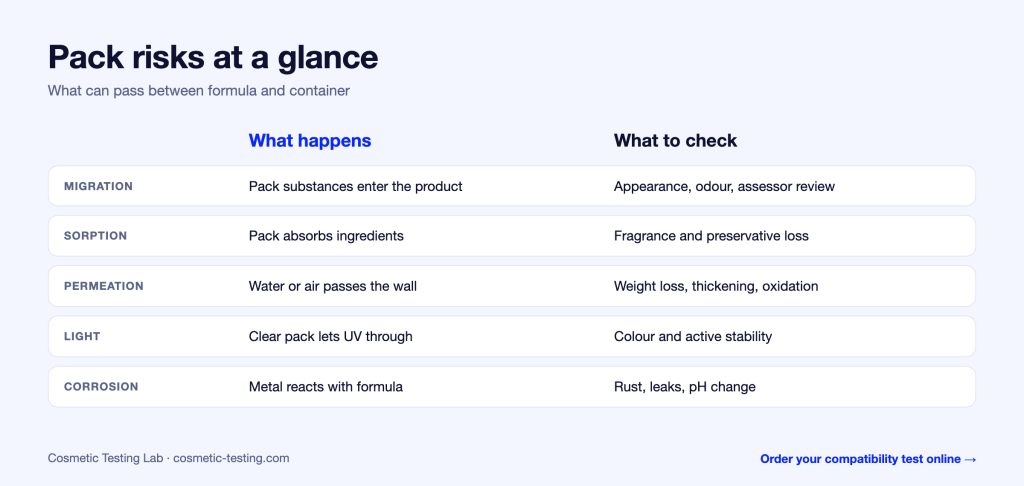
- Migration (leaching): substances such as plasticisers, residual monomers or additives move from the pack into the product.
- Sorption: the plastic absorbs ingredients, such as fragrance, preservatives or oils, from the formula. The preservative level can drop, which links directly to microbial safety.
- Permeation: water or volatile ingredients escape through the wall, so the product dries out, thickens or loses weight. Oxygen can also get in and oxidise sensitive ingredients.
- Light damage: clear packaging lets UV and visible light degrade colours, vitamins or plant extracts.
- Stress cracking and deformation: some plastics crack or soften with oils, alcohol or surfactants.
- Corrosion: metal tubes, caps and aerosol cans can react with acidic, salty or water-based formulas.
- Function failure: pumps clog, droppers leak, seals swell and labels peel or print smudges.
Which formulas are most at risk?
Any formula can interact with its pack, but some deserve extra attention: products with essential oils or strong fragrance, alcohol-based products, formulas with a low or high pH, emulsions with high oil content, products with volatile ingredients and anything with sensitive actives such as vitamin C or retinoids. A simple water-free balm in a glass jar is a lower-risk combination than a fragranced serum in a thin plastic bottle.
How is compatibility tested?
The approach follows the stability protocol. Samples of the finished product are filled in the final packaging and stored under several conditions, for example room temperature, a refrigerator and an elevated temperature, and often with a control stored in an inert container such as glass. At each time point the lab compares the pack sample with the control. Typical checks:
- Formula: appearance, colour, odour, pH and viscosity where relevant.
- Pack: deformation, leakage, cracking, discolouration, label adhesion and print quality.
- Weight loss: a simple way to see if water or volatiles escape through the wall.
- Function: pump dose, closure torque, opening and sealing.
Our stability and compatibility test combines these checks with accelerated storage plans (Basic, Standard or Full) and delivers a signed PDF report you can add to your product file.
Read also pH Testing of Cosmetics: Why pH Drift Matters for Stability
Do the final pack and the test pack have to match?
Yes. This is the most common weakness. Testing the formula in a glass jar and then launching in a plastic tube proves very little. The test pack should be the same material, the same supplier grade, the same closure and, ideally, the same filling method as the commercial pack. If you offer several sizes made of the same material, the assessor may accept the worst case, usually the smallest size with the highest surface-to-volume ratio, but this is a decision to agree in advance.
Choosing packaging: a practical checklist
- Ask your supplier for a specification sheet that states the material and the intended use.
- Match the material to the formula type: glass or suitable barrier plastics for oils and fragrance, airless pumps for oxygen-sensitive actives, opaque packaging for light-sensitive products.
- Check closures and liners, not just the bottle. A liner can be the weakest link.
- Think about the whole life of the product: shipping, hot warehouses and bathroom shelves.
- Buy a small run first and test before ordering large quantities.

Packaging and the CPSR
The CPSR is signed by a qualified safety assessor, and Part A asks for the relevant characteristics of the packaging material. The assessor will want to see that nothing from the pack reaches the user in a harmful amount and that the stability data were generated in the final pack. Compatibility results make that conclusion easy to support. Without them, the assessor may ask for more data and the report is delayed. We issue the CPSR in about 10 business days after we have complete data.
Read also Natural Cosmetics Stability: Special Challenges and Solutions
Packaging, preservation and microbiology
The pack is also part of your preservation system. A pump or airless dispenser limits contamination during use, while a wide-mouth jar invites fingers. Sorption into plastic can lower the effective preservative level. For water-based products, a challenge test is done in the product as it will be sold, and the microbiological specifications test checks the quality of the finished product. Together with compatibility data they make a consistent picture.
What about refills, samples and travel sizes?
Each format is its own formula-and-pack combination. A refill pouch, a sachet and a travel-size tube may use different materials from your hero product, and small units lose water faster because of their larger surface relative to the content. If you plan to sell the same formula in several formats, list them early and let the assessor decide which ones are covered by a worst-case sample and which need their own data.
Common mistakes
- Testing in a sample jar instead of the commercial pack.
- Changing the bottle supplier, the resin or the liner after the test.
- Checking only the formula and ignoring the pack and its function.
- Forgetting that decoration, labels and inks can also react with the product.
- Assuming a pack used by a competitor is safe for your formula.
Frequently asked questions
Is packaging compatibility testing required by law?
The regulation requires the safety report to consider the packaging material and the stability of the product. It does not name a specific test, but compatibility data in the final pack is the usual way to show it.
Do I need to retest if I change the packaging?
Usually yes, at least in a reduced form. A new material, supplier, resin grade or closure can change migration, sorption and permeation, so talk to your assessor about the scope.
Is glass always the safest choice?
Glass is chemically very stable and a good reference, but it is not always the best option. It can break, it lets light through unless tinted and some glass types release alkali into water-based formulas. Test the pack you really intend to use.
Key takeaways
- Compatibility testing checks the formula and the pack together, in the final packaging.
- Typical risks are migration, sorption, permeation, light damage and functional failure.
- Packaging data belongs in the safety report and the product file.
- Any later change of material, supplier or closure should trigger a review.