

Brands often search for cosmetic testing prices in Europe hoping for a single table of typical ranges. A fair answer is more useful than a table: what you pay depends on a handful of factors you can see in advance and, to a large extent, control. This guide explains what drives the cost of cosmetic testing, why two similar products can need very different programmes, and how to plan a budget without surprises. It contains no price figures, because current prices are shown on the website when you order.
Contents
- The short answer
- Factor 1: formula complexity
- Factor 2: which tests the product needs
- Factor 3: depth of the stability plan
- Factor 4: standards and options
- Factor 5: number of products and variants
- Factor 6: repetition
- What is usually not a big driver
- Two products, two programmes
- How to estimate your own budget
- Why the cheapest-looking option can cost more
- Ways to keep the programme efficient
- Frequently asked questions
- Key takeaways
The short answer
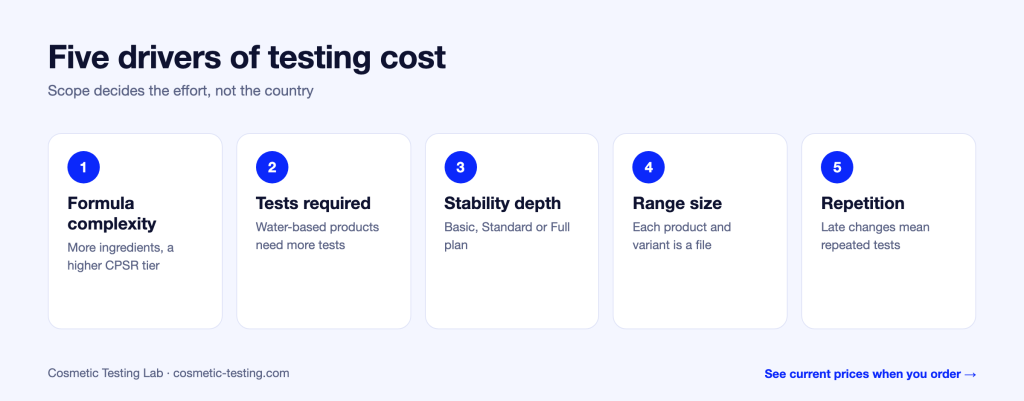
The cost of testing follows scope, not geography: how complex the formula is, which tests it needs, how deep the stability plan goes, how many variants you have and how many times you need to repeat work. A simple anhydrous balm and a fragranced water-based serum are both “a cosmetic”, yet they sit at opposite ends of the effort scale. If you know the six factors below, you can estimate where your product sits before you ask anyone for a quote.
Factor 1: formula complexity
The more ingredients a formula contains, the more the safety assessor has to review. Each ingredient needs its toxicological profile, concentration, function and exposure to be evaluated, and combinations must be considered together. That is why the CPSR comes in three tiers: Simple (up to 10 ingredients), Standard (11–25) and Complex (26 or more, or a fragrance). A fragrance counts as complex because it is itself a mixture of many components, some of which are regulated allergens.
Read also Cosmetic Testing Lab in Europe: A Guide for Non-EU Brands
Factor 2: which tests the product needs
The test list follows the product type, not your preference. Water-containing products normally need a challenge test, a microbiological specifications test and a stability and compatibility test to complete the CPSR. Anhydrous products may need fewer. Leaving out a test that your assessor expects does not save money; it delays the file and tends to cost more when the data are requested later.
Factor 3: depth of the stability plan
Stability testing is where scope varies most. Accelerated plans come as Basic, Standard or Full, and the difference is how many conditions, time points and checks are included. A Basic plan gives an early read for development. A Standard plan suits most launches. A Full plan gives the widest coverage and suits high-risk products or complex packaging. Choosing the right plan for the real risk avoids both over-testing and a thin file.
Factor 4: standards and options
Some tests offer a choice. The challenge test can follow ISO 11930:2019 or USP 51, five reference microorganisms over 28 days. A market that asks for a specific method may require you to select it, and ordering two methods for the same product naturally multiplies the work. Ask your safety assessor and your retail customers which standard they expect before you order.
Read also Cosmetic Compliance Cost for a New Brand: What Drives It
Factor 5: number of products and variants
Every product in a range is its own file. Variants that differ only in colour or scent may be able to share some data, but only if your safety assessor justifies it in writing. Range size, pack formats and the number of batches you test all enter the calculation. A sensible approach is to test a representative lead product thoroughly, and then ask the assessor which variants can reuse its evidence.
Factor 6: repetition
This is the factor brands underestimate. Changing the formula after testing usually means repeating the affected tests. A failed challenge test means adjusting the preservative system and testing again. A sample sent in the wrong pack may not match the pack you sell. Every repetition is avoidable cost, and most come from decisions made too early or too late.
A simple habit helps: keep a change log with the date, what changed and which tests the change touches. Before you alter a formula, a preservative or a packaging supplier, ask whether the change affects an existing report. A new pump supplier can matter for compatibility, while a different batch size usually does not, but your assessor has the final word.
What is usually not a big driver
- Sample logistics. Sample collection from your door by DHL is free, so shipping itself is not a line in your budget.
- Report format. Every test ends in a signed PDF report, so you do not pay extra for a version you can file.
- Company size. The scope of the work sets the effort, not how big the brand is.

Read also Advantages of testing cosmetics with us
Two products, two programmes
Take a solid shampoo bar with eight ingredients and no fragrance. It is nearly anhydrous, so the programme is a Simple CPSR, a stability test and a microbiological test, with a risk assessment that your assessor may accept in place of a challenge test. Now take a fragranced face serum with 22 ingredients in a pump bottle. It is water-based, so it needs a challenge test, a microbiological test, a Standard or Full stability plan to check the pump, and a Complex CPSR because of the fragrance. Both are cosmetics sold in the same market, yet the scope is very different, and so is the cost.
How to estimate your own budget
- List the products you plan to launch and mark which are water-based.
- Count the ingredients in each formula, and note any fragrance. This gives the CPSR tier.
- Pick the tests from the product type, and confirm the list with your assessor.
- Choose the stability plan that matches the risk and the pack.
- Add a buffer for one repeat on your most complex product, in case reformulating is needed.
- Check the current prices on the website, and use the account discount wording below if it applies: create a free account to unlock 10% off your first order and 20% on bundles.
Why the cheapest-looking option can cost more
A low entry cost can hide an incomplete scope. A report that does not follow a recognised standard may be rejected by your assessor. A stability plan that is too short may not support the shelf life you print. A CPSR written on missing data may be returned. When comparing providers, compare what the result is allowed to be used for: a signed report you can place in the PIF, a standard your assessor accepts, and a complete file the first time.
Ways to keep the programme efficient
- Finalise formula and packaging before you order anything.
- Order related tests together, with CPSR to follow, so samples travel once.
- Start stability testing early, because it takes the longest.
- Test one batch and keep it traceable.
- Ask your assessor early which data they will need, and which variants can share evidence.
Frequently asked questions
Why are there no price figures in this article?
Prices change, and the correct number depends on the product, the tier and the plan you pick. The website shows the current figures at the moment you order.
Does a bigger company pay more?
No. The scope of the work sets the effort, not the size of the company. A small brand with a simple balm needs less work than a large brand with a fragranced serum.
Can I cut the cost by skipping the challenge test?
Not safely for water-containing products. In some low-risk cases a documented risk assessment can replace it, but your safety assessor must make that decision.
Key takeaways
- Testing cost follows scope: ingredients, tests, stability depth, variants and repetition.
- CPSR tiers are Simple, Standard and Complex; a fragrance means Complex.
- The best savings come from finalising the formula early and avoiding repeats.
- DHL pickup is free, and every test ends in a signed PDF report.