

“What will it cost to make my product legal?” is usually the first question a new founder asks, and the honest answer is that cosmetic compliance cost depends on how many products you launch, how complex each formula is and how much of the paperwork you buy in. This guide lists every cost block a new brand meets, explains what drives each one and shows where you can plan and save without cutting corners. We do not quote prices here; the aim is to help you budget with confidence.
Contents
- The short answer
- Block 1: The Cosmetic Product Safety Report
- Block 2: Laboratory tests
- Block 3: Responsible person and notification
- Block 4: Labels, claims and ingredient checks
- Block 5: Your own time and the cost of changes
- What drives the cost up
- What helps keep it down
- Budgeting for a first launch
- Do bundles help?
- How the timeline affects cost
- Example: two ways to launch three products
- Common budgeting mistakes
- Frequently asked questions
- Key takeaways
The short answer
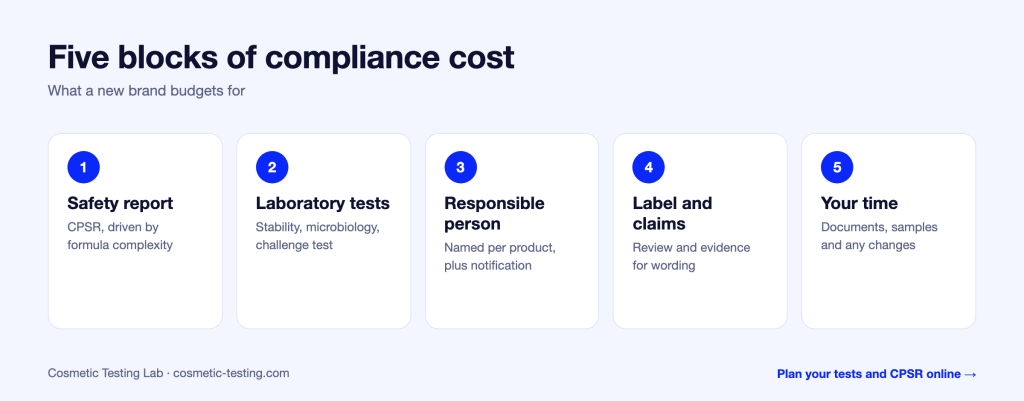
For a new brand, compliance cost is the sum of five blocks: the safety report (CPSR), the laboratory tests that feed it, a responsible person and notification, label and claim checks, and the time you spend managing it all. The biggest swing factors are the number of formulas, the complexity of each formula (ingredient count, fragrance, preservative system) and whether data are ready when you order. Most of the cost is per formula, not per brand, so a tight range is cheaper than a large one.
Block 1: The Cosmetic Product Safety Report
Every cosmetic placed on the EU market needs a signed safety assessment. The CPSR is prepared by a qualified safety assessor and has two parts: Part A with the product information and Part B with the assessment itself. Its cost is driven mainly by formula complexity. A short formula with a handful of well-known ingredients takes the assessor less time than a long formula with many actives, botanical extracts or a fragrance, because each ingredient needs its own toxicological review and exposure calculation. Product type matters as well: a leave-on face product, a rinse-off cleanser and a product for children or for use near the eyes are assessed differently.
Read also Influencer Beauty Brand Compliance: The Basics
Block 2: Laboratory tests
The assessor relies on test data, and tests are the next large block. The usual set for a new water-based product is a stability and compatibility test, a microbiological specifications test and a challenge test. Skin-compatibility testing is added when you want claims such as “dermatologically tested”. What changes the cost: the number of products and variants, the length of the stability plan (basic, standard or full), the number of storage conditions and whether you test several pack types.
Block 3: Responsible person and notification
An EU-based responsible person must be named for each product, and the product must be notified in the CPNP before launch. If you are established in the EU, you can act as the responsible person yourself, provided you can keep the product information file and answer authorities. If you are outside the EU, you need an EU representative who accepts that role, and the service is usually priced per product or per portfolio. Selling in the UK adds a UK responsible person and a separate notification.
Block 4: Labels, claims and ingredient checks
A label review checks the ingredient list, allergens, warnings, period after opening and the mandatory details. Claims need evidence that matches the wording. This block is usually small in money terms but expensive when it is skipped: a reprint of labels or a withdrawn product costs far more than a review. Ingredient checks against the annexes of the regulation should be repeated whenever the lists are amended.
Read also How to Start a Cosmetic Brand in Europe: Complete Guide
Block 5: Your own time and the cost of changes
New brands often forget this one. Collecting supplier documents, sending samples, answering the assessor and building the product information file take hours. Every change of formula or packaging after testing can trigger a repeat of tests and an update to the CPSR. A single late change can cost more than the first complete round of testing.
What drives the cost up
- Many similar variants that are not grouped sensibly.
- Formulas with fragrances, many botanical extracts or nanomaterials.
- Reformulation after a failed challenge test.
- Rush requests and incomplete data that need repeated questions.
- Test samples in a pack that differs from the final one.
What helps keep it down
- Fix the formula and packaging before you order.
- Order tests together and start them in parallel, so the assessor receives everything at once.
- Use a base formula with small variations (such as colour or scent) and ask the assessor how to group them.
- Ask suppliers for complete documentation up front.
- Choose preservation and packaging that already work in similar products.

Read also Cosmetic Gift Sets and Kits: Compliance Rules
Budgeting for a first launch
A practical way to plan is to build a simple table with one row per product and one column per block. Fill each cell with a quote, not an estimate, and add a contingency for one round of changes. Treat compliance as part of the product cost, like the packaging, and not as an extra at the end. Brands that put it in the plan early rarely face surprises; brands that discover it after printing labels usually pay twice.
Do bundles help?
If you need several documents at once, ordering them together saves effort and often money, because the tests and the CPSR are coordinated and the data arrive complete. As always with regulatory documents, you decide what you need; we do not give legal advice, and your responsible person remains accountable for the final file.
How the timeline affects cost
Time is a cost that does not appear on an invoice. A challenge test takes 28 days, a stability plan runs for weeks or months, and the CPSR is usually ready about 10 business days after the assessor has complete data. If you order these one after another, the launch moves back by the sum of the waiting times, and the stock you already produced sits in a warehouse. Ordering in parallel shortens the path to the longest single item. It is also wise to agree the launch date only after the formula is final and the samples are on their way to the laboratory, because every promise made to a retailer before that point is a risk you carry.
Example: two ways to launch three products
Imagine a brand with a cleanser, a day cream and a serum. In the first approach, the founder tests the cleanser, waits for the result, then repeats the process for the others, changes the serum preservative after a failed challenge test and updates the paperwork twice. In the second, the founder fixes all three formulas, sends all samples at once, receives the three test sets together and orders three CPSRs in one step. The products and the rules are identical, but the second path uses fewer assessor hours, avoids repeated questions and reaches the market sooner. The difference comes from planning, not from any shortcut in safety.
Common budgeting mistakes
- Budgeting per brand when most costs are per formula.
- Counting only the CPSR and forgetting the tests behind it.
- Leaving the responsible person role until the week of launch.
- Ignoring the timeline: cash locked in stock while waiting for documents is a cost too.
- Assuming a reference formula from a manufacturer is already assessed for your brand.
Frequently asked questions
Can I skip the CPSR to save money?
No. A safety assessment is a legal requirement for every cosmetic product placed on the EU market, whatever the size of the brand or the batch.
Is compliance cheaper for handmade or tiny brands?
The legal requirements are the same. Costs are lower mainly because such brands often have a short, simple formula and few products, not because the rules are lighter.
When should I ask for a quote?
As soon as the formula is final. Quotes based on a complete ingredient list are more accurate and avoid surprises when the assessor reviews the actual formula.
Key takeaways
- Compliance cost has five blocks: CPSR, tests, responsible person and notification, label and claims, and your own time.
- Formula complexity and the number of products are the biggest drivers.
- Late changes and failed tests are the most expensive surprises.
- Order tests together, with complete data, to keep the process short.