

If you run a small skincare label, a soap kitchen or a beauty startup, testing can feel like something designed for big companies with big budgets. It is not, but it does need a plan. This guide explains cosmetic testing for small businesses: which tests the law expects, which you can usually skip, and how to organise the work so you launch without wasted rounds. The direct answer: EU law has no exemption for small or handmade brands, so every product needs a signed safety report backed by test data; what you can control is the order, scope and timing of that testing.
Contents
- The short answer
- Does the law treat small brands differently?
- Which tests a typical small brand needs
- Typical test plans by product type
- What you usually do not need
- The order of work that saves time
- Ways to keep testing lean without cutting corners
- What to prepare before you order
- Mistakes that cost small brands time
- Working with a lab as a small business
- A realistic timeline
- Frequently asked questions
- Key takeaways
The short answer
Before you sell a cosmetic in the EU, a qualified safety assessor must sign a Cosmetic Product Safety Report (CPSR) for it. For most products, the assessor needs stability and packaging compatibility data, a microbiological quality test of the finished product and, for water-based formulas, a preservation efficacy (challenge) test. Clinical or efficacy studies are only needed for specific claims, and animal testing is banned. Freeze your formula and packaging first, then test in parallel, and you will reach the CPSR faster and with fewer repeats.
Does the law treat small brands differently?
No. Regulation (EC) No 1223/2009 applies to every cosmetic placed on the EU market, whether it is made in a factory or a home workshop, sold in thousands or in dozens, through a retailer, a website or a craft market. The obligations are the same: a responsible person, a safety assessment, a product information file, a CPNP notification and a compliant label. The amount of work does depend on the product, though. A simple balm with a handful of ingredients is easier to assess than a complex fragranced emulsion. Market surveillance authorities can check any seller, including small online shops and market stalls, so being small is not a reason to skip the file.
Read also Do Handmade and Small-Batch Cosmetics Need a CPSR?
Which tests a typical small brand needs
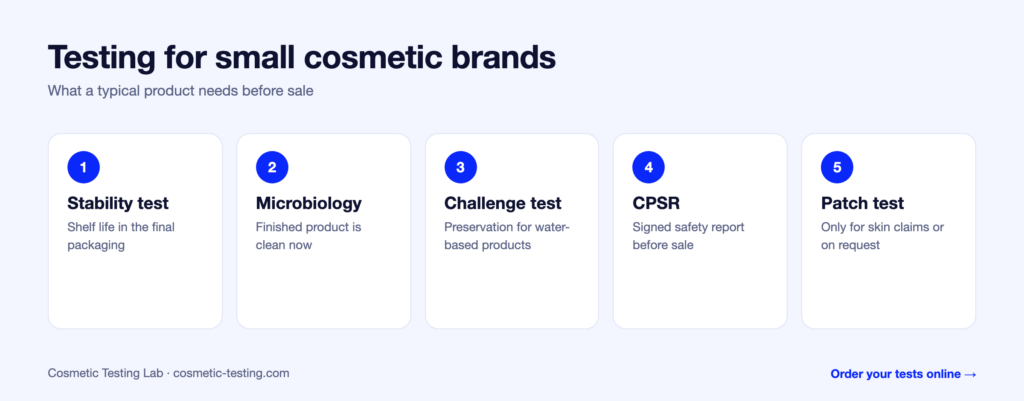
- Stability and compatibility test: shows the product stays stable in its packaging and supports the shelf life or period after opening on the label.
- Microbiological specifications test: checks that the finished product is clean now, within the limits the assessor expects.
- Challenge test: shows the preservative system protects water-containing products against contamination during use.
- CPSR: the safety assessor’s report, which brings the data together and concludes whether the product is safe.
Low-risk products, such as some anhydrous oils and balms, may not need a challenge test if the safety assessor documents why. Do not assume this; ask before you order.
Typical test plans by product type
- Face cream, lotion or serum with water: stability, microbiology and challenge test.
- Shampoo, shower gel or liquid soap: the same three, because these products contain water and are used in wet bathrooms.
- Anhydrous balm, body oil or lip balm: stability and microbiology; a challenge test only if the assessor asks for it.
- Products for children or the eye area: the same basics, with extra care in the safety assessment.
These are typical starting points, not rules. The safety assessor makes the final call for each formula.
What you usually do not need
- Clinical or efficacy studies, unless you make claims such as “reduces wrinkles by” a measured amount. Claims need evidence that matches their wording, so modest claims keep costs down.
- Animal testing. It is banned for cosmetics in the EU, and no reputable assessor will ask for it.
- A patch test for every product. It is not a general legal requirement, but it is useful when you plan claims such as “dermatologically tested” or “for sensitive skin”, or when the assessor asks for it.
- An ISO 22716 certificate. Good manufacturing practice is required, but formal certification is not mandatory. You must still be able to show how you work.
Read also Launching a Product Line: How to Plan Tests for Many Products
The order of work that saves time
- Finalise the formula and get documentation for every raw material from your suppliers.
- Choose the final packaging, because stability results only apply to the packaging tested.
- Make a representative batch.
- Start stability, microbiological and challenge testing at the same time.
- Send the results and the formula to the safety assessor for the CPSR.
- Finish the label, build the PIF and notify in the CPNP.
Ways to keep testing lean without cutting corners
- Launch fewer products first. Three well-documented products earn more trust and revenue than ten half-finished ones.
- Build variants on one base. Shades or scents built on the same base formula may share some data, but only the safety assessor can decide which results cover which variant. Ask before you order.
- Do not change the formula after testing. Even a small change, such as a new fragrance or preservative, can mean repeating tests.
- Keep claims modest. Every extra claim needs extra evidence.
- Order tests together. Create a free account to unlock 10% off your first order and 20% on bundles.

What to prepare before you order
- The final ingredient list with INCI names and percentages for the safety assessor.
- Supplier documents for each raw material, such as specifications and safety data.
- Samples in the final packaging, from a representative batch.
- The label text and planned claims, so the assessor can check them.
Read also How to Choose a Cosmetic Contract Manufacturer
Mistakes that cost small brands time
- Testing in a sample jar, then launching in a different pump bottle.
- Sending too little sample, so the lab has to ask for more.
- Relying on a supplier’s “pre-tested base” after adding your own actives or fragrance.
- Missing raw material documents, which delay the CPSR even when all tests are done.
- Adding claims to the website after the safety assessment was signed.
Working with a lab as a small business
You do not need your own laboratory or a large order. With us, you order online, we collect your samples from your door with free DHL pickup, and you receive signed PDF reports that your safety assessor can use in the CPSR and PIF. As a guide, the microbiological specifications test takes about five days after we receive samples, the challenge test runs for 28 days, the patch test takes about two weeks in total, and the CPSR is ready about ten business days after we have complete data. Stability testing uses accelerated plans, so its duration depends on the plan you choose.
A realistic timeline
Because the tests run in parallel, the challenge test and the stability plan usually set the pace. Once the results are in, allow time for the CPSR, then for the label, PIF and notification. Many small brands plan a few months from frozen formula to first sale. Starting the tests the week your formula and packaging are final is the single biggest time saver.
Frequently asked questions
Can I sell at markets or to friends before the tests are done?
No. Selling or giving away cosmetics in the course of a business counts as making them available, and the CPSR must be in place first.
Can one test cover several scents?
Sometimes. If the variants share the same base and differ only slightly, the safety assessor may accept shared data. The decision is theirs.
Which test should I order first?
Start stability, microbiology and, for water-based products, the challenge test together, as soon as the formula and packaging are final.
Key takeaways
- Small and handmade brands follow the same EU rules as large companies.
- Most products need stability, microbiological and, if water-based, challenge test data for the CPSR.
- Freeze formula and packaging first, then test in parallel.
- Fewer products and modest claims keep testing lean.