

Launching one product is a project. Launching ten or thirty at once is a logistics problem, and cosmetic product line testing can easily become the slowest and most expensive part of the plan if you treat every item as a separate start. This guide shows how to plan tests for a whole range: how to group products, what can sensibly be shared, what cannot, and how to sequence samples so that your launch date holds.
Contents
- The short answer
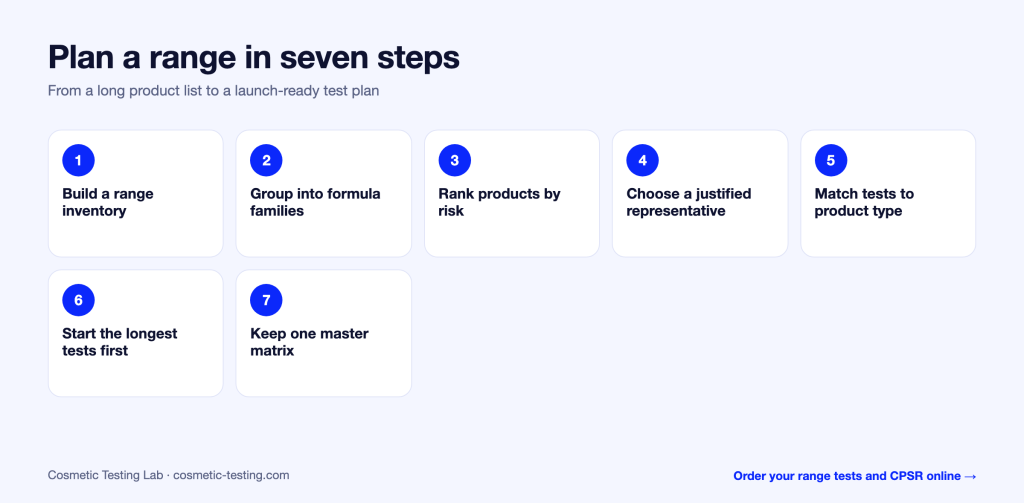
- Step 1: Build a range inventory
- Step 2: Group products into formula families
- What can be shared inside a family, and what cannot
- Step 3: Rank by risk
- Step 4: Choose the tests for each product type
- Step 5: Sequence by lead time
- Freeze the formula before you test
- Packaging: test the pack you will sell
- Keep one master matrix
- Adding products later
- Common mistakes with product ranges
- Frequently asked questions
- Key takeaways
The short answer
Plan a range by grouping your products into formula families, ranking them by risk, testing a justified representative of each family, and ordering the long tests first. Every product still needs its own notification, product information file and CPSR, so the saving does not come from skipping paperwork but from reusing data where your safety assessor agrees it is scientifically sound. Never assume that one test covers a whole line; confirm what can be shared before you order.
Step 1: Build a range inventory
Start with one spreadsheet, one row per product, as it will be sold. Columns that matter:
- Product name and the version of the formula.
- Product type (cream, serum, shampoo, balm, powder, spray).
- Water content and the preservation system.
- Fragrance, colourants and active ingredients.
- Packaging type, material and fill size.
- Target user (adults, children, sensitive skin) and area of use (face, eye area, hair).
- Claims you plan to make.
- Markets and label languages.
This one table drives every later decision. It also reveals that a range of twenty products is often really six or eight different formulas.
Read also Cosmetic Testing for Small Business and Startups: A Lean Plan
Step 2: Group products into formula families
A formula family is a set of products built on the same base, where the differences are small: a different fragrance, a different shade or a slightly different active. Typical families are a moisturiser with three scents, a shampoo base in four variants, or a liquid foundation in many shades. Group them and mark what changes inside each family. The more the differences touch preservation, the skin or the pack, the less you can share.
What can be shared inside a family, and what cannot
This is where the saving is, and where the risk is. As a general rule, and always subject to your safety assessor’s judgement:
- Often shareable: raw-material documentation, the manufacturing process and GMP records, the base-formula safety data and, where justified, a challenge test on the most demanding member of the family.
- Usually product-specific: the exact ingredient list and concentrations, the safety assessment of any change in fragrance or colourants, label warnings, claims and the notification itself.
- Depends on the change: the microbiological quality, stability and preservation evidence. A fragrance can alter preservation, and a pigment can change viscosity or stability, so the difference must be assessed rather than assumed away.
Standards such as ISO 11930 do not give an automatic rule for grouping. The decision to accept a representative sample is a documented judgement, and some assessors will ask for more than one test in a family. Settle this before you order.
Step 3: Rank by risk
Not all products need the same effort first. Rank them to decide what goes to the lab first:
- Water-based, leave-on and sensitive-area products (face, eye area, baby): highest priority.
- Products with new or unusual actives, strong claims or a reduced preservation system.
- Rinse-off products with robust preservation.
- Anhydrous products such as oils, balms and powders, where the main questions are stability and microbiological quality.
High-risk products are the ones most likely to need reformulation, and an early failure is far cheaper than one found after printing and filling.
Read also How to Choose a Cosmetic Contract Manufacturer
Step 4: Choose the tests for each product type
As a rough guide, which usually means that your assessor makes the final call:
- Water-containing creams, lotions, serums, shampoos: challenge test, microbiological specifications test and stability test.
- Anhydrous products and powders: stability and microbiological quality; a documented risk assessment may replace the challenge test for low-risk formulas.
- Products with skin-related claims or for sensitive users: consider a patch test to support the safety assessment and the claims.
- Every product: a CPSR signed by a qualified assessor, using the data above.

Step 5: Sequence by lead time
Work backwards from your launch date using the longest steps:
- Stability and compatibility take the longest, because they run accelerated ageing in the final pack.
- Challenge test: 28 days of incubation.
- Patch test: about two weeks in total.
- Microbiological specifications: about 5 days after we receive the samples.
- CPSR: about 10 business days after complete data.
Because the CPSR needs the test results, it sits at the end of the chain. Send samples in waves: high-risk families first, then the rest, so the lab and the assessor work in parallel instead of in a queue. Create a free account to unlock 10% off your first order and 20% on bundles.
Freeze the formula before you test
A test result belongs to the exact formula and pack that were tested. If marketing changes the fragrance after the challenge test, or the supplier changes a raw material, the evidence may no longer apply. Agree a formula freeze for each family before samples leave your premises, and send samples from a representative production or pilot batch, not a one-off bench prototype.
Read also Dropshipping Cosmetics in the EU: Legal Pitfalls
Packaging: test the pack you will sell
If the same formula goes into a glass jar, a tube and a pump bottle, the pack is a variable. Materials can absorb preservatives or fragrance, release substances or let oxygen in. Plan stability and compatibility per pack type, and note that a new fill size in the same material usually raises fewer questions than a new material. Your assessor will tell you how far a result can be extended.
Keep one master matrix
Add columns to your inventory for each test and document: sample sent, report received, CPSR status, notification status and label approved. Use the same product names and formula versions in the lab orders, the CPSR, the CPNP notification and the artwork, because mismatched names are one of the most common causes of delay.
Adding products later
Ranges grow. When you add a new variant in a year, a well-kept matrix lets you see at once which family it belongs to, which reports already exist and what needs to be repeated. Keep the original formula versions, batch records and reports in one place. If the new product differs only in a point your assessor has already evaluated, the extra work can be small. If it changes the preservation system, the pack or the target user, treat it as new and plan the tests from the start.
Common mistakes with product ranges
- Assuming one report covers every variant without asking the assessor.
- Changing fragrance or shade late after the data was generated.
- Testing prototypes that differ from the production formula.
- Ordering everything at the last minute, so that the longest tests set the launch date by accident.
- Forgetting label languages and warnings for each market until the end.
Frequently asked questions
Can I use one CPSR for several products?
Each product needs its own safety assessment. Closely related variants can often be documented efficiently, but that is for your responsible person and assessor to decide.
Do shades of the same make-up need separate tests?
Not always. It depends on whether the colourants change the safety profile or the stability. Ask your assessor to define the shades covered by each test.
Should I launch the whole range together?
You can, but a staged launch, with the highest-priority families first, reduces the risk and spreads the workload.
Key takeaways
- Group products into formula families and test a justified representative where your assessor agrees.
- Rank by risk and send high-risk families to the lab first.
- Start the longest tests first and freeze each formula before testing.
- Keep one matrix so that names, versions and statuses match across all documents.