
A cream can pass every lab test on the shelf and still arrive at the customer cracked, leaking or separated. A cosmetic transport stability test checks whether your product and its packaging survive the journey from your warehouse to the customer’s door. This guide explains what shipping does to a formula, which tests are used and how to document the result in your safety file.
Contents
- The short answer
- What does shipping do to a cosmetic product?
- What can go wrong?
- Is a transport test required by law?
- Which tests simulate shipping?
- What should you check after the test?
- Packaging choices that help
- Formulas that need extra attention
- Do you need to repeat the test if packaging changes?
- How to document transport testing in the PIF
- A worked example
- Common mistakes
- Frequently asked questions
- Key takeaways
The short answer
Yes, you should check how your product behaves in transport, but the EU Cosmetics Regulation does not prescribe a specific “shipping test”. Your product must be safe and of consistent quality under normal conditions, and distribution is part of its life. In practice, brands combine a stability and compatibility test (temperature extremes, packaging contact) with a physical shipping simulation (vibration, drops, compression) and then review the result with their safety assessor.
What does shipping do to a cosmetic product?
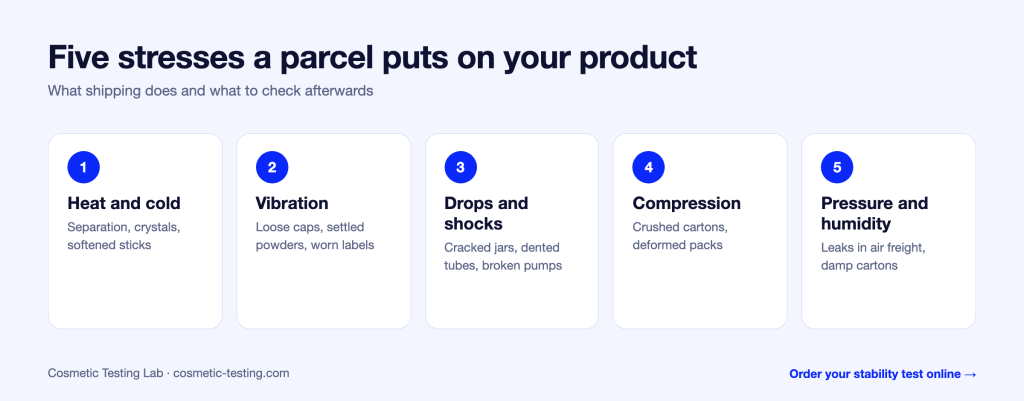
A parcel is rarely treated gently. Between your packing table and the customer it may be loaded, dropped, stacked, vibrated for hours and stored in vehicles or depots with no climate control. Typical stresses are:
- Temperature swings. A parcel van or a container in summer can get much hotter than a stock room, and winter loads can freeze.
- Vibration. Hours of road vibration can loosen caps, settle powders, separate emulsions and abrade labels.
- Shock and drops. Impacts during sorting can crack jars, dent tubes and break pumps.
- Compression. Boxes at the bottom of a stack carry the weight of everything above.
- Pressure changes. Air freight can push liquid out of containers that are not designed to equalise.
- Humidity. Damp conditions can affect cartons, labels and some powders.
Read also Natural Cosmetics Stability: Special Challenges and Solutions
What can go wrong?
The damage is not always visible at first. Watch for these failures:
- Leakage through the closure, pump or tube seal, which also contaminates other items in the box.
- Emulsion separation, grittiness, crystals or a change in viscosity after heat or freezing.
- Colour, odour or texture changes that customers read as “spoiled”.
- Pumps that clog or airless systems that stop dispensing.
- Broken seals or tamper-evident features that make the product look used.
- Label damage that removes mandatory information such as the ingredient list or batch number.
Some of these are cosmetic complaints; others are real quality or safety issues, for example a leaking closure that lets microorganisms in.
Is a transport test required by law?
Not as a named requirement. Regulation (EC) No 1223/2009 requires that a cosmetic product is safe under normal or reasonably foreseeable conditions of use, and that the safety report considers the stability of the finished product and the packaging. Good manufacturing practice under ISO 22716 also addresses storage and distribution of finished goods, which is why many assessors expect a brand to show that it has thought about distribution. If you ship worldwide, the climate you must plan for is wider than if you only sell locally.
Which tests simulate shipping?
Two families of tests are usually combined.
1. Temperature and storage tests
These show what the formula does when conditions change. Typical elements are a period at raised temperature, a period in the cold, repeated freeze–thaw or heat–cold cycles and observation at room temperature. The samples are inspected for appearance, colour, odour, pH, viscosity, separation and packaging damage. This is the core of a stability test, and the exact plan depends on the product type and the markets you plan to serve.
2. Physical distribution tests
These simulate the mechanical hazards of the supply chain: random vibration, drops, compression and sometimes atmospheric conditioning. Packaging laboratories commonly work with published procedures from bodies such as ISTA (International Safe Transit Association), which has procedures for parcel delivery, and ASTM D4169, a general standard for testing shipping containers and systems. These procedures were written for transport packaging in general, not for cosmetics specifically, so your safety assessor decides how to interpret the result for your product.
Read also What Is Cosmetic Stability Testing? A Plain-English Guide
What should you check after the test?
A pass is not just “nothing broke”. Write down the acceptance criteria before you start and compare after the test:
- Is any product visible on the outside or in the secondary carton?
- Has the weight changed, which suggests slow leakage or evaporation?
- Do pH, viscosity and appearance still match the specification?
- Does the pump still dispense a consistent dose, and does the cap still open and close properly?
- Are the label, carton and batch code intact and legible?
- If the container was damaged, is a microbiological test on the tested sample needed to show it stayed clean?
Packaging choices that help
- Closures with a liner or induction seal for liquids and creams, and pumps with a lock position for shipping.
- Headspace. A container that is filled to the brim has no room for thermal expansion.
- Glass jars and bottles need dividers or moulded inserts; plastic is lighter but can deform in heat.
- A shipping carton that fits the product tightly, with fill that does not let the item move.
- Sealed bags around liquids inside the parcel, so a leak stays contained.

Formulas that need extra attention
Emulsions with a thin viscosity, oils with waxes that melt, lip products, sticks, natural formulas without strong stabilisers, aerosols, water-based gels and anything containing ingredients that crystallise in the cold are the usual suspects. If your formula is fragile in the cold or heat, add warning instructions for carriers or choose packaging that protects it. Aerosols and perfumes can also be subject to dangerous-goods rules when shipped, which is a separate topic from stability.
Read also Accelerated Stability Testing for Cosmetics at 40°C: How It Works
Do you need to repeat the test if packaging changes?
Usually yes, at least partly. A new bottle, closure, pump, liner, label material or carton changes how the product interacts with the pack and how well it survives shipping. Before you switch supplier, ask your assessor which checks you need to repeat. A change of the formula or the filling line should trigger the same question.
How to document transport testing in the PIF
Keep the test protocol, the conditions, the number of samples, the photos, the acceptance criteria and the signed report together. Note the packaging details (material, closure type, carton specification) and the batch tested. The conclusion on stability and packaging then feeds into Part A of the CPSR, where the safety assessor considers whether the product stays safe up to the end of its shelf life.
A worked example
A small brand sells a water-based serum in a glass bottle with a dropper, shipped by parcel service to several countries. A first summer shipment arrives with several droppers loosened and a few bottles leaking into the carton. The brand switches to a bottle with a tighter closure and a moulded tray, adds a sealed bag, and runs a temperature series plus a drop and vibration simulation on the new pack. The serum keeps its pH and viscosity, the weight loss is negligible and no bottle leaks. The signed results go into the product file and the complaint rate falls.
Common mistakes
- Testing only the product on the shelf and never the full shipping pack.
- Using packaging for the test that differs from the final pack.
- Using only one temperature condition and ignoring both heat and freezing.
- Skipping a written acceptance criterion, so the result cannot be judged.
- Assuming that a parcel service’s “fragile” sticker protects the product.
Frequently asked questions
Is a transport stability test mandatory?
There is no named legal requirement, but your product must remain safe and of good quality up to the customer, and your safety assessor will want evidence for stability and packaging. A transport element is a sensible part of that evidence.
Can I ship samples to the lab in my normal parcel?
For our tests you order online and we arrange free DHL pickup from your door. Pack the samples in their final packaging as you would send them to a customer.
How long does it take?
The timeline depends on the plan you choose. Temperature cycles can be completed within weeks, while a full shelf-life study naturally takes longer.
Key takeaways
- Shipping adds heat, cold, vibration, shocks and pressure changes your shelf tests do not show.
- There is no named legal “shipping test”, but stability and packaging evidence is expected.
- Combine temperature-based stability work with a physical distribution simulation.
- Define acceptance criteria first and keep the signed report in your product file.