

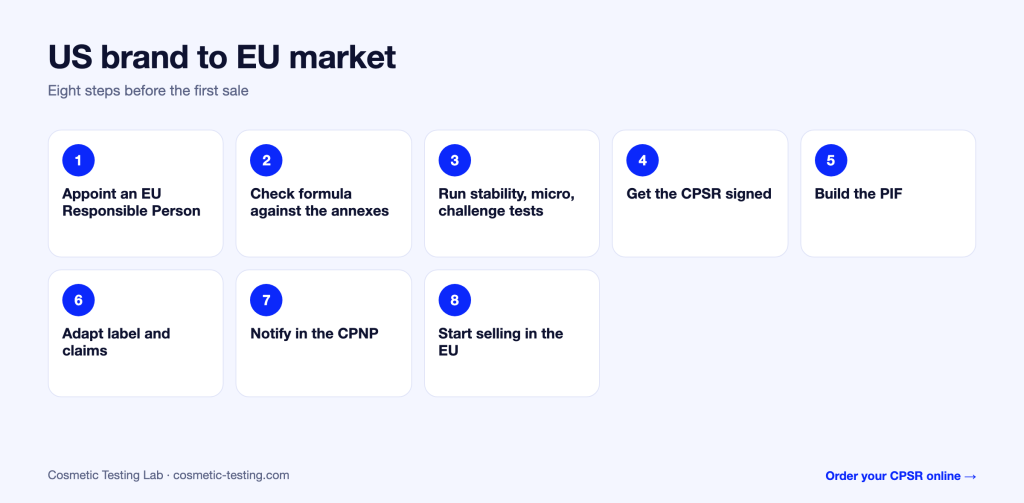
If you want to sell US cosmetics in the EU, being compliant at home is not enough: the EU has its own rules on who is responsible, what safety file you need, what goes on the label and how the product is notified. This step-by-step checklist walks a US brand through the process, from the EU Responsible Person to the CPNP notification, and gives a realistic order of work.
目次
- The short answer
- Step 1: Appoint an EU Responsible Person
- Step 2: Understand what the PIF contains
- Step 3: Get the CPSR from a qualified safety assessor
- Step 4: Gather the tests the assessor needs
- Step 5: Check the formula against the EU annexes
- Step 6: Adapt the label
- Step 7: Check your claims
- Step 8: Notify in the CPNP
- A realistic timeline
- Common mistakes
- Frequently asked questions
- Key takeaways
The short answer
To place a cosmetic on the EU market you need an EU Responsible Person, a product information file (PIF) with a signed Cosmetic Product Safety Report (CPSR), an EU-compliant label, and a notification in the Cosmetic Products Notification Portal (CPNP) before the product is sold. The legal base is Regulation (EC) No 1223/2009. A US safety file is a useful starting point, but it does not replace these EU documents. A CPSR is the central piece, and the tests behind it take the longest, so start there.
Step 1: Appoint an EU Responsible Person
Under Article 4, every cosmetic placed on the EU market needs a Responsible Person established in the EU. For an imported product, the importer is the Responsible Person by default, but a US brand usually designates a company or service in the EU in writing, with that party’s agreement. The Responsible Person guarantees compliance, keeps the PIF available for authorities, and handles notification and reports of serious undesirable effects. Choose a partner who actually reviews your file; the legal responsibility is real.
Step 2: Understand what the PIF contains
The product information file is the dossier the Responsible Person must keep, under Article 11, at their address and make available to authorities. It is kept for ten years after the last batch is placed on the market. It typically contains:
- a description of the product and its formula with concentrations;
- the CPSR;
- a description of the manufacturing method and a statement of compliance with good manufacturing practice (ISO 22716 is the usual reference);
- proof of any claimed effect where justified;
- data on animal testing, which is banned for EU cosmetics, and on any serious undesirable effects.
Step 3: Get the CPSR from a qualified safety assessor
Article 10 requires a safety assessment before a product is placed on the market. The CPSR has two parts, set out in Annex I of the Regulation. Part A collects the product data: formula, physical and chemical properties, stability, microbiological quality, impurities, packaging, normal and foreseeable use, exposure and the toxicological profile of each ingredient. Part B is the assessor’s reasoned conclusion on safety, including labelled warnings and the assessor’s credentials. The assessor must hold qualifications set out in Article 10, such as a diploma in pharmacy, toxicology, medicine or a similar discipline. Our guide on what a CPSR is explains the structure.
Step 4: Gather the tests the assessor needs
The Regulation does not name a fixed list of tests, so the assessor decides, based on your product. Typical requests are:
- Stability and compatibility: to support the shelf life or PAO and show the product is stable in its packaging. See our stability test.
- Microbiological quality: counts and absence of specified organisms in the finished product. See the microbiological specifications test.
- Challenge test: for water-containing products, to show the preservation works. See the challenge test; ISO 11930:2019 is the usual reference in the EU.
- Patch test or other skin tolerance data: sometimes, for leave-on products, new actives or sensitive-skin positioning. See the patch test.
A US USP 51 report can still be useful data, but ask your assessor before relying on it.
Step 5: Check the formula against the EU annexes
Ingredients are restricted by annex: Annex II lists prohibited substances, Annex III restricted ones, Annex IV colourants, Annex V preservatives and Annex VI UV filters. Several things differ from US practice:
- Some ingredients accepted in the US are banned or limited in the EU. One verifiable example is butylphenyl methylpropional (lilial), a fragrance ingredient prohibited in the EU.
- Only UV filters on the EU list may be used in sunscreens, so a US filter set may need reformulating.
- Fragrance allergens must be declared above set thresholds; the list was widened by Regulation (EU) 2023/1545.
- Nanomaterials have a separate notification duty and, for some, extra rules.
Also note that products the US treats as OTC drugs, such as sunscreens and anti-dandruff shampoos, are generally cosmetics in the EU, and then need the full cosmetic file.

Step 6: Adapt the label
Article 19 sets the labelling basics. Check each of these on your pack:
- name or registered name and address of the Responsible Person in the EU;
- country of origin for imported products;
- nominal content;
- a minimum durability date (“best before the end of”) for products with a shelf life of 30 months or less, or the open-jar PAO symbol for longer-lasting products;
- precautions for use and any warnings the Regulation requires;
- batch number;
- function of the product, unless clear from the presentation;
- the ingredient list in INCI nomenclature, in descending order of weight.
The language of mandatory information is decided by each Member State, so check your target markets. A sticker over the US label is common for first shipments, but a printed EU label is cleaner.
Step 7: Check your claims
Claims are governed by Regulation (EU) No 655/2013, which sets six common criteria: legal compliance, truthfulness, evidential support, honesty, fairness and informed decision-making. US phrases such as “clinically proven”, “dermatologist tested” or “hypoallergenic” need evidence that fits the EU rules. Drug-like claims, such as treating acne or protecting from sunburn without the proper basis, can move a product out of the cosmetic category. Keep the supporting studies in the PIF.
関連記事 CPNP届出:化粧品の登録方法
Step 8: Notify in the CPNP
Before placing the product on the market, the Responsible Person submits the product details to the CPNP under Article 13. The notification includes the category, name, Responsible Person, country of origin for imports, formula information and the label and pack images. Poison centres and market-surveillance authorities use this database. Notify each product and each materially different formulation; check how shades and variants should be grouped.
A realistic timeline
The longest item is usually testing. A challenge test runs 28 days, and accelerated stability tests run for weeks, so it is common to plan around two to three months in total. The CPSR itself is typically ready about ten business days after the assessor has complete data. Label design, printing and the CPNP notification can run in parallel. Starting with the tests and the assessor’s feedback avoids rework later.
Common mistakes
- Assuming the US safety file, or an FDA registration, is accepted in the EU.
- Selling first and notifying later.
- Using a US-only ingredient or UV filter that the EU does not authorise.
- Missing the Responsible Person address or the durability date on the label.
- Reusing US claims without EU-standard evidence.
Frequently asked questions
Can I use my own US address as Responsible Person?
No. The Responsible Person must be established in the EU. Many US brands appoint a service or distributor there in writing.
Does MoCRA compliance count for the EU?
Not directly. MoCRA records, such as safety substantiation, overlap with the CPSR data, but the EU requires its own signed CPSR and notification.
Do I need to translate the whole label?
Mandatory information must be in a language accepted by the Member State where the product is sold. Check each country, since rules vary.
Key takeaways
- People: an EU Responsible Person and a qualified safety assessor are needed.
- Files: a PIF with a signed CPSR, kept ten years after the last batch.
- Product: check ingredients against the annexes and adapt the label and claims.
- Sequence: test first, notify in the CPNP, then sell.