

If you sell perfumed products, fragrance allergen labeling in the US is a rule you should plan for even though it is not yet in force. The Modernization of Cosmetics Regulation Act (MoCRA) told the FDA to create a fragrance allergen disclosure rule, but at the time of writing no proposed rule has been published. This guide explains what US labels show today, what MoCRA says, how the EU system works as a likely reference point, and what you can prepare now.
Obsah
- The short answer
- What does a US label show for fragrance today?
- What does MoCRA say about fragrance allergens?
- How does the EU handle fragrance allergens?
- What might the FDA borrow from the EU?
- What data should you collect now?
- Fragrance and safety substantiation under MoCRA
- If you also sell in the EU or UK
- Common mistakes
- Frequently asked questions
- Key takeaways
The short answer
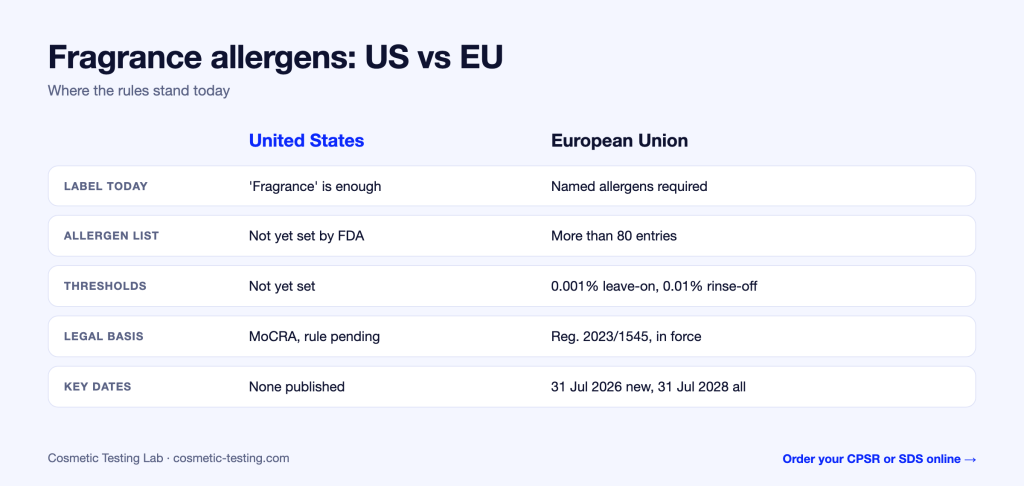
Today a US cosmetic label may list a fragrance simply as “Fragrance” or “Parfum”, with no allergen names. MoCRA requires the FDA to issue a regulation that will name the fragrance allergens that must be disclosed, but that rule has not been proposed yet, so there is no federal allergen list, threshold or date to comply with. The EU already requires individual allergen names on the label under Regulation (EU) 2023/1545. Brands that sell on both sides of the Atlantic should treat the EU list as the practical planning baseline.
What does a US label show for fragrance today?
Retail cosmetics in the US must carry an ingredient declaration, and most ingredients are listed individually in descending order of predominance. Fragrance and flavor ingredients are an exception: the FDA explains that they can be listed simply as “Fragrance” or “Flavor”, because fragrance formulas are likely to be trade secrets and the Fair Packaging and Labeling Act cannot be used to force their disclosure. The same FDA page notes that the agency does not have the same legal authority to require allergen labeling for cosmetics as it has for food. In practice, a shopper with a fragrance allergy cannot tell from most US labels which allergen is inside.
Prečítajte si aj Nekomedogénne tvrdenie: aké testy a dôkazy potrebujete
What does MoCRA say about fragrance allergens?
MoCRA, passed in December 2022, adds a labeling provision to the Federal Food, Drug, and Cosmetic Act that directs the FDA to establish, by regulation, which fragrance allergens must be disclosed on cosmetic labels. As the law is generally summarised, the FDA was to publish a proposed rule within 18 months of enactment, in mid-2024, and a final rule after the comment period. That date passed without a proposal. Trade sources point to the agency’s regulatory agenda as listing a proposed rule, but target dates have slipped more than once, so treat any date you read as a plan, not a promise. Check the FDA’s MoCRA page and the Federal Register for the current status before you finalise artwork.
What we can say safely: the obligation exists in the statute, the details do not exist yet, and a final rule would normally be followed by a compliance period so that labels can be changed. Statements such as “all US products must list allergens from 2026” are not supported by an FDA source.
How does the EU handle fragrance allergens?
The EU has required declaration of certain fragrance allergens since the early 2000s, starting with a list of 26 substances. Commission Regulation (EU) 2023/1545 amended Annex III of Regulation (EC) No 1223/2009 and extended the list to more than 80 entries, including several essential oils and natural extracts that are now listed in their own right. The principle is unchanged:
- an allergen on the list must appear in the ingredient list by name when it is present above 0.001% in leave-on products or 0.01% in rinse-off products;
- the concentration is calculated for the finished product, not for the fragrance concentrate;
- the new rules apply to products placed on the EU market from 31 July 2026, and to products already on the market from 31 July 2028.
Counts differ slightly between sources, depending on how groups and extracts are counted, so use the Official Journal text for the exact list. Our guide on what a CPSR is explains where this information ends up in the EU safety file.
What might the FDA borrow from the EU?
MoCRA does not copy the EU system, but it points the FDA to existing frameworks, and the EU list is the most developed one. Nobody can say today which choices the FDA will make, so these are the open questions worth watching:
- Which substances: the EU list, the older 26-substance list, or something shorter.
- Which thresholds: the EU uses 0.001% and 0.01%. A US rule could differ.
- Where the disclosure goes: on the pack, in the ingredient list, or elsewhere, such as a website or leaflet.
- Which products: all cosmetics with fragrance, or only some categories. How small businesses are treated under MoCRA may matter as well.
Whatever the final text says, the underlying data you need will be the same: the identity and concentration of each allergen in your finished product.
Prečítajte si aj Oftalmologicky testované: požiadavky na tvrdenie vysvetlené
What data should you collect now?
You do not need to wait for the FDA to prepare. A sensible file for every scented product contains:
- Full fragrance composition from the supplier. Ask for an allergen declaration that lists each EU-listed substance and its percentage in the fragrance concentrate. An IFRA certificate alone does not give this.
- Your fragrance dosage in each formula, for example 0.5% or 1.2% of the finished product.
- Calculated allergen levels in the finished product: percentage in the concentrate multiplied by the dosage. Compare each result with 0.001% for leave-on and 0.01% for rinse-off.
- A statement of product type (leave-on or rinse-off), since the threshold depends on it.
- The supplier’s SDS for the fragrance oil, which lists hazardous components and is useful when you compile your own safety data sheet.
Update the calculation whenever the fragrance supplier reformulates the oil, which does happen without a loud announcement. Ask suppliers to notify you in writing.
Fragrance and safety substantiation under MoCRA
Labeling is only one side. MoCRA already requires the responsible person to keep records that support adequate safety substantiation for each product. The FDA states that neither the law nor its regulations require specific tests, so brands decide what evidence is adequate. For a scented leave-on product, a reasonable file includes the fragrance supplier’s data, IFRA compliance, allergen calculations and any skin tolerance data. If a fragrance is part of the safety story, document it rather than relying on a general statement.

If you also sell in the EU or UK
For EU sales the allergen declaration is not optional and not future: the Regulation applies now to new products and will apply to everything on the market from 31 July 2028. A product that is fully compliant in the US can still fail an EU label check if the allergens are missing. The EU safety assessor will also expect the fragrance data in the product information file, and a perfumed formula usually falls into the most complex CPSR tier. Our CPSR service covers this. The UK has its own, separate amendments, so check them if you sell there.
Prečítajte si aj Viacjazyčné kozmetické etikety pre trhy EÚ
Common mistakes
- Waiting for the FDA rule and having no allergen data when it arrives.
- Reading the IFRA certificate as an allergen declaration. IFRA limits use levels for safety; it is not the label list.
- Calculating on the fragrance concentrate instead of the finished product.
- Forgetting that natural products with essential oils can contain listed allergens too.
- Printing “Fragrance” on an EU-bound product.
Frequently asked questions
Do I have to list fragrance allergens on my US label today?
Not under a specific federal allergen rule. You may list “Fragrance” as a single ingredient. Voluntary disclosure is allowed, and some brands do it to build trust, but make sure the information is accurate.
Will the US use the same list as the EU?
Unknown. The FDA has not published a proposal. The EU list is a likely reference, but the final US list, thresholds and dates may differ.
Does a safety data sheet replace allergen labeling?
No. An SDS addresses workplace and transport hazards of the product. Allergen labeling is a consumer label rule. The two documents use related data, but they have different purposes.
Key takeaways
- Today: “Fragrance” is acceptable on US labels, with no allergen names.
- Coming: MoCRA requires an FDA rule, but no proposal, list or date is published yet.
- EU: more than 80 listed allergens, 0.001% leave-on and 0.01% rinse-off, applying from 31 July 2026 and 31 July 2028.
- Prepare: get full allergen declarations from your fragrance supplier and calculate levels per product.