

The MoCRA small business exemption is often described as a way for small brands to skip US cosmetic regulation. That is a dangerous simplification. The exemption removes only a few duties, it has a clear sales threshold, and it never applies to certain product types. This guide explains who qualifies, which rules you can skip, which still apply, and what a sensible small brand should do anyway.
Obsah
- The short answer
- Who qualifies as a small business?
- Which requirements does the exemption remove?
- What still applies to small brands
- Who never gets the exemption?
- Why a small brand should still test
- A practical compliance plan under the threshold
- What changes when you outgrow the exemption?
- Does the exemption help with the EU?
- Frequently asked questions
- Key takeaways
The short answer
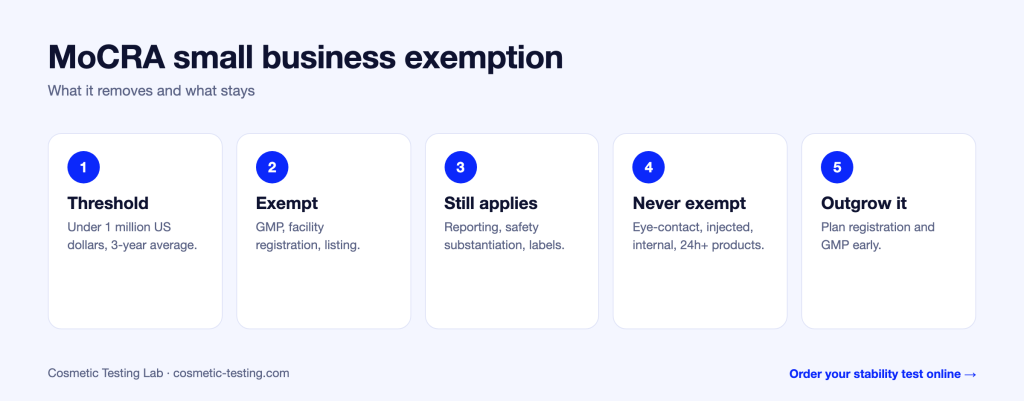
Under the Modernization of Cosmetics Regulation Act (MoCRA), a business whose average gross annual US cosmetic sales over the previous three years are under one million US dollars, adjusted for inflation, is exempt from the good manufacturing practice (GMP) provisions and from facility registration and product listing. It is not exempt from adverse event reporting, safety substantiation, labelling or recall rules, and it gets no exemption at all if it makes certain higher-risk products. Treat the exemption as a smaller to-do list, not as a free pass. Your product still has to be safe and properly preserved, which is where a stability test and a microbiological test come in.
Who qualifies as a small business?
The statute looks at the responsible person and at owners or operators of facilities. If their average gross annual sales of cosmetic products in the United States over the previous three-year period are below the threshold, they count as a small business. Some points to keep in mind:
- It is a sales test, not an employee test. The law sets no headcount limit.
- Three-year average. A strong year does not push you out immediately, but a growing brand can lose the exemption as the average rises.
- US sales of cosmetics. The measure concerns US cosmetic sales, not your whole company or export revenue.
- Inflation adjustment. The threshold is adjusted for inflation, so confirm the current figure with FDA or an adviser rather than relying on an old blog post.
How sales are counted across related companies, private-label brands and contract manufacturers is a legal question. If you share ownership with other brands, ask a regulatory adviser before you assume you qualify.
Prečítajte si aj Testovanie kozmetiky pre malé podniky a startupy: štíhly plán
Which requirements does the exemption remove?
A qualifying small business is not subject to two sections of the law:
- Good manufacturing practice. FDA must write GMP rules for cosmetic facilities, and small businesses are outside them.
- Facility registration and product listing. You do not have to register your facility or list your products with FDA.
That is the whole list. The rest of MoCRA still applies, as the next sections show.
What still applies to small brands
- Adverse event reporting. The responsible person must report serious adverse events to FDA within 15 business days of receipt, with a copy of the label. Small businesses keep records for three years instead of six, unless they make the excluded product types.
- Safety substantiation. Every cosmetic must have adequate substantiation of safety, and the records must be kept. FDA does not prescribe one set of tests, so the evidence is up to a competent assessor.
- Labelling. The label must show a domestic address, phone number or electronic contact for adverse event reports, and the existing ingredient and warning rules still apply. Expect further labelling requirements, such as fragrance allergen disclosure, once FDA finalises them.
- Recalls and records access. FDA’s authority to order a recall of a harmful product and to access safety records applies regardless of size.
- Existing law. The Federal Food, Drug, and Cosmetic Act still prohibits adulterated and misbranded cosmetics, and state laws apply separately.
Who never gets the exemption?
The exemption does not apply to anyone manufacturing or processing these products:
- products that regularly contact the mucous membrane of the eye under customary use;
- injected products;
- products intended for internal use;
- products intended to alter appearance for more than 24 hours under customary use, where removal by the consumer is not part of customary use.
Mascaras and eyeliners that are used at the lash line are the obvious cases to check, as are lash and brow products and some semi-permanent items. Whether a given product “regularly contacts” the eye mucosa is a judgement call, so document your reasoning. Also note that products that are drugs, such as sunscreens or anti-dandruff shampoos, sit under different rules altogether.
Prečítajte si aj Nariadenie EÚ o kozmetike 1223/2009 jednoducho
Why a small brand should still test
Even where no rule asks for a test, the safety substantiation duty and ordinary product liability make evidence valuable. Small brands often use natural or low-preservative formulas, which raises the microbial risk. Practical minimums are:
- a microbiological test on the finished product, so you know what is in the jar before it ships;
- a challenge test for water-containing products, to show the preservative system works over the shelf life;
- a stability and compatibility test in the final packaging, to check colour, smell, texture and pack interaction.
Retailers and marketplaces often ask for such reports, whatever the law says, so the investment tends to pay off beyond compliance.

A practical compliance plan under the threshold
- Calculate your three-year average of US cosmetic sales and write down the result and the date.
- Check each product against the four excluded categories and note the outcome.
- Set up adverse event handling: one inbox, a log, a 15-business-day alarm.
- Put contact details on every label and confirm they work.
- Build a safety file per product: formula, ingredient safety data, test reports, label and claims.
- Review annually. When sales approach the threshold, plan for registration, listing and GMP early.
What changes when you outgrow the exemption?
Once the three-year average passes the threshold, you must register facilities and list products, and GMP rules apply. FDA has not yet finalised the cosmetic GMP rule, so the exact content is still open, but ISO 22716 is the usual reference for good practice, and many brands already follow it for EU sales. Build habits early: batch records, supplier checks, cleaning logs and retained samples cost little when the company is small and are painful to retrofit.
Prečítajte si aj Zodpovedná osoba pre kozmetiku (RP): kto ju potrebuje
Does the exemption help with the EU?
No. The EU Cosmetics Regulation has no small business exemption for the safety report: every product placed on the EU market needs a Responsible Person, a product information file and a signed CPSR, whatever your size. A US brand planning to export should treat the US exemption as irrelevant for Europe, and our guide to MoCRA versus the EU Cosmetics Regulation shows the main differences.
Frequently asked questions
Do small businesses have to register with FDA?
Not if they meet the sales test and do not make the excluded product types. Confirm your status each year.
Does the exemption mean no safety testing?
No. Safety substantiation applies to all cosmetics. The law does not list mandatory tests, but you need adequate evidence that your product is safe, and microbial quality, preservation and stability are standard parts of it.
Can I sell eye makeup under the exemption?
Products that regularly contact the eye mucosa are excluded from the exemption, so a maker of such products is treated like any other manufacturer for GMP, registration and listing. Check your products carefully.
Key takeaways
- The exemption is based on average US cosmetic sales over three years, not on employee numbers.
- It removes only GMP and facility registration and product listing; reporting, safety substantiation and labelling still apply.
- Eye-contact, injected, internal-use and long-lasting appearance products never qualify.
- Testing is still the best evidence of safety, and the exemption does not help in the EU.