

A US label is not an EU label. If you want to convert an FDA cosmetic label for Europe, you need to change more than the address: the ingredient list, units, dates, symbols, language and several mandatory statements all follow different rules. This guide compares the two systems and shows what to change, in the order we would do it. It is general information, not legal advice.
Obsah
- The short answer
- FDA label versus EU label: the main differences
- Responsible Person and country of origin
- Net contents and units
- Ingredient list: from INCI to EU rules
- Dates, batch numbers and symbols
- Precautions, warnings and function
- Language and claims
- Common mistakes when converting a US label
- A practical conversion checklist
- Frequently asked questions
- Key takeaways
The short answer
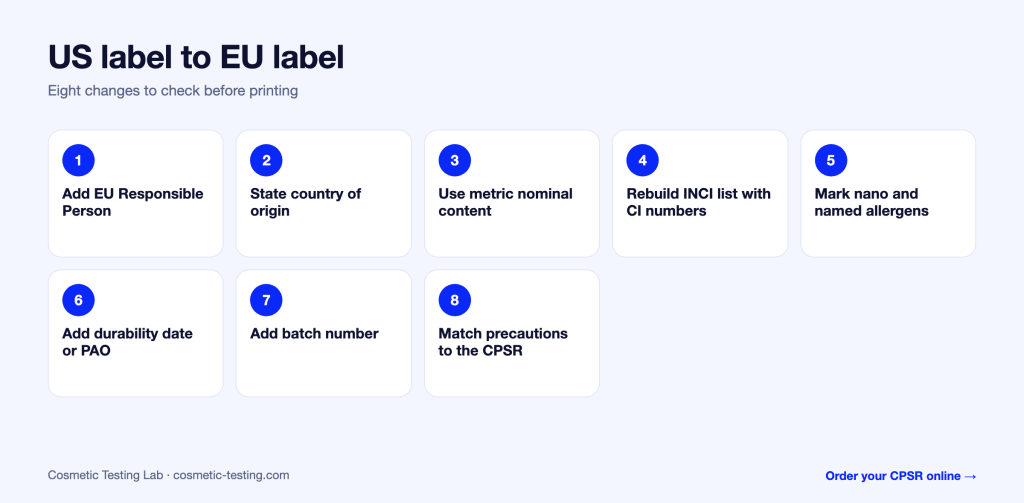
A cosmetic label made for the US usually needs these changes for the EU: an EU Responsible Person name and address, the country of origin, a nominal content in metric units, a batch number, a durability date or a period-after-opening symbol, precautions that match the safety report, an INCI ingredient list, and the language of each country where you sell. Under Regulation (EC) No 1223/2009 (Article 19), these items must be on the container and packaging. Your CPSR and the label must agree, because the safety assessor decides which warnings the product needs.
FDA label versus EU label: the main differences
Both systems want the consumer to know what the product is, how much is inside, who stands behind it and what it contains. The details differ. In the US, the main label items include the product identity, the net quantity, the name and place of business of the manufacturer, packer or distributor, the ingredient declaration and required warnings. Since the Modernization of Cosmetics Regulation Act (MoCRA), the label must also carry a domestic address, phone number or electronic contact through which the responsible person can receive adverse event reports.
The EU asks for an EU-based Responsible Person, and for imported products the country of origin. The sections below go through each item.
Prečítajte si aj Viacjazyčné kozmetické etikety pre trhy EÚ
Responsible Person and country of origin
The EU label must show the name and address of the Responsible Person established in the EU. A US “distributed by” line does not replace it. For imported products, the country of origin must also be stated, for example “Made in USA”. If your EU Responsible Person is a service provider, agree in writing which exact name and address will appear, because it must match the information notified in the CPNP. You can keep your US contact line for MoCRA purposes next to it; the two serve different authorities.
Net contents and units
US labels usually show both US customary and metric units, which is already close to what the EU wants. The EU requires the nominal content by weight or volume, shown in metric units. Check that rounding and symbols are right, and note that very small packs, free samples and single-use portions have limited exemptions. Check the exact wording before you rely on an exemption.
Ingredient list: from INCI to EU rules
Both systems use INCI names in descending order of weight, so this part looks easy, but there are EU-specific points:
- The list is introduced by the word “Ingredients” (translated for each market).
- Ingredients below 1% can be in any order after those above 1%.
- Colourants are listed by their Colour Index (CI) number, and not by US names such as “FD&C Blue No. 1”. Check each shade against the EU colourant annex.
- Nanomaterials are followed by “(nano)”.
- Fragrance allergens above set limits must be named. Under Regulation (EU) 2023/1545 the list of named allergens grows from 26 to many more, with dates that apply to new and existing products. Check the current dates before printing.
- Impurities and processing aids are not listed.
Ingredients that are restricted in the EU may also need a warning text. A US formula that was tolerated at home may need a change before the label can be finalised.
Prečítajte si aj Ako označiť malé kozmetické obaly a vzorky
Dates, batch numbers and symbols
Many US labels carry no date at all, and the batch code is on the carton only. The EU expects:
- a date of minimum durability (“best used before the end of”) if the product lasts 30 months or less, or
- a period-after-opening (PAO) symbol, the open jar with a number of months, where the product lasts longer and deterioration after opening matters;
- a batch number or reference that allows traceability, on the container and on the outer packaging.
The durability date and the PAO number come from your data. A stability test and, for water-based products, a challenge test are the usual evidence.
Precautions, warnings and function
EU law requires the precautions that the safety assessor identifies and that are set out in the annexes. They must appear on the label, and where this is impossible, on an enclosed leaflet with the “see leaflet” symbol. Warnings required by US law do not automatically carry over, and EU ones may differ in content. Examples include mandatory sentences for certain hair dyes, products with specific preservatives, or ingredients limited for children under three.
The product function must be stated if it is not clear from the product presentation. A US product named only by brand and scent may need a clear descriptor in the EU.

Language and claims
Several label items must be in the language determined by the Member State where the product is sold. That often means one language per country, or a multi-language label. Plan your artwork early: several languages in a small space can require a booklet label or an outer carton. Our guide to multilingual labels goes into more detail.
Claims are a separate topic. A US marketing line such as “clinically proven” or “dermatologist tested” must meet the common criteria for cosmetic claims in the EU and be backed by evidence. If you want to keep a claim, check it against your data. A patch test report, for example, can support a statement on tolerance for the tested conditions, but only within what it shows.
Prečítajte si aj Požiadavky na označovanie kozmetiky v EÚ: kompletný zoznam
Common mistakes when converting a US label
The same few errors appear again and again. Brands keep US colour names instead of CI numbers, print only the US address, forget the durability or PAO symbol, copy a warning from the US label that the safety report does not support, or translate the marketing text but not the mandatory statements. Another frequent problem is a label that is correct but does not match the CPNP entry. Before artwork goes to print, one person should compare the label, the CPSR and the notification line by line.
A practical conversion checklist
- Appoint the EU Responsible Person and confirm the exact name and address for the label.
- Add the country of origin and check metric content.
- Convert the INCI list: CI numbers, nano, allergens, order.
- Set durability or PAO, based on test data.
- Add batch number and function if needed.
- Copy the safety assessor’s precautions onto the label.
- Translate for each target country and check space.
- Review claims and symbols before sending files to print.
Frequently asked questions
Can I ship US-labelled products to the EU with a sticker?
Yes, if the sticker or overlabel carries every required item in the right language and sits on the container and packaging in a way that stays legible. Many brands print dedicated EU labels because stickers can cover US-mandatory text or peel.
Do I need to remove the US contact line?
No. You may keep it. The EU Responsible Person must appear in addition, in a clearly legible form.
Does the label need to match the CPSR?
Yes. The precautions, durability or PAO and function on the label should follow the safety report, and the CPNP notification should match both.
Key takeaways
- Add an EU Responsible Person and the country of origin.
- Rebuild the ingredient list with CI numbers, nano marks and allergens.
- Back the durability date or PAO with stability and challenge test data.
- Match precautions and claims to the CPSR and translate for each market.