

Starting a cosmetic brand is exciting, and Europe is one of the most attractive markets in the world, with one set of rules across all EU countries. It is also one of the most regulated. This guide shows how to start a cosmetic brand in Europe in the right order, from the first idea to the first sale, so you avoid the expensive mistakes of printing packaging before the formula is proven safe.
Contents
- The short answer
- Step 1: define the product, market and claims
- Step 2: choose how the product gets made
- Step 3: appoint the responsible person
- Step 4: get the safety assessment (CPSR)
- Step 5: test the formula and the packaging
- Step 6: build the product information file
- Step 7: design a compliant label
- Step 8: notify the product in CPNP
- Step 9: choose how and where to sell
- Step 10: build business basics in parallel
- Common mistakes new brands make
- A launch checklist
- Frequently asked questions
- Key takeaways
The short answer
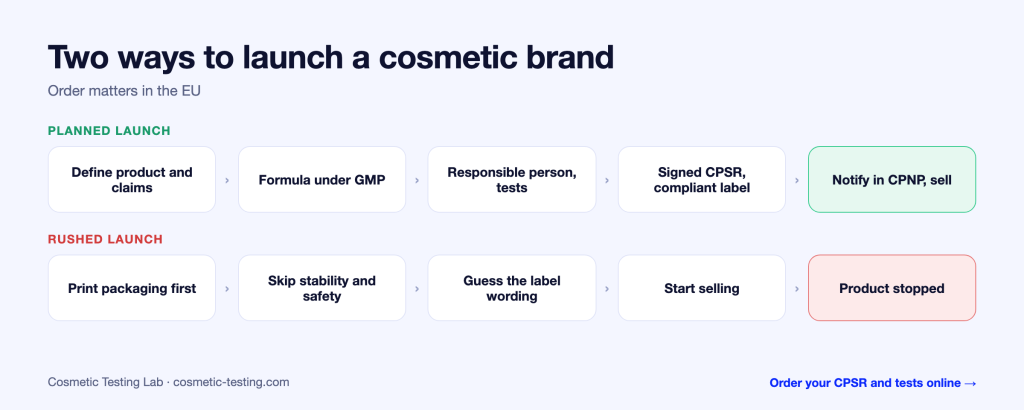
To start a cosmetic brand in Europe you need a clear product concept, a formula made under good manufacturing practice, a responsible person established in the EU, a signed safety assessment (CPSR) backed by stability and microbiological data, a compliant label, and a notification in the EU’s CPNP portal before the first sale. These duties come from Regulation (EC) No 1223/2009. If you follow them in order, launch is predictable. If you skip steps, the product can be stopped later.
Step 1: define the product, market and claims
Start with who the product is for, what it does and where you will sell it. These answers decide the category (skin care, hair care, make-up, fragrance), the target countries and the claims you can make. Decide early which statements you want on the pack, such as “sensitive skin” or “long-lasting”, because each needs evidence under the Claims Regulation (EU) No 655/2013. A small, focused range of two to four products is easier to document than twenty, and it gives you room to learn.
Read also Influencer Beauty Brand Compliance: The Basics
Step 2: choose how the product gets made
You have three common routes:
- Make it yourself. Full control, but you must follow good manufacturing practice (ISO 22716 is the recognised standard) with documented hygiene, equipment and batch records, even for a kitchen-table start-up.
- Use a contract manufacturer. The manufacturer produces to your formula or theirs, and brings its own quality system. You still remain responsible for the product on the market if you are the brand owner.
- Private label or white label. You sell a ready-made formula under your name. It is the fastest route, but check who holds the safety documents and whether they cover your final pack and claims.
Whichever route you choose, get the full ingredient list with percentages, supplier specifications and an SDS for the raw materials, because every later step depends on them.
Step 3: appoint the responsible person
Every cosmetic placed on the EU market needs a responsible person established in the EU. For a product made in the EU this is normally the manufacturer. If you import, it is usually the importer, unless the non-EU manufacturer gives a written mandate to an EU-based person. A brand that sells under its own name usually takes on this role. The responsible person is accountable for safety, the product information file, notification and the label, and the name and address appear on the pack. It is a legal responsibility, not a formality, so choose a person or company that can really keep the documents.
Step 4: get the safety assessment (CPSR)
Before launch, the responsible person must have a cosmetic product safety report. It has Part A, with the safety data on the formula, and Part B, the assessment signed by a qualified safety assessor. The assessor needs reliable data: the formula, raw-material information, stability, microbiological quality and, for water-based products, preservation efficacy. Our overview of the CPSR explains the parts and how the work is organised. Gathering the data first saves time, because the assessor cannot conclude on missing information.
Read also Cosmetic Compliance Cost for a New Brand: What Drives It
Step 5: test the formula and the packaging
The tests support the report and your shelf-life and label decisions:
- A stability and compatibility test shows how the product and its packaging behave over time, and supports the durability date or the period after opening.
- A microbiological specifications test checks the quality of the finished product.
- A challenge test proves that the preservative system works in water-based products.
- A patch test can support tolerance claims such as “suitable for sensitive skin”.
Run the tests on the final formula in the final packaging when possible. A change of formula or pack after testing may require repeating part of the work.
Step 6: build the product information file
The product information file collects the safety report, the formula, manufacturing method, the statement on good manufacturing practice, proof of claims and data on animal testing. It has to be available at the address of the responsible person for ten years after the last batch is placed on the market. Create it from day one as a living folder instead of rebuilding it from emails at the end.
Step 7: design a compliant label
The label must show the responsible person and EU address, the country of origin for imports, the nominal content, the date of minimum durability or the period after opening, precautions, the batch number, the function if not obvious and the full INCI ingredient list, in the language of each market. If a fragrance is present, check whether allergens must be named. Do not send artwork to print before the safety report is signed, because warnings and shelf life come from it. Claims on the pack must match the evidence in your file.

Read also How to Choose a Cosmetic Contract Manufacturer
Step 8: notify the product in CPNP
Before the first sale, the responsible person notifies the product in the Cosmetic Products Notification Portal. The notification is free of charge and gives authorities and poison centres access to the key information. It includes the category, the name, the responsible person, the country of origin for imports, the presence of nanomaterials and CMR substances, and the frame formulation. A notification is not an approval, and it does not replace the safety report.
Step 9: choose how and where to sell
Online shops, marketplaces and retail all have the same legal base, but their requirements can differ. Many marketplaces and retailers ask for the safety report, the label, notification proof and test reports before listing. If you sell across borders, check the language rules for the label and any local rules for the product type. Plan logistics, returns and a process for complaints: the responsible person must also handle undesirable effects, so keep a simple system to receive and record reports.
Step 10: build business basics in parallel
While the technical file is being built, prepare the business side: a company structure, a brand name that you can use and protect as a trademark in your target markets, product liability insurance if your insurer or retailers ask for it, and supplier agreements. These steps are not cosmetic law, but they are usually needed to open accounts with retailers and to survive a quality complaint. Check each point with a lawyer or advisor who knows your country.
Common mistakes new brands make
- Ordering packaging before safety checks. A formula change can make boxes useless.
- Assuming the supplier’s paperwork covers you. A contract manufacturer’s documents rarely cover your final claims.
- No responsible person in the EU. Especially common with brands outside the EU.
- Claims without evidence. “Hypoallergenic” or “dermatologically tested” without a study.
- Skipping preservation testing. A water-based product without proof of preservation is a risk for you and the user.
A launch checklist
- Product concept, market and claims defined.
- Route to manufacture chosen, GMP documented.
- Responsible person appointed.
- Stability, microbiological and challenge data ready.
- Signed CPSR in the product information file.
- Label checked against the CPSR and claims evidence.
- CPNP notification completed.
- Complaint and recall process in place.
Frequently asked questions
How long does it take to launch?
It depends mostly on formulation and testing time. Stability testing runs over weeks, and the safety report follows once complete data is available. Start data collection as early as possible.
Do I need a company before I begin?
You can develop the product as an individual, but the responsible person and any sale are normally tied to a legal entity. Ask an advisor in your country.
Can a brand outside the EU sell in Europe?
Yes, provided there is a responsible person established in the EU and the product meets all the requirements. Without it, the product cannot be placed on the EU market.
Key takeaways
- Follow the order: concept, formula, responsible person, tests, safety report, label, notification.
- Test before you print and keep a living product information file.
- Each claim on the pack needs evidence in the file.
- Free DHL sample pickup and signed reports make the testing part simple.