
Two labels cause more confusion than almost any other on a cosmetic pack: the date and the little open-jar symbol. If you are working out cosmetic shelf life and PAO, you need to know what each one means, which one the law requires for your product and how to support the number you print. This guide walks through it step by step.
Contents
- The short answer
- What is shelf life on a cosmetic?
- What is PAO?
- Which one do you need?
- How is shelf life determined?
- How is the PAO determined?
- Shelf life versus PAO: how they interact
- Which products tend to have which?
- What does the CPSR say about it?
- Common mistakes with expiry and PAO
- Do you need to label storage conditions?
- A simple workflow
- Frequently asked questions
- Key takeaways
The short answer
Shelf life (the date of minimum durability) is how long an unopened product stays within its specification when stored properly; the PAO (period after opening) is how long it stays safe and good to use once the consumer has opened it. In the EU, products with a minimum durability of 30 months or less carry a “best used before the end of” date, while products with a longer durability carry the PAO symbol instead. Both periods must be supported by data in the product file. The rule comes from Article 19 of Regulation (EC) No 1223/2009, and there are exceptions, so always check your own product against the text.
What is shelf life on a cosmetic?
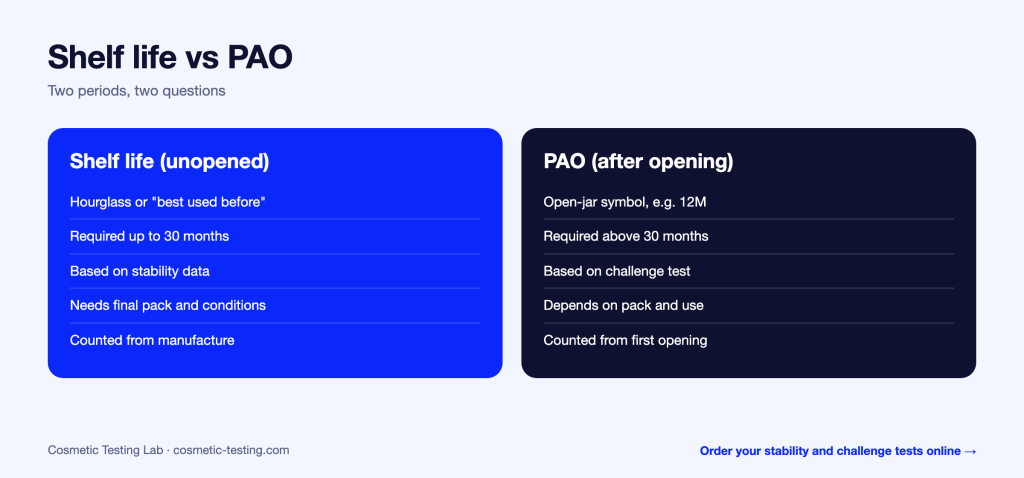
Shelf life is the period during which an unopened product, kept in its original pack under the stated storage conditions, remains safe, effective and acceptable in appearance, smell and texture. The legal term is the “date of minimum durability”. It is shown as an hourglass symbol or the words “best used before the end of”, followed by the date (month and year, or day, month and year) or by a reference to where it is on the pack.
Read also Cosmetics Expiry Date: The 30-Month Rule and Best-Before Explained
What is PAO?
PAO stands for period after opening. It is shown by the open-jar symbol with a number and the letter M, for example 12M for twelve months. It tells the consumer how long the product can be used after the first opening. Opening exposes the product to air, fingers, water and microbes, so the PAO is often shorter than the unopened shelf life and depends strongly on the preservation system and the type of pack.
Which one do you need?
Article 19 of the Cosmetics Regulation sets the rule in simple terms:
- Minimum durability of 30 months or less: show the date of minimum durability. The PAO symbol can be added where it is useful to the consumer.
- Minimum durability of more than 30 months: the date is not required, but the PAO must be shown.
- Not relevant: the PAO may be left out when the idea of deterioration after opening makes no sense, for example for single-use products or products that cannot deteriorate in a way that creates risk.
Many brands show both, which is allowed and helps customers. Check the exact wording of the Regulation and the guidance for your market before printing.
How is shelf life determined?
You cannot pick the figure from a competitor’s pack. Shelf life is based on stability data from the finished product in its final packaging. Samples are stored at normal and stress conditions and checked for appearance, odour, pH, viscosity and the behaviour of the pack. Accelerated studies give early indications, and real-time studies confirm the claimed period. Our stability and compatibility test is built for this and ends in a signed PDF.
The assessor also considers microbiological quality over time, since a product that is physically stable can still become contaminated.
Read also Natural Cosmetics Stability: Special Challenges and Solutions
How is the PAO determined?
There is no single test that delivers a PAO. It is a judgement supported by several pieces of evidence:
- Preservation efficacy: a challenge test shows that the preservative system keeps the product protected against contamination. We use five reference microorganisms over 28 days, following ISO 11930:2019 or USP 51.
- Stability: data that the formula and pack remain acceptable during use.
- Type of pack: pumps and tubes protect better than jars used with fingers.
- Consumer use: how often, how long and how the product is handled.
- Microbiological quality: the microbiological specifications test confirms the finished product is within limits.
Common PAO values such as 6M, 12M or 24M are chosen from this body of evidence, not from a table.
Shelf life versus PAO: how they interact
The two periods answer different questions and do not add up. A product that is good for 36 months unopened does not become good for 36 months after opening. A short PAO also does not shorten the unopened date. If a cream has a 24-month shelf life and a 12M PAO, the consumer reads the unopened date as the limit for a sealed pack and the 12 months as the limit once the pack is open. The two periods are counted separately, so each one needs its own supporting evidence. Most brands pick the symbols that are easiest to understand and avoid combinations that contradict each other.
Which products tend to have which?
Generalisations help for planning but never replace data. Anhydrous products, such as balms and oils, can have long unopened life but may oxidise once opened. Water-based creams and lotions rely on preservatives and often carry a PAO of 6 to 24 months depending on the pack. Make-up, such as mascara, is exposed to contamination more than most and usually has a shorter PAO. Single-use sachets generally do not need a PAO. Fragranced products and sun care products have their own specific stability concerns, especially with light and heat.
Read also What Is Cosmetic Stability Testing? A Plain-English Guide
What does the CPSR say about it?
The CPSR is signed by a qualified safety assessor and Part A includes the stability of the product under reasonably foreseeable storage conditions. The assessor looks at whether the stated shelf life and PAO are supported by your data. If the stability study covers only a few weeks, a 30-month claim will raise questions. We issue the CPSR in about 10 business days after we have complete data.
Common mistakes with expiry and PAO
- Copying a competitor’s shelf life instead of using your own data.
- Printing a 36-month date after a three-month accelerated study with no real-time follow-up.
- Leaving the PAO symbol off a product that needs one because the durability exceeds 30 months.
- Changing the pack or preservative without reviewing the claimed periods.
- Choosing a PAO without a challenge test on a water-based formula.
- Forgetting that storage conditions on the label, such as “keep away from sunlight”, are part of the claim.
Do you need to label storage conditions?
Often yes. Shelf life is only valid under the storage conditions that were tested, so the label should carry any precaution that the data depends on, such as keeping the product away from direct sunlight or heat, or closing the pack tightly after use. These precautions are part of the safety assessment and should match what the stability study assumed. If your product is likely to be stored in a hot bathroom or a car, say so to your assessor early.
A simple workflow
- Finalise formula and pack.
- Run stability and compatibility testing on the final product.
- Run the challenge test and microbiological test.
- Ask the assessor to confirm the shelf life and PAO in the CPSR.
- Print the label and notify the product.
- Keep monitoring real-time samples and update the claim if needed.
Frequently asked questions
Can I show both a date and a PAO?
Yes. Many brands do. Make sure the two are consistent and that both are supported by data in the product file.
Does a PAO of 12M mean the product expires 12 months after I buy it?
No. It counts from the first opening, not the purchase. Before opening, the date of minimum durability or the batch information governs.
Do natural or handmade cosmetics need these labels too?
Yes. There is no exemption for natural or handmade products, and they often need closer attention because oils oxidise and simple preservation systems may not be enough.
Key takeaways
- Shelf life covers unopened storage; PAO covers use after opening.
- Up to 30 months of durability needs a date; longer durability needs the PAO symbol.
- Both periods must be supported by stability, preservation and microbiological data.
- Review the claim whenever the formula, pack or preservative changes.