

If you are planning a launch, one of the first questions is how long the paperwork will take. Cosmetic testing turnaround is different for every test, and the slowest one usually sets your launch date. This guide shows the realistic timing of each common test, what is fixed by the method and what you can influence, and how to order so that nothing waits for anything else.
Contents
- The short answer
- Why turnaround differs so much between tests
- Microbiological specifications test: about 5 days
- Challenge test: 28 days
- Stability and compatibility: it depends on the plan
- Patch test: about two weeks in total
- CPSR: about 10 business days after complete data
- What really sets your total timeline
- How to shorten the process without cutting corners
- Common reasons a project runs late
- What about the safety data sheet?
- A realistic example
- Frequently asked questions
- Key takeaways
The short answer
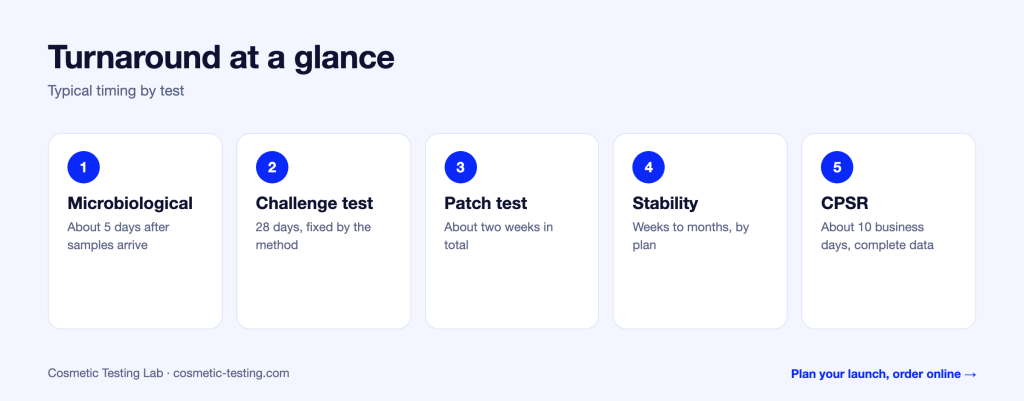
A microbiological specifications test takes about 5 days after the lab receives your samples, a patch test about two weeks in total, a challenge test 28 days because the method itself runs for 28 days, a CPSR about 10 business days once all data is complete, and a stability programme takes longest because it measures how the product ages. The safety report depends on the test results, so the real critical path is: sample shipping, then the slowest test, then the report. Ordering the tests together saves weeks.
Why turnaround differs so much between tests
Some tests measure a state: how clean the product is today. Others measure a process over time: how well the preservative system survives repeated contamination, how the formula changes in heat, or how skin responds after a set exposure. A state can be read in days. A process cannot be hurried without changing what is measured. This is why you cannot simply pay for speed on a challenge test or a stability study; the method defines the minimum time.
Read also Advantages of testing cosmetics with us
Microbiological specifications test: about 5 days
The microbiological specifications test checks the quality of the finished product, usually counting aerobic bacteria, yeast and mould and looking for specified harmful organisms, following the relevant ISO methods. Cultures need a few days to grow, so the result is ready about 5 days after we receive the samples, followed by a signed PDF report. It is the fastest of the core tests, and it is often needed first because a clean result is a precondition for the other work.
Challenge test: 28 days
The challenge test deliberately contaminates the product with five reference microorganisms and counts survivors at set intervals over 28 days, following ISO 11930:2019 or USP 51. The 28 days are part of the method, not a queue. Start day counts from when the lab begins the test, so allow extra time for shipping and set-up. If a product fails, a reformulation and a repeat add another full cycle, which is why many brands test an early sample while they still can change the preservative system.
Stability and compatibility: it depends on the plan
A stability and compatibility test uses accelerated storage, for instance warm and cold conditions plus cycling, to predict how the product will behave over its life, and checks that it is compatible with the packaging. We offer Basic, Standard and Full plans, and the longer the plan, the more evidence you get on shelf life and period after opening. These programmes take weeks to months, not days, and the exact duration is shown for each plan when you order. If you need a launch date, choose the plan early and start it as soon as the final packaging is ready.
Stability studies can also continue after launch. Many brands begin with an accelerated plan to support the first documentation and keep real-time observation running in parallel.
Read also Cosmetic testing process in Cosmetic Testing Lab (from start to finish)
Patch test: about two weeks in total
The patch test is a single 48-hour occlusive patch applied to volunteers, followed by skin assessment. The patch itself is short, but recruiting, applying, reading, evaluating and signing the report bring the total to about two weeks. It can run alongside other tests because it uses a separate portion of product.
CPSR: about 10 business days after complete data
The CPSR is signed by a qualified safety assessor and has Part A and Part B. We aim to deliver about 10 business days after receiving complete data. The word complete matters: the assessor needs the formula, specifications, relevant test reports and details of the packaging and intended use. Missing data stops the clock. The report also reflects the complexity of the formula, with tiers based on the number of ingredients and the presence of a fragrance, which is a reason to send accurate formula information the first time.
What really sets your total timeline
A simple planning model looks like this:
- Preparation: finalise the formula and packaging, produce the samples.
- Shipping: free DHL pickup from your door, then transit to the lab.
- Testing: the longest test you ordered sets this step.
- Safety report: starts once the data is complete, about 10 business days.
- Notification and launch: product notification and label checks follow.
Because the CPSR depends on test data, the order of operations matters. Starting the CPSR before the tests are complete usually does not save time; it starts the clock on a file that cannot be signed yet.
Read also Outsource Cosmetic Testing or Test In-House? A Practical Guide
How to shorten the process without cutting corners
- Order tests together. Parallel tests run side by side, so total time is close to the longest test, not the sum.
- Follow the sample requirements. Correct quantity, final packaging and clear labelling avoid delays. Read our microbiological test page before you pack.
- Send complete data. Formula, ingredient percentages and intended use available on day one prevent waiting.
- Fix the formula first. A late change means repeating tests, which costs far more time than a careful start.
- Plan the long tests first. Start the challenge and stability work as early as possible, since they define the end date.
Common reasons a project runs late
- Samples arrive in the wrong packaging, or with too little product.
- A failed challenge test that needs reformulation and a repeat.
- An ingredient or supplier change after testing has started.
- Waiting for formula details or raw-material documents from suppliers.
- Booking the safety report last instead of preparing data in parallel.
What about the safety data sheet?
A safety data sheet does not wait for laboratory results in the same way. It is a REACH-compliant 16-section document built from the formula and the raw-material information, available in 30+ languages, so it can be prepared while the tests run. The sooner you share the full formula, the sooner it can be finalised.
A realistic example
Imagine a water-based face cream. The brand finalises the formula, packs three sealed units and orders microbiological, challenge and stability tests and a CPSR together. The microbiological result arrives first, the challenge test finishes after its 28 days, the stability plan completes on its own schedule, and the CPSR is delivered about 10 business days after the last data point. The brand then notifies the product and launches. Nothing waited unnecessarily, and the timeline is set by the two slow processes rather than by paperwork gaps.
Frequently asked questions
Can the challenge test be done faster than 28 days?
No. The 28-day period is part of ISO 11930:2019 and USP 51. A shorter test would not measure the same thing and would not support your safety documentation.
Does the turnaround start when I order or when you receive the samples?
Laboratory turnaround starts when the samples arrive, because the lab cannot begin without them. That is why shipping and careful packing matter. Pickup from your door is free.
Do the tests need to be finished before the CPSR starts?
The CPSR needs complete data, including the relevant test reports. Starting preparation early is fine, but the signed report depends on the results.
Key takeaways
- Microbiology is about 5 days, a patch test about two weeks, a challenge test 28 days, and a CPSR about 10 business days after complete data.
- Stability programmes take the longest and depend on the plan you choose.
- Order tests in parallel and send complete, correct samples and formula data.
- Fix the formula before testing to avoid repeats.