

Facial oils, body oils, beard oils and solid balms look simple: a few oils, a butter, perhaps an essential oil. Yet the facial oil testing requirements in the EU are the same as for a complex cream, because the law regulates the product, not the number of ingredients. The good news is that anhydrous formulas often need less microbiological testing than water-based products. The not-so-good news is that oils fail in other ways, mainly oxidation, so stability and the choice of packaging matter more. This guide explains what to test and why.
Contents
- The short answer
- Which products does this cover?
- Do oils and balms need a challenge test?
- What should the microbiological test cover?
- Oxidation: the real stability risk
- Packaging matters more than you think
- Essential oils and fragrance allergens
- Botanical oils and unwanted impurities
- Skin safety and patch testing
- Claims and labelling for oils and balms
- Testing checklist for facial oils and balms
- Common mistakes with oils and balms
- Frequently asked questions
- Key takeaways
The short answer
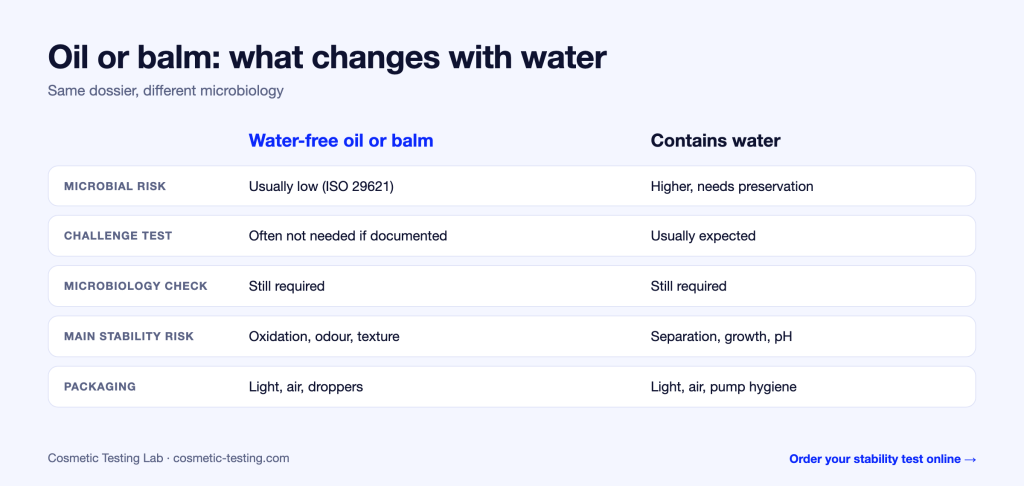
Every oil and balm needs a signed CPSR, a product information file and a CPNP notification before launch. For a truly water-free formula, a challenge test is often not needed if your safety assessor documents the product as low microbiological risk. You still need a microbiological quality check, a stability and compatibility test (oxidation, odour, texture, packaging) and a review of the essential oils and botanical ingredients. If the formula contains any water, the rules change and a challenge test is usually expected.
Which products does this cover?
The same logic applies to facial oils and serums, body oils, massage oils, beard oils, cuticle oils, lip balms, solid body balms, salves and butters. They are leave-on cosmetics. Facial oils are applied close to the eyes and mouth, lip balms are partly swallowed, and baby or massage oils reach large areas of skin. These details change the exposure the assessor considers.
Read also Beard Oil Regulations: Testing Men’s Grooming Products
Do oils and balms need a challenge test?
Preservation efficacy testing exists to show that bacteria and fungi cannot grow in a product during use. Microorganisms need water. ISO 29621 describes microbiologically low-risk products, and a formula without free water (for example a pure oil blend, an oil-and-wax balm or a butter) usually falls into this group. In that case the assessor can accept the risk assessment instead of a challenge test, provided the argument is documented and the formula really is anhydrous.
That conclusion no longer holds when you add water or a water-containing ingredient:
- emulsified balms, creams and lotion-oil hybrids;
- hydrosols, floral waters and aloe vera in an oil serum;
- plant extracts delivered in water or glycerin that bring water with them;
- products that can pick up water in use, such as an open pot touched with wet fingers.
For these, plan a challenge test following ISO 11930. See the details in our guide to the challenge test.
What should the microbiological test cover?
Even an anhydrous product must be free from harmful microorganisms. A microbiological specifications test usually reports the total aerobic count, yeasts and moulds and the absence of specified organisms in the finished product. It also shows that your manufacturing is clean: raw materials, equipment and filling all matter. Test the final formula in the final container, and repeat when the supplier of a main raw material changes.
Oxidation: the real stability risk
Plant oils contain unsaturated fatty acids that react with oxygen, which causes rancid smell and colour change and can reduce skin tolerance. A stability plan for an oil or a balm typically checks:
- odour, colour and clarity over time and at elevated temperature;
- oxidation markers, for example peroxide value, where the plan includes them;
- crystallisation or cloudiness of butters and waxes, and graininess in balms;
- melting or softening of solid balms in warm transport and storage;
- separation if the formula combines oils with waxes or other phases.
Antioxidants such as tocopherol help, but they are not a substitute for testing. The results define the shelf life and the period after opening shown on the label.

Read also Baby Cosmetics Safety Testing: What the File Must Show
Packaging matters more than you think
Essential oils and some oils can soften or attack plastics, rubber teats of droppers and pump seals. Light and air accelerate oxidation. Test the product in the exact bottle, dropper, pump or tin that customers will receive, and think about:
- amber or opaque glass for light protection;
- dropper teat materials that can swell or release substances;
- pumps and closures that let air in;
- label adhesives and inks that may smear when the oil spills.
Essential oils and fragrance allergens
Essential oils are mixtures of many constituents, some of which are known skin allergens. Regulation (EU) 2023/1545 extends the list of fragrance allergens that must be named on the label when present above set levels, with transition dates to check for new and existing products. Some constituents are also restricted, and certain citrus oils contain phototoxic components, so the assessor needs the composition data of each oil, not just the name. Ask your supplier for a certificate of analysis and calculate the allergen content of the final product.
Botanical oils and unwanted impurities
Cold-pressed and natural oils can carry traces of pesticides, heavy metals or other contaminants from the field or the extraction process. The safety assessor expects specifications from the supplier and, for sensitive uses such as lip balms or products for children, a closer look at the impurity profile. Choose suppliers who provide batch-specific certificates, and keep them in the product information file.
Read also Lip Balm Safety Testing: What Lip Products Need Before Sale
Skin safety and patch testing
Facial oils stay on the skin and are used daily, often on sensitive areas. For products with essential oils, botanical extracts or a long “gentle” claim, a 48-hour patch test adds evidence that the finished formula is well tolerated. It supports the safety assessment and any “dermatologically tested” or “suitable for sensitive skin” claim, when the study design allows it.
Claims and labelling for oils and balms
Natural, organic, vegan, non-comedogenic, anti-ageing or “nourishing”: every claim needs support under Regulation (EU) No 655/2013. Terms like “chemical-free” are misleading and should be avoided. The label needs the INCI list (botanical names for plant oils), batch number, nominal content, responsible person details, precautions and a period after opening symbol or a date of minimum durability. If the oil is flammable or the carrier is a fine-fragrance type, check the storage and transport rules, because distributors may ask for a safety data sheet.
Testing checklist for facial oils and balms
- Confirm whether the formula contains any water or water-containing ingredient.
- Document the microbiological risk assessment; add a challenge test when water is present.
- Run a microbiological specifications test on the finished product.
- Test stability, including oxidation, in the final packaging.
- Collect composition data of every essential oil and calculate allergens.
- Consider a patch test for products that stay on the face.
- Build the PIF, request the CPSR, notify in the CPNP.
Common mistakes with oils and balms
- Assuming that an oil never needs microbiological testing.
- Adding a bit of hydrosol or aloe to an “oil” and skipping the challenge test.
- Testing in a glass jar and selling in a plastic pump.
- Copying an essential oil blend from a supplier without checking allergens.
- Giving a long shelf life without oxidation data.
Frequently asked questions
Does a facial oil need a challenge test?
Not if it is genuinely water-free and the risk assessment documents it as low risk. If the formula includes water or a water-containing ingredient, a challenge test is usually required.
Do I need a CPSR for a lip balm or beard oil?
Yes. Any cosmetic placed on the EU market needs a CPSR, whatever the size of the batch or the number of ingredients.
How long does a facial oil last?
It depends on the oils, antioxidants and packaging. A stability test with oxidation checks gives the evidence for the shelf life and the period after opening.
Key takeaways
- Oils and balms need the same dossier as any cosmetic: CPSR, PIF and CPNP.
- Anhydrous formulas may skip the challenge test, but not the microbiological quality check.
- Oxidation and packaging are the main stability risks.
- Essential oils call for allergen calculations and often a patch test.