

A parcel sits in a cold van overnight, a jar is left in a car on a summer afternoon, a pallet crosses a mountain pass in January. Your cosmetic will meet temperatures you never planned for. A freeze thaw test for cosmetics shows what happens when it does, before your customers find out. This guide explains freeze-thaw and temperature cycling tests, how they are run, how to read the results and where they fit in a stability programme.
Contents
- The short answer
- Why temperature cycling matters
- What is the difference between freeze-thaw and temperature cycling?
- A typical test procedure
- What is checked after each cycle?
- Which products are most at risk?
- How to read and use the result
- Where it fits in a stability programme
- Why stability data belongs in your safety file
- Common mistakes
- Frequently asked questions
- Key takeaways
The short answer
A freeze-thaw test exposes a cosmetic product to repeated cycles of freezing and thawing, and temperature cycling alternates between cold and warm conditions. Both check that the product keeps its appearance, texture, smell, pH and packaging performance after the temperature stress of transport and storage. They are quick, inexpensive indicators of physical stability, especially for emulsions and water-based products, but they complement long-term and accelerated stability studies rather than replace them.
Why temperature cycling matters
Cosmetics are rarely kept in the ideal conditions of a laboratory. They travel in unheated lorries, wait in warehouses, sit in shop windows, bathrooms and cars. Freezing water forms ice crystals that can break an emulsion or damage a thickener. Heat softens waxes, lowers viscosity and speeds chemical reactions. Repeating these swings is harder on a formula than steady storage, because the product expands and contracts, and ingredients dissolve and crystallise again each time. A product that is stable at one temperature may still fail after a few cycles.
Read also Natural Cosmetics Stability: Special Challenges and Solutions
What is the difference between freeze-thaw and temperature cycling?
- Freeze-thaw: the product goes below freezing, commonly around −10 °C to −20 °C, and is then brought back to room temperature. It simulates winter transport, an unheated warehouse or a window sill in frost.
- Temperature cycling: the product alternates between a cool temperature (for example a refrigerator) and an elevated one (often 40 to 45 °C). It simulates the daily swings of a hot car, a sunny shelf or a summer shipment.
Some programmes combine both in one sequence. The exact conditions are not fixed by law; they are chosen by the manufacturer and justified, and the ISO technical report on stability testing, ISO/TR 18811, deliberately leaves the protocol to the producer.
A typical test procedure
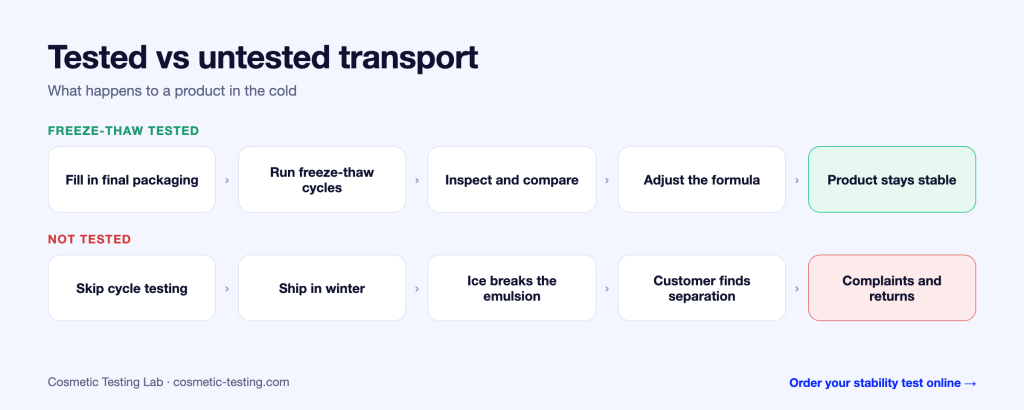
Laboratories use slightly different designs, but a common freeze-thaw protocol looks like this:
- Fill the product into its final packaging, and keep a control sample at room temperature.
- Place samples at a freezing temperature for around 24 hours.
- Move them to room temperature for around 24 hours. This is one cycle.
- Repeat for several cycles, commonly three, and for sensitive products five or more.
- Inspect the samples after each cycle and compare with the control.
- Record the results and decide whether the product passes.
A temperature cycling protocol follows the same pattern, swapping the freezing step for a cold step and adding an elevated-temperature step. Products with a risk of freezing damage can also be tested for how they behave when they are not frozen but cooled to a refrigerator temperature.
What is checked after each cycle?
- Appearance and colour: separation, creaming, oil droplets, sweating, colour change, specks.
- Texture and viscosity: thinning, thickening, graininess, gritty crystals, lumps.
- Smell: any new or stronger odour that can signal degradation.
- pH: a drift may signal ingredient breakdown, and can affect the preservative.
- Packaging: leaks, deformation, cracking, label peeling, pump failure, a bulging lid.
- Re-homogeneity: whether the product returns to its original state after gentle shaking, if the label allows it.
Define the acceptance criteria before you start. A small, reversible change can be acceptable; permanent separation or crystals are not.
Read also What Is Cosmetic Stability Testing? A Plain-English Guide
Which products are most at risk?
Water-containing products are the main concern, because water is what freezes. Typical problem cases are:
- Oil-in-water and water-in-oil emulsions, where ice crystals can push droplets together and break the emulsion.
- Gels and thickened serums made with polymers that lose structure after freezing.
- Surfactant systems such as shampoos and cleansers that turn cloudy or form precipitates in the cold.
- Products with butters, waxes or oils that crystallise or turn grainy after warming and cooling.
- Formulas with sunscreen filters or actives at the edge of their solubility, which can crystallise.
Anhydrous products, such as pure oils and balms, do not freeze-damage in the same way, but they can still melt, bloom or turn grainy under temperature swings, so cycling is still relevant for them.
How to read and use the result
If the product passes every cycle without a significant change, you gain confidence that it will survive normal transport and storage. If it fails, you have learned something cheap and useful. Typical fixes include a different or stronger emulsifier, a better thickener system, a lower or adjusted oil phase, an anti-freeze humectant such as glycerin or propanediol at suitable levels, a change of pH, or protective packaging and a storage instruction. After any change, repeat the test. If you choose to ship with a warning, such as “protect from frost”, the safety assessor will usually want to see why.

Where it fits in a stability programme
Freeze-thaw and cycling are one piece of a complete study. A full programme typically combines:
- Accelerated storage at elevated temperature, to predict shelf life and the period after opening.
- Room temperature and, if relevant, cool storage for real-time observation.
- Light exposure where the pack is transparent.
- Freeze-thaw or cycling for transport stress.
- Compatibility with packaging, because the container can absorb, leach or react with the formula.
At Cosmetic Testing Lab, the stability and compatibility test runs accelerated plans (Basic, Standard and Full) with a signed PDF report. Ask which temperature conditions suit your product and your markets, since a product shipped to cold regions needs more attention than one sold only locally.
Read also Accelerated Stability Testing for Cosmetics at 40°C: How It Works
Why stability data belongs in your safety file
The EU Cosmetics Regulation requires the safety assessment to consider the stability of the product, and the Commission guidance on the CPSR lists stability as part of the physical and chemical characteristics. A signed stability report therefore supports your CPSR and your product information file. Stability and preservation are linked: a product that separates or changes pH can lose protection, so see the challenge test and, for finished-batch quality, the microbiological specifications test.
Common mistakes
- Testing in a lab jar instead of the real packaging.
- Using only one cycle, which can miss slow damage.
- Skipping a control sample, so changes cannot be judged.
- Defining the pass criteria after seeing the result.
- Ignoring a small change that gets worse in the full stability study.
Frequently asked questions
How many cycles are enough?
Three cycles are a common minimum for a first screen, and five or more are used for sensitive formulas or demanding markets. There is no legal number, so justify your choice.
Do I need a freeze-thaw test if I only sell in warm countries?
Possibly not at freezing temperatures, but heat cycling still matters. Review the conditions your product will really face, including transport routes, and test those.
Can I rely on freeze-thaw instead of accelerated stability?
No. It is a stress screen for transport and temperature swings. It does not tell you the shelf life or the period after opening, which need accelerated and real-time studies.
Key takeaways
- Freeze-thaw and cycling tests copy the cold and heat swings of real transport and storage.
- Emulsions, gels, surfactant systems and products with butters are the most at risk.
- Test in the final packaging, with a control sample and set criteria in advance.
- Use it alongside accelerated and real-time stability, not instead of them.