

If you sell cosmetics in the United States, MoCRA adverse event reporting is one of the few duties that applies to every brand, including the smallest. This guide explains in plain language what counts as a serious adverse event, who must report it, how fast, what records you must keep and how to set up a simple process before the first complaint arrives.
Inhoud
- The short answer
- Who is the responsible person?
- What counts as a serious adverse event?
- The 15-business-day clock
- What you send to FDA
- The label must show how to reach you
- Records: six years, or three for small businesses
- Does the small business exemption help?
- Build a simple adverse event process
- Use testing to prevent and investigate cases
- Common mistakes
- How does this compare with the EU?
- Frequently asked questions
- Key takeaways
The short answer
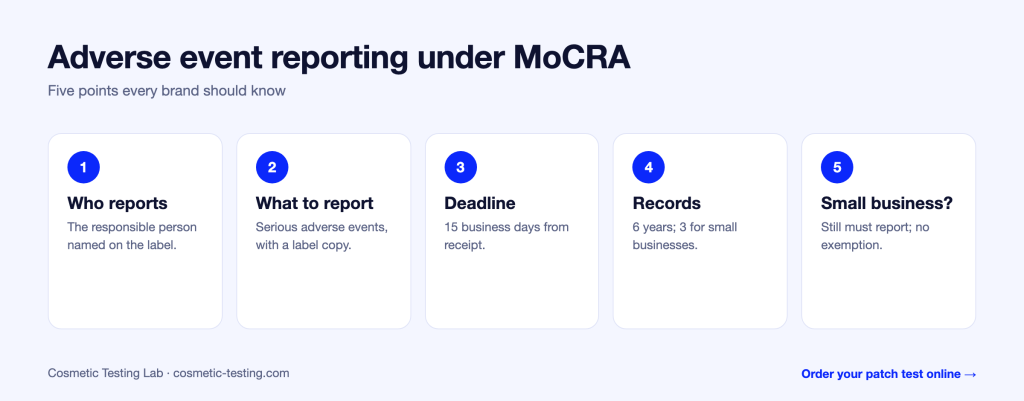
Under the Modernization of Cosmetics Regulation Act (MoCRA), the “responsible person” named on the label must report every serious adverse event to FDA within 15 business days of receiving it, with a copy of the label, and must keep adverse event records for six years (three years for qualifying small businesses). The small business exemption does not remove this duty. A solid safety file, including a CPSR-style safety assessment and a patch test, will not prevent every reaction, but it shows you took safety seriously and makes each case easier to investigate.
Who is the responsible person?
MoCRA defines the responsible person as the manufacturer, packer or distributor of a cosmetic whose name appears on the label. If your brand name and address are on the pack, that is usually you, even when a contract manufacturer fills the bottles. If you are a private-label brand, the company named on the label carries the duty, so agree in writing who receives consumer complaints and who files reports. Do not assume your manufacturer will do it for you.
Lees ook Productinformatiebestand voor cosmetica (PIF): wat moet erin staan?
What counts as a serious adverse event?
An adverse event is any health-related event associated with using a cosmetic that is unwanted. A serious adverse event is the subset that results in, or in reasonable medical judgment requires intervention to prevent:
- death or a life-threatening experience;
- inpatient hospitalization;
- a persistent or significant disability or incapacity;
- a congenital anomaly or birth defect;
- an infection;
- significant disfigurement, which FDA describes as including serious and persistent rashes, second- or third-degree burns, significant hair loss, or a persistent or significant change of appearance.
A mild, short-lived itch or redness is an adverse event you should record, but it is normally not a serious one. A chemical burn that needs treatment at a hospital, or an eye infection linked to a mascara, is the kind of case that must be reported. When in doubt, ask whether a doctor was needed and whether the effect lasted; if the answer is unclear, treat the case as potentially serious and document why you decided as you did.
The 15-business-day clock
The statute says the report is due no later than 15 business days after the report reaches the responsible person. The clock starts when you receive the complaint, whether by email, phone, social media message, a retailer or a review that someone forwards to you. It does not start when you finish investigating. Business days exclude weekends and federal holidays, but a weekend email still counts as received. Put a date stamp on every incoming complaint and assign one person to log it the same day.
What you send to FDA
The report goes to FDA electronically through the route FDA designates for cosmetic reports, and it must include a copy of the product label. In practice, collect these details in your complaint log so the submission takes minutes, not days:
- product name, lot number and where it was bought;
- the reporter’s contact details (handled carefully under privacy rules);
- what happened, when, and how the product was used;
- treatment received and outcome;
- photos of the product and the reaction if the person agrees to share them.
If you later receive new and material medical information about the same case within one year of your first report, you must send it to FDA, again within 15 business days of receiving it. Keep follow-up emails in the same case file.
Lees ook Cosmetovigilantie: ernstige ongewenste effecten melden
The label must show how to reach you
MoCRA requires the label to carry a domestic address, a domestic phone number or electronic contact information (for example a monitored email address or web form) through which the responsible person can receive adverse event reports. Small business status does not change this. Check that the contact route on your pack is real and monitored: a dead mailbox does not pause the 15-day clock, and it will look bad in an inspection. If you also sell in the EU or UK, remember that those markets have their own label rules, so plan a separate label review.
Records: six years, or three for small businesses
You must keep records of each adverse event report you receive, serious or not, together with any related medical records you obtain, for six years. A qualifying small business keeps them for three years, unless it makes the higher-risk product types described below, in which case the six-year period applies. FDA may ask to see these records, so keep them organised and retrievable. A simple spreadsheet or a folder per case works for a small brand, provided entries are dated and nothing is deleted.
Does the small business exemption help?
The exemption covers businesses whose average gross annual US cosmetic sales over the previous three years are under one million US dollars, adjusted for inflation. It exempts them from the GMP and the facility registration and product listing provisions, but not from adverse event reporting, safety substantiation or labelling. It also does not apply at all to makers of products that regularly contact the eye mucous membrane, injected products, products for internal use, or products meant to change appearance for more than 24 hours. Read the full rules in our guide to selling cosmetics in the USA and check your own position before relying on the exemption.
Lees ook Europese cosmeticaverordening 1223/2009 in gewone taal uitgelegd
Build a simple adverse event process
- One inbox. Route the label contact, website form and social messages to one monitored place.
- Same-day log. Record date received, product, lot, symptoms and contact details.
- Triage within a day. Ask the follow-up questions: was medical care needed, how long did it last, how was the product used?
- Decide and document. Serious or not, with the reasoning. If serious, file within the deadline.
- Look at the batch. Check retained samples and records for the lot, and ask whether other complaints exist for it.
- Close the loop. Keep all emails, photos and the FDA confirmation in the case file.
Use testing to prevent and investigate cases
Most serious cases in cosmetics trace back to a few causes: irritation or allergy to an ingredient, contamination, or misuse. A microbiological test and a challenge test reduce the risk of contaminated or poorly preserved products, and a patch test on human volunteers gives evidence about skin tolerance before launch. When a complaint comes in, retained samples tested for microbial quality can quickly show whether the batch was at fault. For brands that also export, a CPSR is required in the EU and combines this data in one signed document. We do not give legal advice, and these tests do not replace reporting.

Common mistakes
- Waiting for the investigation. The deadline runs from receipt, not from your conclusion.
- Assuming the exemption covers it. Small businesses still report.
- Not recording non-serious events. They still need records, and patterns matter.
- Leaving it to the manufacturer. The name on the label owns the duty.
- Losing records. Mixed inboxes and deleted DMs make an inspection painful.
How does this compare with the EU?
In the EU, the Responsible Person must notify the competent authority of serious undesirable effects, and the product information file must contain data on undesirable effects. The idea is similar, but terms, forms and authorities differ, so a US process needs adapting if you sell in both markets.
Frequently asked questions
Do I have to report every customer complaint to FDA?
No. Only serious adverse events must be reported. All adverse event reports you receive should still be recorded and kept for the required period.
What if I am not sure whether an event is serious?
Document the facts and your reasoning, and consider asking a regulatory adviser. If the facts point to hospitalization, medical intervention or lasting harm, file within the deadline rather than waiting.
Do I need to report events that happen outside the US?
The duty relates to cosmetics marketed in the United States. If the same product is sold elsewhere, follow the rules of each market and ask an adviser how overlapping cases should be handled.
Key takeaways
- The brand named on the label must report serious adverse events to FDA within 15 business days of receipt.
- Keep records of every adverse event report for six years, or three years for a qualifying small business.
- The small business exemption does not remove reporting, labelling contact details or safety substantiation.
- Good safety data and a simple complaint process make every case faster to assess.