

If your US formula uses a preservative that the EU restricts, you will have to change it before you ship. This guide to EU restricted preservatives shows which common US preservatives hit limits in Europe, how to read the rules, and how to reformulate without losing microbial protection. It is general information, not legal advice.
Inhoud
- The short answer
- Why a US-compliant formula can fail in the EU
- How to read Annex V
- Isothiazolinones: the biggest change for US formulas
- Parabens: allowed, but with tighter rules
- Formaldehyde releasers and other substances to check
- What to use instead
- Prove the new system works
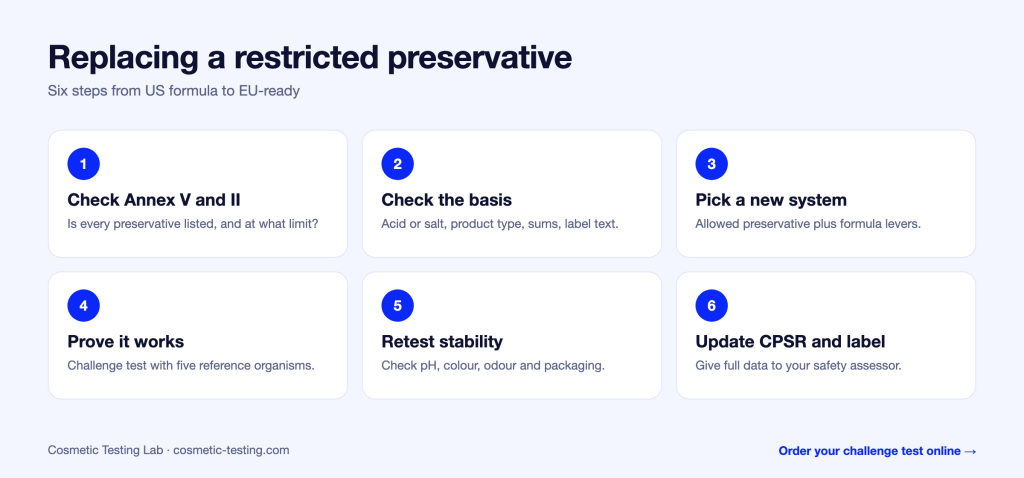
- A practical reformulation checklist
- Frequently asked questions
- Key takeaways
The short answer
In the EU, only preservatives listed in Annex V of Regulation (EC) No 1223/2009 may be added to a cosmetic for preservation, and each comes with limits on concentration, product type or label wording. A US formula that uses methylisothiazolinone, a high paraben load or a formaldehyde releaser often needs reformulating, and every new preservative system must be proven with a challenge test before the safety assessor signs the CPSR. Several EU preservative limits have been tightened over the past decade, so use the current consolidated text and not an old supplier datasheet.
Why a US-compliant formula can fail in the EU
In the US, the FDA does not keep a positive list of preservatives for cosmetics. Brands choose a preservative, are responsible for the safety of the product, and prove that safety through the evidence they hold. The EU works the other way round: Annex V is a closed list. If a substance is used as a preservative and is not on it, it cannot be added for that purpose, and several well-known substances are prohibited outright in Annex II.
That means a formula that is fully legal at home can contain a substance that is limited, restricted to certain product types, or not allowed at all in Europe. Finding this early is far cheaper than discovering it when the safety assessor reviews the file.
Lees ook In de EU toegelaten conserveermiddelen voor cosmetica: bijlage V uitgelegd
How to read Annex V
Each entry lists the substance, its INCI name and a maximum concentration, usually calculated in a specific way (for example as the acid, not the salt). Other columns restrict the product type (for instance rinse-off only), set a limit for children under three, or require a warning on the label. Substances that are also on other lists, such as the fragrance allergen list, follow those rules in addition.
Three practical points save time:
- Check the concentration basis. A limit expressed as the acid means you must convert salts and esters.
- Check the product type. A preservative allowed in a shampoo may be banned in a leave-on cream.
- Check sums and mixtures. Some entries cap the total of a group of related substances, not each one.
Isothiazolinones: the biggest change for US formulas
Methylisothiazolinone (MIT) became a major contact allergen, and the EU acted. Regulation (EU) 2016/1198 prohibited MIT in leave-on products, and Regulation (EU) 2017/1224 lowered the rinse-off limit to 0.0015% (15 ppm). The mixture of methylchloroisothiazolinone and methylisothiazolinone is also limited to 0.0015% in rinse-off products and is not allowed in leave-on products. The two entries are mutually exclusive in the same product.
If your US lotion, wipe or leave-on hair product relies on MIT, it must be replaced entirely. Rinse-off products need a hard look at the actual dose, because 15 ppm is far below what many US formulas use. Note that scientific committees have kept reviewing these substances, so confirm the latest text before you finalise.
Parabens: allowed, but with tighter rules
Parabens are not banned in the EU, which surprises many US brands. They are, however, tightly restricted:
- Methylparaben and ethylparaben: up to 0.4% (as acid) for a single ester and 0.8% for mixtures of esters.
- Propylparaben and butylparaben: a combined maximum of 0.14% (as acid), and not in leave-on products designed for the nappy area of children under three years.
- Isopropyl-, isobutyl-, phenyl-, benzyl- and pentylparaben are prohibited.
A US formula that stacks four parabens for broad-spectrum cover can exceed these sums even when each single value looks small. Add them up on the same basis before you decide.
Lees ook Natuurlijke conserveermiddelen voor cosmetica die echt werken
Formaldehyde releasers and other substances to check
Formaldehyde and several releasers are tightly regulated. Where a finished product contains formaldehyde above 0.05%, the label must state “releases formaldehyde”. Some releasers have been removed from the allowed list over time. Methyldibromo glutaronitrile, once common, is no longer allowed. Others, such as DMDM hydantoin, remain on Annex V with a cap, so check the entry and its label requirement instead of assuming.
Other ingredients with typical limits include phenoxyethanol (1%), benzyl alcohol and salicylic acid (with age and product-type conditions). Many US formulas sit close to these limits, so verify each ingredient on the current list.
What to use instead
There is no single drop-in replacement. Most reformulations combine several measures:
- Allowed preservatives at permitted levels, for example phenoxyethanol-based systems, organic acids and their salts such as benzoates and sorbates (pH-dependent), or other Annex V entries suited to your product type.
- Multifunctional ingredients such as certain glycols and fatty-acid esters that support preservation. They are not a substitute on their own, and the claim “preservative-free” needs care.
- Formula levers: lower water activity, adjusted pH, chelating agents, and fewer nutrient-rich botanicals.
- Process and packaging: airless pumps and clean production lower the load the preservative has to handle.
The right option depends on your emulsion, pH, surfactants and packaging. A system that works at pH 5 may fail at pH 7.
Prove the new system works
Whenever you change the preservative system, you cannot rely on the old data. A challenge test challenges the product with five reference microorganisms over 28 days, and the standard we apply is ISO 11930:2019 or USP 51. The EU CPSR guidance expects this evidence for products where microbial growth is a risk, such as water-based formulas. After the challenge test, run a microbiological specifications test on the finished product to confirm its quality.
Also repeat stability and compatibility testing. A new preservative can change pH, colour, odour or viscosity, and it can interact with the packaging. A preservative that passes today but loses efficacy after months at warm storage is a hidden risk.
Lees ook Regelgeving voor nanomaterialen in cosmetica: regels en notificatie
A practical reformulation checklist
- List every ingredient with its function and concentration.
- Check each preservative against the current Annex V and Annex II.
- Check product type, concentration basis, sums and label conditions.
- Choose a new system and make a small test batch.
- Run a challenge test, then stability and microbiological tests.
- Give the full data to your safety assessor for the CPSR.
- Update the label, including any required warning wording.
Frequently asked questions
Are parabens banned in the EU?
No. Several parabens are allowed within limits, and some are prohibited. The limits are lower than many US formulas assume, especially for propylparaben and butylparaben.
Can I keep my US preservative if the product is rinse-off only?
Sometimes. Some entries allow a higher use in rinse-off than in leave-on, but the limit still applies. Methylisothiazolinone, for example, is capped at 15 ppm even in rinse-off products.
Do I need a new challenge test after changing the preservative?
Yes. A different preservative system is a different product from a microbiological point of view, so the earlier results do not carry over.
Key takeaways
- The EU allows only Annex V preservatives, with concentration, product-type and label conditions.
- MIT in leave-on products is prohibited, and rinse-off use is capped at 15 ppm.
- Parabens are allowed within tighter limits, with some banned outright.
- Every new preservative system needs a challenge test, stability data and a signed CPSR.