
California gets the attention, but state cosmetics laws on PFAS and other chemicals now reach well beyond it. Washington, Minnesota, Maine, Colorado, Maryland and Vermont have their own bans, with different scopes, dates and penalties, and New York is a state to watch. If you sell nationally, you need one compliance check that covers all of them. This guide compares the laws that matter most and shows how to build that check.
Inhoud
- The short answer
- Why a state-by-state view matters
- Washington: the Toxic-Free Cosmetics Act (HB 1047)
- Minnesota: Amara’s Law
- Maine, Vermont and Colorado
- New York and other watch-list states
- Intentionally added versus trace PFAS
- Why the SDS will not settle this
- Build a multi-state compliance matrix
- Reformulating without breaking the product
- Common mistakes
- Frequently asked questions
- Key takeaways
The short answer
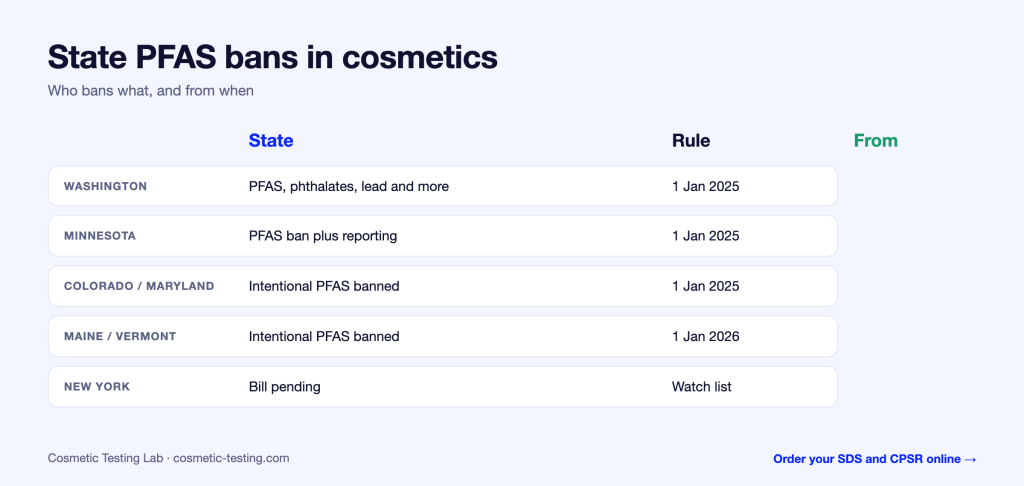
Several states ban intentionally added PFAS in cosmetics, namely Colorado, Maryland, Minnesota and Washington since 1 January 2025, and Maine and Vermont since 1 January 2026, while Washington also bans phthalates, formaldehyde, lead and other chemicals and Minnesota adds a PFAS reporting duty. New York has no enacted cosmetics ban that we could confirm; a bill is pending. The patchwork changes often, so this article is general information, not legal advice. Verify each date on the official pages in the sources before you rely on it.
Why a state-by-state view matters
The federal law, MoCRA, regulates facility registration, product listing and safety substantiation, but it does not set a national ingredient ban list. States have filled the gap. Because most brands ship nationwide, the strictest state in effect decides the formula. Marketplaces and retailers also ask for declarations that cover all states. If you already compared the EU and US approaches, you know the EU prohibited-ingredient list is long and centrally managed; in the US you have a growing set of local lists. Our guide to the CPSR shows how an EU safety assessment screens each ingredient, a habit worth copying for US state checks.
Lees ook Europese cosmeticaverordening 1223/2009 in gewone taal uitgelegd
Washington: the Toxic-Free Cosmetics Act (HB 1047)
Washington’s law, signed in May 2023, has the broadest ingredient list outside California. From 1 January 2025, it bans intentionally added:
- PFAS
- ortho-phthalates
- formaldehyde and methylene glycol
- mercury and mercury compounds
- triclosan
- m-phenylenediamine and o-phenylenediamine and their salts
- lead and lead compounds (and lead at or above 1 ppm)
The law also lets the Department of Ecology restrict formaldehyde-releasing chemicals by rule, an initial set from 2026 and the rest from 2027 at the earliest. Retailers could sell existing stock until 1 January 2026, but that allowance did not extend to manufacturers. Manufacturers that produce, import or distribute non-compliant products face civil penalties per violation, with higher penalties for repeat offences. Check the session law text for the exact figures.
Minnesota: Amara’s Law
Minnesota Statute 116.943 prohibits selling, offering or distributing cosmetics with intentionally added PFAS, effective 1 January 2025. It covers 10 other product categories too. A cosmetic is defined as an article, excluding soap, applied to the body to cleanse, beautify or alter appearance, and components count too. Minnesota also created a reporting duty: manufacturers of products with intentionally added PFAS sold in the state must report details such as product description, purpose of the PFAS and amount by CAS number. The initial deadline of 1 January 2026 has been moved more than once (a September 2026 date has been reported), so confirm the current date with the Minnesota Pollution Control Agency. The statute also allows the agency to require test results and a certificate of compliance within 30 days of a request.
Maine, Vermont and Colorado
- Maine: from 1 January 2026, selling cosmetics with intentionally added PFAS is prohibited. The ban also reaches products sold in a fluorinated container or one containing intentionally added PFAS, so packaging matters. Soap and prescription products are outside the definition.
- Vermont: reported ban from 1 January 2026 on cosmetics with intentionally added PFAS, with a trace-amount exception for technically unavoidable presence. Confirm against the statute.
- Colorado: HB 22-1345 prohibits selling or distributing cosmetics with intentionally added PFAS from 1 January 2025.
Maryland also bans a list of chemicals, including 13 named PFAS, in cosmetics from 1 January 2025. Connecticut is reported to phase in a labeling and notice requirement from mid-2026 and a full ban from 2028; verify before planning around it. Other states, such as New Jersey, Oregon and New Hampshire, are reported to be moving as well.
Lees ook Verantwoordelijke persoon voor cosmetica (RP): wie heeft er een nodig en wat doet hij?
New York and other watch-list states
New York has enacted PFAS limits for apparel and menstrual products, but when we checked, we could not confirm an enacted cosmetics ban. The Beauty Justice Act, which would cover PFAS and other chemicals in personal care products, was still pending. Treat New York as a watch-list state and check the legislature’s site before shipping decisions.
Intentionally added versus trace PFAS
Most of these laws target intentionally added PFAS, meaning PFAS deliberately included to give the product a function such as water resistance or slip. Trace contamination from raw materials or processing is treated differently, and some laws include trace or unavoidable-use language while others leave it to rulemaking. A supplier’s statement that PFAS are “not intentionally added” is not an analytical result. Laboratory PFAS testing is a specialist field that we do not offer, so ask your supplier or a specialised lab, and keep the results in your file.
Why the SDS will not settle this
A safety data sheet lists classified hazards and ingredients above set thresholds. Many restricted substances, PFAS included, are not hazard-classified and may not appear. Use the SDS for transport, workplace and wholesale questions, and run a separate ingredient screen for state bans.
Lees ook CPNP-kennisgeving: zo registreert u een cosmetisch product
Build a multi-state compliance matrix
- List every SKU and every state you ship to, including marketplace sales.
- Export full ingredient lists with CAS numbers, including fragrance, colour and preservative components.
- Screen each ingredient against each state’s list; keep one matrix with ingredient, state, law, date and decision.
- Collect supplier declarations that cover PFAS, phthalates, formaldehyde releasers, lead and mercury.
- Check packaging: Maine looks at fluorinated containers.
- Set reminders for effective dates and review the matrix at least twice a year.
Reformulating without breaking the product
Replacing a PFAS ingredient usually means a new silicone, ester or polymer, and replacing a formaldehyde releaser means a new preservative system. Both change how the product behaves. Run stability tests on the new version, and a microbiological test on the finished product. For water-based formulas, a challenge test confirms that the new preservation system works. Batch-to-batch records show regulators and retailers that you acted in good time.
Common mistakes
- Only following California: Washington adds lead and triclosan, and Maine looks at containers.
- Trusting old stock: sell-through periods differ, and in Washington the one for retailers did not protect manufacturers.
- Ignoring reporting laws: a product can be legal to sell but still require a report, as in Minnesota.
- Relying on a single supplier email: ask for a signed declaration with CAS numbers and a date.
- Assuming federal preemption: MoCRA has carve-outs that, in our reading of the FDA summary, leave state ingredient bans in place. Confirm with a US lawyer.
Frequently asked questions
Do these laws apply to online sales shipped into the state?
Generally yes. The laws apply to products sold, offered or distributed in the state, which normally includes online orders delivered there. Confirm with counsel for your situation.
Is soap covered?
Several laws, including Minnesota, Maine and Washington, exclude soap from the cosmetic definition, but the wording differs. Check each definition rather than assuming.
Can a CPSR help with US state laws?
A CPSR is an EU document, but its ingredient-by-ingredient review is a good base for US screening, because many state lists copy chemicals already prohibited in the EU. Our CPSR service gives you that file with a signed assessment.
Key takeaways
- Six or more states ban intentionally added PFAS in cosmetics; Washington also bans phthalates, formaldehyde, lead and more.
- Minnesota adds a PFAS reporting duty; Maine also reaches fluorinated containers.
- New York remains pending; keep a watch list and re-check dates.
- Keep a multi-state matrix, supplier declarations and re-test after any reformulation.