

Many brands assume that a formula sold legally in the US can be shipped to Europe unchanged. It cannot always be. Several ingredients banned in the EU are still allowed in the US, and the EU also caps or conditions many more that US law leaves to the brand’s own judgement. This guide shows why the lists differ, gives verified examples, and sets out a practical check you can run before you export.
Innhold
- The short answer
- Why do the two systems differ?
- Example 1: Lilial (butylphenyl methylpropional)
- Example 2: HICC (Lyral)
- Example 3: Methylisothiazolinone in leave-on products
- Example 4: Parabens
- Other groups that need a second look
- A six-step check before you export
- What if an ingredient fails?
- Common mistakes
- Frequently asked questions
- Key takeaways
The short answer
US federal law prohibits or restricts only a short list of cosmetic ingredients by name, while the EU keeps long annexes of banned and restricted substances in Regulation (EC) No 1223/2009. Ingredients such as Lilial, HICC (Lyral) and methylisothiazolinone in leave-on products can be legal in the US yet cannot be placed on the EU market. Before exporting, compare every ingredient and its concentration with the EU annexes, and have the result reviewed in the safety assessment (CPSR).
Why do the two systems differ?
The US framework puts the responsibility on the company: a cosmetic must be safe, properly labeled and not adulterated, and the FDA can act when a problem appears. Beyond a few named substances and the colour additive rules, there is no general positive or negative ingredient list. The FDA’s own page on prohibited and restricted ingredients names only a handful by regulation: bithionol, chlorofluorocarbon propellants, chloroform, halogenated salicylanilides, hexachlorophene, mercury compounds, methylene chloride, certain cattle materials, vinyl chloride and zirconium-containing complexes in aerosols, plus the rules for sunscreen ingredients and colour additives. The EU works differently. Its cosmetics Regulation lists prohibited substances in Annex II (well over a thousand entries), restricted ones in Annex III, and approved colourants, preservatives and UV filters in Annexes IV, V and VI. Article 15 also bans substances classified as carcinogenic, mutagenic or toxic for reproduction (CMR 1A or 1B) unless specific conditions are met.
The result: the EU list is updated regularly, so a formula that was acceptable two years ago may need review today.
Les også CMR-stoffer i kosmetikk forklart: hva er forbudt
Example 1: Lilial (butylphenyl methylpropional)
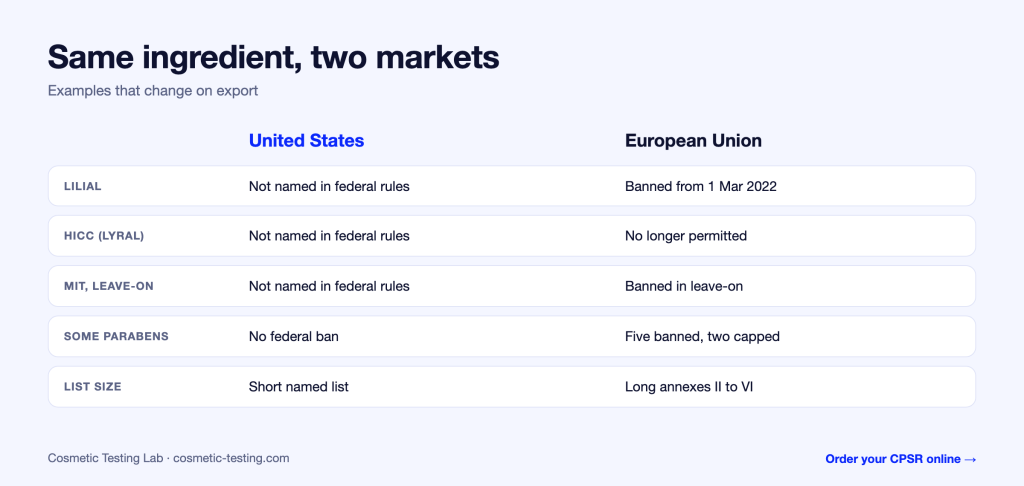
Lilial is a fragrance ingredient with a soft floral note. In the EU it was prohibited by Commission Regulation (EU) 2021/1902, with the ban applying from 1 March 2022, after it was classified as toxic for reproduction. It is covered by the CMR rules and also affects products already on the shelf, not just new ones. The FDA’s allergen page lists Lilial among older fragrance allergens and notes that it is no longer in the EU list because the EU no longer permits it in cosmetics. Nothing in the US cosmetic rules by name stops its use. If your fragrance supplier uses it, your product may need a new fragrance before export.
Example 2: HICC (Lyral)
HICC, also called Lyral, is another fragrance ingredient that was removed from the EU market because of its link to contact allergy. The FDA allergen page notes it is no longer in the EU list because the EU no longer permits it. As with Lilial, this is a case where an older fragrance formula can contain a substance that is fine for US sale but not for the EU. Ask your fragrance house for the full composition, not only an IFRA certificate.
Example 3: Methylisothiazolinone in leave-on products
Methylisothiazolinone (MIT) is a preservative. After a rise in allergic reactions, the EU banned it in leave-on cosmetics (Commission Regulation (EU) 2016/1198, applying from early 2017) and later reduced the permitted level in rinse-off products to a very low figure. In the US no federal rule names MIT, so it can still appear in leave-on products. For an exporter, this matters for lotions, creams and wipes. Check the current Annex V entry and replace the preservative if the product is leave-on. A replacement system must be proven, which means a new challenge test.
Les også Forbudte kosmetiske ingredienser i EU: guide til vedlegg II og III
Example 4: Parabens
The EU did not ban all parabens. It prohibited five of them (isopropylparaben, isobutylparaben, phenylparaben, benzylparaben and pentylparaben) and limited propylparaben and butylparaben to a combined maximum of 0.14%, with extra conditions for leave-on products intended for the nappy area of children under three. Methylparaben and ethylparaben remain permitted within their annex limits. Check the current Annex II and V texts, because details have been amended. In the US there is no federal ban on these parabens, so a formula can contain a level or type that an EU assessor will not accept.
Other groups that need a second look
Banned substances are only part of the picture. Allowed ingredients also face conditions in the EU:
- Colourants (Annex IV): only listed colourants and uses are allowed, and several US colour additives have no EU equivalent.
- UV filters (Annex VI): the approved list and maximum concentrations differ from US sunscreen rules.
- Preservatives (Annex V): a positive list with maximum levels and conditions.
- Fragrance allergens: Regulation (EU) 2023/1545 requires named allergens on the label above set thresholds.
- Nanomaterials: they need notification and are checked individually.
- Microplastics: an EU restriction on intentionally added synthetic polymer microparticles is being phased in, with different dates by product type.
The lists are not symmetrical: a few ingredients are accepted in the EU but not in the US, so the check works in both directions when you import.
A six-step check before you export
- Export the full formula with INCI names, CAS numbers and percentages, including the fragrance and any premixes.
- Look up each ingredient in the EU cosmetic ingredient database (CosIng) and the Annexes II to VI.
- Check concentrations and conditions, such as product type, body area, age group and combined limits across related ingredients.
- Screen for CMR classification and for recent amendments, since the annexes change.
- Review the fragrance with your supplier, including allergens above the labeling thresholds.
- Record the outcome in your product file. The safety assessor will reach the same conclusions from the data, so it saves time to arrive prepared. Our guide on what a CPSR is shows what the assessor evaluates.
Les også Regulering av nanomaterialer i kosmetikk: regler og melding
What if an ingredient fails?
You usually have three options. First, replace the ingredient with an EU-compliant alternative that performs similarly. Second, adjust the level to the permitted maximum if the substance is restricted rather than banned. Third, make an EU-specific version of the product and keep the original for the US. In all cases, reformulation changes stability and preservation. Re-run the stability test for the new formula and the challenge test for water-containing products before the assessor signs off. Do not assume that existing US data automatically carries over.
Common mistakes
- Checking only the main actives and forgetting fragrance, preservatives and colour premixes.
- Relying on “FDA compliant” as proof the formula is EU-ready.
- Using an old ingredient list from a supplier without checking recent annex changes.
- Replacing a preservative without repeating preservation testing.
- Assuming that a transition period lets you ship old US stock to the EU.
Frequently asked questions
Is a US cosmetic with Lilial illegal in the EU?
Yes, a cosmetic containing Lilial can no longer be placed on the EU market since the ban applied from 1 March 2022. The same product can still be marketed in the US, because no federal rule names the substance.
Where can I check whether an ingredient is allowed?
Start with the annexes of Regulation (EC) No 1223/2009 on EUR-Lex and the CosIng database, then confirm the current wording, because annexes are amended often. Your safety assessor will do the same check formally.
Does MoCRA bring the US closer to the EU list?
MoCRA adds registration, listing, safety substantiation and adverse event reporting, but it does not copy the EU annexes. Ingredient bans remain mostly different between the two systems.
Key takeaways
- Gap: the US names a few banned ingredients; the EU keeps long annexes.
- Examples: Lilial, HICC, MIT in leave-on products and some parabens are treated differently.
- Check: screen every ingredient, including the fragrance, against Annexes II to VI before export.
- Reformulate: a replacement needs new stability and, for water-based products, new challenge test data.