

Slovenia is a small but well-organised EU market, with drugstore chains, pharmacies and a strong interest in natural and locally made cosmetics. If you want to sell cosmetics in Slovenia, you follow the same EU rules as everywhere else in the Union, plus a short list of national points: Slovene on key label items, a national implementing decree, two named authorities and, for Slovenian responsible persons, a product file in Slovene. Our laboratory is based in Slovenia, so these are questions we hear often. This guide explains them for brands that already comply with Regulation (EC) No 1223/2009 or are preparing to.
Contents
- The short answer
- The EU baseline in brief
- Who supervises cosmetics in Slovenia?
- Which label information must be in Slovene?
- Product information file in Slovene
- Registering a Slovenian responsible person
- Microbiological quality tied to ISO 17516
- Distributors, translations and professional products
- Penalties
- Practical checklist for Slovenia
- Common mistakes
- Frequently asked questions
- Key takeaways
The short answer
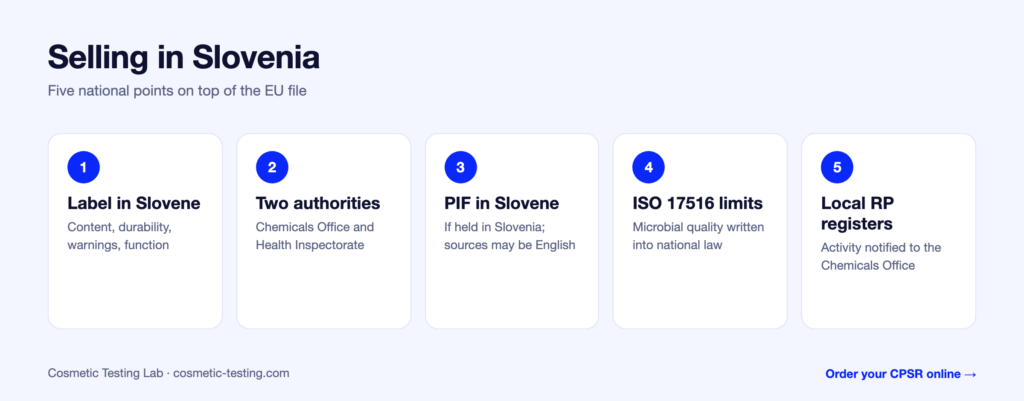
For Slovenia you need the standard EU file: a responsible person in the EU, a signed CPSR, a product information file and a CPNP notification. Nationally, the Decree on the implementation of the EU Cosmetics Regulation requires Slovene for key label information, names the Chemicals Office of the Republic of Slovenia and the Health Inspectorate as competent authorities, ties microbiological quality to ISO 17516 and, since 2023, requires the information in the product file to be in Slovene. This is general information, not legal advice; check details with the competent authority.
The EU baseline in brief
Four elements apply in every EU country, Slovenia included:
- Responsible person (RP): a company or person established in the EU, named on the label, accountable for compliance.
- Safety report (CPSR): Part A (product data) and Part B (safety assessment), signed by a qualified safety assessor.
- Product information file (PIF): the CPSR, formula, manufacturing method, claim evidence and test reports, kept for ten years after the last batch.
- CPNP notification: every product is notified in the EU portal before it is placed on the market.
There is no separate Slovenian product registration. A product correctly notified in CPNP can be sold in Slovenia once the national label and file points below are covered.
Read also Selling Cosmetics in Croatia: Rules, Authorities and Labels
Who supervises cosmetics in Slovenia?
The national rules sit in the Uredba o izvajanju Uredbe (ES) o kozmetičnih izdelkih (Decree on the implementation of the EU Cosmetics Regulation, Official Gazette 61/2013, amended in 2023). It names two competent authorities:
- Chemicals Office of the Republic of Slovenia (Urad Republike Slovenije za kemikalije), a body within the Ministry of Health. It cooperates with the European Commission and other member states, collects reports of serious undesirable effects and keeps a register of Slovenian responsible persons.
- Health Inspectorate of the Republic of Slovenia (Zdravstveni inšpektorat RS, ZIRS). Health inspectors carry out inspections and take samples, and the inspectorate is responsible for the regulation’s articles on the obligations of responsible persons and distributors, traceability and in-market control.
In practice, an inspector may visit a shop, a warehouse or the responsible person, check labels and ask for the product information file within a set deadline.
Which label information must be in Slovene?
Article 19(5) of the EU regulation lets each member state decide which label items must be in its language. Slovenia requires the following in Slovene on the packaging:
- the nominal content (weight or volume);
- the date of minimum durability or the period after opening;
- precautions for use and warnings;
- the function of the product, unless it is clear from its presentation;
- the information placed on an enclosed leaflet, label or card when the packaging is too small, and the rules for non-prepacked products.
The ingredient list stays in INCI names, which are the same in every EU language. The brand name and the responsible person’s name and address do not need translating. Slovenian retailers usually ask for the Slovene text early, so plan a sticker or a multilingual label before your first delivery.
Product information file in Slovene
The 2023 amendment added a rule that the information in the product information file must be in Slovene, while sources and original technical and scientific documents may be provided in English. This matters most if your responsible person, and therefore the file, is in Slovenia. Test reports and the CPSR in English are generally fine as source documents, but expect to provide Slovene summaries or a Slovene version of the main information. If your responsible person is in another EU country, the rules of that country apply to the file’s language.
Read also Selling Cosmetics in Germany: Rules, Authorities and Labels
Registering a Slovenian responsible person
If you set up as a responsible person in Slovenia, the decree requires you to register your activity in advance with the Chemicals Office, using the form published on its website, and to report changes within 15 days. This is separate from the CPNP notification of each product. Foreign brands that use a responsible person in another member state do not register in Slovenia for that reason alone.
Microbiological quality tied to ISO 17516
Unusually, the Slovenian decree writes the microbiological limit values of EN ISO 17516:2014 into national law: the responsible person must make sure the product meets them. For most cosmetics that means a total count of at most 1,000 CFU per gram or millilitre, and 100 CFU for products for the eye area, mucous membranes and children under three, with specified microorganisms absent. A microbiological specifications test on the finished product is the simplest proof, and a challenge test shows that the preservation holds during use.

Distributors, translations and professional products
- Distributors who translate labels: a distributor who makes available in Slovenia a product already on the market elsewhere, and translates label elements on its own initiative, must submit a distributor notification in CPNP.
- Distributor checks: before selling, a distributor checks that the label information is present and that the Slovene language rules are met. Your Slovenian partner will ask you for this.
- Professional-use products: since 2023, responsible persons and distributors must make sure that cosmetics intended only for professional use are accessible only to professional users.
- Serious undesirable effects: reports go to the Chemicals Office through the national e-government portal.
Read also Selling Cosmetics in France: Rules, Authorities and Labels
Penalties
The decree sets fines for companies, sole traders and responsible individuals, for example for missing product files, missing Slovene label information or failing microbiological limits. Inspectors can also order products off the shelves. A complete file and correct labels are the best protection.
Practical checklist for Slovenia
- Confirm your EU responsible person and CPNP notification.
- Make sure the CPSR is signed and based on stability, microbiological and, for water-based products, challenge test data.
- Prepare Slovene text for nominal content, durability or PAO, warnings and function.
- If the responsible person is in Slovenia, register the activity with the Chemicals Office and keep the file information in Slovene.
- Check that the product meets ISO 17516 limits.
- Give your Slovenian distributor the CPNP reference, label text and contact for documents.
Common mistakes
- Translating only the product name and leaving warnings in English.
- Assuming an English-only product file is enough for a Slovenian responsible person.
- Forgetting the distributor notification when a local partner translates the label.
- Selling professional-only products freely online.
Frequently asked questions
Do I need to register my cosmetic products in Slovenia?
No separate product registration exists. Products are notified once in CPNP. A responsible person based in Slovenia registers its activity with the Chemicals Office.
Does the whole label have to be in Slovene?
No. Key items such as nominal content, durability, warnings and function must be in Slovene; INCI names, the brand and the responsible person’s address stay as they are.
Can my CPSR be in English?
Original technical and scientific documents may be in English, but if the file is held in Slovenia, its information must be available in Slovene.
Key takeaways
- Slovenia applies the EU regulation through a national decree from 2013, amended in 2023.
- The Chemicals Office and the Health Inspectorate are the competent authorities.
- Key label items must be in Slovene, and a Slovenian product file must be in Slovene.
- Microbiological quality must meet ISO 17516 limits, so test before you launch.