

Sugar scrubs, salt scrubs, coffee scrubs, shower exfoliators: they feel simple to make and satisfying to use, which is why so many small brands start with them. But body scrub testing is not simpler than testing a cream. A scrub combines abrasive particles, oils, often surfactants and sometimes water, and it is used in a wet bathroom with wet hands. This guide explains what an exfoliator needs before you sell it in the EU and where scrubs most often go wrong.
Contents
- The short answer
- What counts as a body scrub?
- Choosing the exfoliating particles
- Do scrubs need a challenge test?
- Microbiological quality of the finished scrub
- What a stability test checks in a scrub
- Packaging: jars, tubes and pumps
- Skin tolerance and the “gentle” claim
- Fragrance, essential oils and colour
- Labelling checklist for scrubs
- Common mistakes with scrubs
- Testing plan in practice
- Frequently asked questions
- Key takeaways
The short answer
Every body scrub placed on the EU market needs a signed CPSR, a product information file and a CPNP notification, whatever its size or batch. The data behind it usually includes a stability and compatibility test (particles, texture, colour, fragrance, packaging) and a microbiological quality check. A challenge test is expected when the formula contains water or can take up water in use, and a scrub that looks “dry” often can. The abrasive itself must be chosen carefully, because the EU restricts plastic microbeads.
What counts as a body scrub?
Body scrubs, foot scrubs, lip scrubs, shower exfoliators, exfoliating soaps and polishing salts are all cosmetics: products applied to the skin to clean or care for it. They come in three common formats:
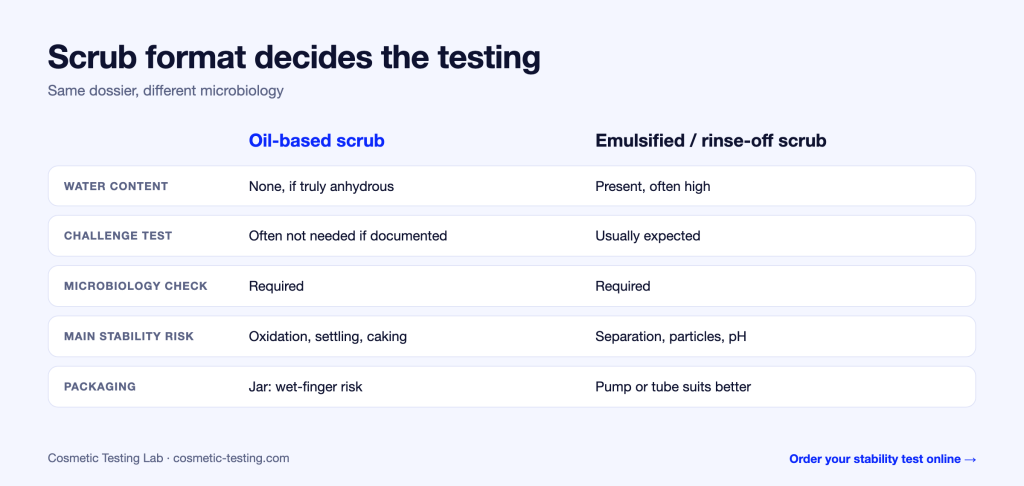
- Oil-based scrubs: sugar or salt suspended in oils and butters, usually sold in jars.
- Emulsified scrubs: a cream or gel base containing water plus particles.
- Surfactant scrubs: a washing base with particles, rinsed off in the shower.
The format decides the microbiological risk, so identify it first.
Read also Hair Dye Testing: What the EU Requires Before You Sell
Choosing the exfoliating particles
The particles are the heart of the product, and the regulatory and safety questions start there.
- No plastic microbeads. Regulation (EU) 2023/2055 restricts synthetic polymer microparticles. For microbeads used to exfoliate, polish or cleanse, the restriction has applied since the regulation came into force in October 2023, and the transition periods for other uses are different. Check the exact dates for your product type in the regulation.
- Natural and mineral options such as sugar, salt, coffee, ground shells or seeds, clays, pumice, jojoba esters or cellulose are the usual alternatives. They are not automatically gentle.
- Particle shape and size matter. Fine, rounded particles polish the skin. Sharp, irregular fragments from crushed nutshells or fruit stones can scratch and may be unsuitable for the face, lips or damaged skin.
- Source and purity. Ground plant materials can carry dust, mould spores, pesticide residues or traces of heavy metals, so ask for a certificate of analysis for every batch.
Do scrubs need a challenge test?
A challenge test shows that bacteria and fungi cannot multiply in the product during its life. Microorganisms need water, so the answer depends on the format:
- Emulsified and surfactant scrubs contain water and almost always need a challenge test following ISO 11930.
- Anhydrous oil-and-sugar scrubs can be documented as low microbiological risk under the logic of ISO 29621, but only if the formula really contains no free water.
- Hidden water changes that. Hydrosols, aloe, fruit purees, honey, plant extracts in water or glycerin, and moist ingredients such as fresh coffee grounds all bring water in.
In use, the risk rises again: customers dip wet fingers into an open jar in the shower. Even an oil-based scrub can pick up water and contamination, which is why the assessor will look at the packaging and the instructions for use as well as the formula. Our guide to the challenge test explains the method and the criteria.
Microbiological quality of the finished scrub
Regardless of format, the finished product must be free from harmful microorganisms. A microbiological specifications test usually reports the total aerobic count, yeasts and moulds and the absence of specified organisms such as Pseudomonas aeruginosa, Staphylococcus aureus, Escherichia coli and Candida albicans. It also shows whether your raw materials, equipment and filling are clean. Natural particles deserve special attention because they bring their own microbial load.
Read also Body Lotion Testing: What Hand and Body Creams Need Before Sale
What a stability test checks in a scrub
Scrubs are physically unstable products by nature, with solids in a liquid or semi-solid base. A stability plan typically looks at:
- particles settling to the bottom or floating to the top, and whether a quick stir restores the product;
- oil separation and a layer of oil on the surface;
- sugar or salt dissolving into any water in the formula, which changes texture and can grow crystals;
- colour and fragrance changes at elevated temperature and in light;
- oxidation of oils and butters, with odour as the first sign;
- melting, hardening or caking of butter-based scrubs in warm or cold storage and transport.
The results support the shelf life and the period after opening printed on the label.
Packaging: jars, tubes and pumps
A scrub behaves differently in each pack, so test it in the container customers will receive. Wide jars invite finger contact and water. Pumps and tubes protect the formula better but can clog with large particles. Essential oils and some oils can soften plastic liners and lid seals, and glass jars in a shower raise a safety question that is worth stating clearly in the instructions. Keep the stability and compatibility data for each pack type in the file.

Skin tolerance and the “gentle” claim
Physical exfoliation removes the outer layer of dead skin cells, and over-use or the wrong particle can leave skin red and tender. Exfoliators with acids such as AHA or BHA add a chemical effect that the assessor must evaluate for concentration and pH. If you want to say “gentle”, “for sensitive skin” or “dermatologically tested”, support the claim with data: a 48-hour patch test gives evidence on the finished formula and fits into the safety assessment when the study design allows it. Claims need evidence under Regulation (EU) No 655/2013.
Read also Lip Balm Safety Testing: What Lip Products Need Before Sale
Fragrance, essential oils and colour
Scrubs are often strongly scented. Fragrance allergens must be listed on the label when present above the thresholds set in the cosmetics rules, and Regulation (EU) 2023/1545 widens the list with transition dates for new and existing products. Citrus oils may be phototoxic, which matters when a scrub is used before sun exposure. Colourants must be permitted for the intended use, and some can stain the skin, grout or towels.
Labelling checklist for scrubs
- INCI ingredient list, including botanical names of plant particles.
- Responsible person name and address in the EU, nominal content and batch number.
- Period after opening symbol or a date of minimum durability, based on your stability data.
- Precautions: avoid the eyes, do not use on broken skin, patch-test if sensitive, and do not use a glass jar in the shower where relevant.
- Function: “body scrub” is fine; anti-cellulite or slimming claims need real evidence.
Common mistakes with scrubs
- Treating an oil scrub as “water-free” while adding honey, hydrosol or aloe.
- Using crushed shells on the face or lips.
- Skipping stability because the recipe worked at home last winter.
- Promising a shelf life that the oils cannot support.
- Ignoring the wet bathroom when choosing the pack.
Testing plan in practice
- Classify the format: oil-based, emulsified or surfactant.
- Check that the exfoliating particles are not plastic microbeads and request supplier data.
- Run the microbiological quality check on the finished product.
- Add a challenge test if the formula contains or can take up water.
- Run stability in the final packaging.
- Consider a patch test for sensitive-skin claims.
- Collect everything into the PIF, request the CPSR and notify in the CPNP.
Frequently asked questions
Does a sugar scrub need a challenge test?
Not necessarily. A genuinely water-free sugar-and-oil scrub can be documented as low risk. If the formula contains water, a water-containing ingredient or an emulsifier system, a challenge test is usually expected.
Can I use microbeads in a scrub?
No, not synthetic polymer microbeads. Use natural or mineral particles and check the exact timing and scope in Regulation (EU) 2023/2055.
How long does a body scrub last?
It depends on the oils, particles, water content and packaging. A stability test gives the evidence for the shelf life and the period after opening.
Key takeaways
- A scrub needs the full dossier: CPSR, PIF and CPNP notification.
- Water, even in small amounts, decides whether a challenge test is needed.
- Choose natural particles carefully; plastic microbeads are out.
- Stability in the real pack protects texture, shelf life and your reviews.