

Body lotion testing and hand cream testing look simple: a familiar emulsion, well-known ingredients, a pump or a tube. Yet these products are applied to large areas of skin, used every day, often several times a day, and sold in big packs that stay open for months. Before sale, a hand cream or body lotion needs a CPSR supported by stability and packaging data, microbiological quality data and, for water-based formulas, a challenge test; skin tolerance data is optional but useful. This guide shows what to check and why body and hand products deserve their own checklist.
Contents
- The short answer
- Why body and hand products need their own checklist
- Safety assessment: exposure drives the margins
- Preservation and the challenge test
- Microbiological quality of the finished product
- Stability and packaging compatibility
- Skin tolerance
- Claims to watch on hand and body products
- Labelling details that are often missed
- Variants and pack sizes
- Pre-launch checklist
- Frequently asked questions
- Key takeaways
The short answer
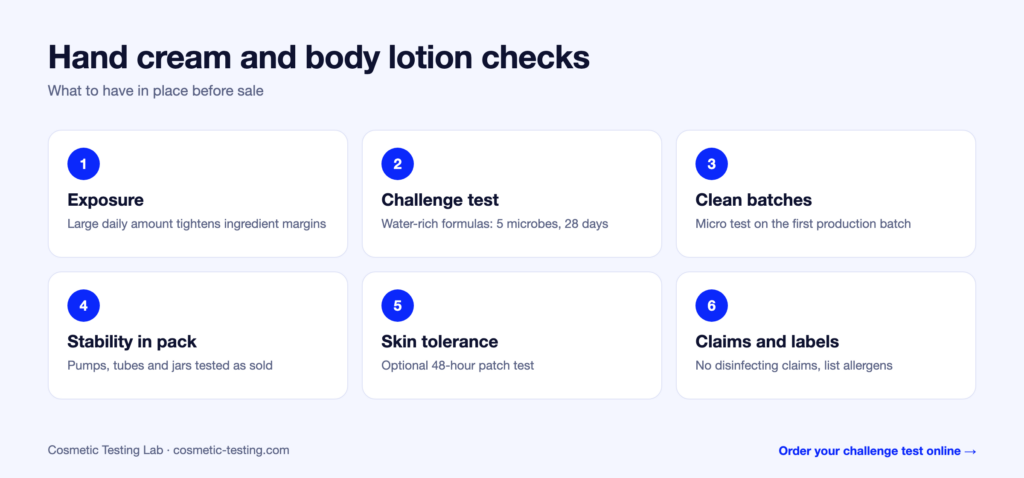
Every hand cream and body lotion sold in the EU must have a cosmetic product safety report, a product information file, a responsible person and a CPNP notification. For a water-based emulsion, the safety assessor will normally expect a preservation efficacy (challenge) test, microbiological results for the finished product, and stability data in the final packaging. A patch test is not mandatory, but it strengthens the file and supports claims. The details that make body and hand products special are exposure, pack size and the way they are used.
Why body and hand products need their own checklist
- Large exposure. A body lotion is spread over most of the body and stays on the skin. In the default exposure tables used by EU safety assessors, the daily amount for body lotion is several times higher than for a face cream.
- Frequent use. Hand cream is reapplied after every hand wash, so the product and its pack are handled many times a day.
- Big packs, long use. 250 ml and 500 ml pumps and family-size tubs can stay open for many months.
- Wet environments. Bathrooms, kitchen sinks and wet hands bring water and microorganisms into contact with the product.
Read also Lip Balm Safety Testing: What Lip Products Need Before Sale
Safety assessment: exposure drives the margins
The safety assessor calculates how much of each ingredient reaches the body, using the default amounts and retention factors in the SCCS Notes of Guidance. Because a body lotion is used in large amounts and left on the skin, the margin of safety for each ingredient is tighter than in a face cream at the same concentration. An essential oil, preservative or active that is acceptable in a small face product may need a lower level in a body lotion. Give your assessor the facts that change the calculation:
- where the product is used (hands, body, face too?);
- how often and how much, based on the instructions on the pack;
- the target group, especially if children are included;
- the full formula, including the fragrance composition and allergens.
The assessor writes the result into the CPSR; the more precise your input, the fewer questions later.
Preservation and the challenge test
Most lotions and hand creams are rich in water, which makes them attractive to bacteria and moulds. Fingers dip into jars, wet hands press pumps and tubes suck back air and residues. A challenge test shows whether the preservative system copes with repeated contamination: the product is inoculated with five reference microorganisms and monitored for 28 days, usually according to ISO 11930:2019. Test the final formula at its intended pH, because some preservatives lose strength if the pH drifts. Packaging matters too: an airless pump reduces the risk of contamination compared with an open jar, and the safety assessor can take this into account in the microbiological risk assessment.
Microbiological quality of the finished product
A challenge test proves the preservative works; a microbiological test shows that the batch you made is clean now. ISO 17516 gives the limits most assessors use. For a typical hand cream or body lotion, the total count of aerobic mesophilic microorganisms should not exceed 1,000 CFU per gram or millilitre, and specified microorganisms such as Escherichia coli, Pseudomonas aeruginosa, Staphylococcus aureus and Candida albicans must be absent in one gram. Stricter limits apply to products for children under three and for the eye area. Check the first production batch, and every batch if you fill in small runs.
Read also Body Scrub Testing: What Exfoliators Need Before You Sell
Stability and packaging compatibility
Body products travel and live in warm places: delivery vans in summer, steamy bathrooms, bags on a radiator. A stability test stores the product at different temperatures and checks appearance, colour, odour, pH and viscosity over time. For body and hand products, pay special attention to:
- Viscosity changes that make a lotion too thin or too thick for its pump.
- Emulsion separation at high temperature or after freeze-thaw cycles.
- Pump and dip-tube behaviour: clogging, dripping or air locks.
- Tube compatibility: fragrance or oils migrating into plastic, cracking or delamination.
- Fragrance stability, which often changes before anything else.
Always test in the final packaging. The results set the shelf life and the period after opening (PAO) printed on the pack.
Skin tolerance
A patch test is optional, but it is useful for hand creams with urea or acids, for strongly fragranced lotions, for products aimed at dry or sensitive skin and whenever you want to say “dermatologically tested”. A single 48-hour occlusive patch test on the finished product shows whether the formula irritates skin on first contact. Remember that claims about eczema, psoriasis or healing cracked skin move a product towards medical territory; keep wording cosmetic.
Claims to watch on hand and body products
- “Antibacterial” or “disinfecting”. The European Commission’s 2020 technical guidance on leave-on hand gels lists such claims as ones cosmetic hand gels must not use. A product whose main purpose is to kill germs falls under biocide rules rather than cosmetics law.
- “48-hour hydration”. Needs efficacy evidence that matches the exact claim.
- “Repairs” or “heals”. Risky wording; describe cosmetic effects such as softer, smoother or more comfortable skin.
- “Natural” or “free from”. Must be truthful and not mislead, in line with the common criteria for cosmetic claims.
Read also Perfume Safety Testing: What Fragrances Need Before Launch
Labelling details that are often missed
Fragrance allergens must be listed individually when they exceed 0.001% in leave-on products, which body lotions and hand creams are. Regulation (EU) 2023/1545 extended the list of allergens that must be labelled: products placed on the market since 31 July 2026 must follow the new rules, and products already on the market before that date may be sold until 31 July 2028. Also check the PAO symbol, the nominal quantity, the batch code and the ingredient list for every pack size.
Variants and pack sizes
Every scent is a different formula. Unless your safety assessor agrees that data can be shared, each fragrance version may need its own safety assessment and some of its own tests. A new pack size in the same material is usually simpler, but a change from jar to pump or from plastic to aluminium tube is a new packaging that needs compatibility data.
Pre-launch checklist
- Final formula, with fragrance allergens declared by the supplier.
- Stability and compatibility test in the final pack, giving shelf life and PAO.
- Challenge test on the final formula.
- Microbiological test on the first batch.
- Optional patch test, and efficacy data for any performance claim.
- CPSR, product information file, label check and CPNP notification by the responsible person.
Frequently asked questions
Does a hand cream always need a challenge test?
Water-based hand creams almost always do. Anhydrous balms and some products with very low water activity may be classified as low-risk by a documented assessment based on ISO 29621, but that decision belongs to your safety assessor.
Can one set of tests cover my hand cream and my body lotion?
Only if they are the same formula. Different formulas need separate data, and different packaging may need its own compatibility check.
How long does testing take?
A challenge test runs 28 days plus reporting, the microbiological test takes about 5 days after we receive samples, the patch test about two weeks, and the CPSR about 10 business days once all data is complete. Stability depends on the plan you choose.
Key takeaways
- Large, daily exposure makes ingredient margins tighter than in face products.
- Water-based lotions and hand creams need a challenge test and clean batches.
- Test stability in the final pump, tube or jar to set shelf life and PAO.
- Keep claims cosmetic: no disinfecting or healing promises.