

Whether you make a classic lacquer, a gel colour or a cuticle oil, the nail polish regulation EU brands must follow is the same law that covers every other cosmetic: Regulation (EC) No 1223/2009. This guide turns it into a practical checklist of what to test, what to document and which ingredients need extra care before you sell nail products in the EU.
Contents
- The short answer
- Which rules apply to nail products?
- Which ingredients are banned or restricted in nail products?
- What does the CPSR need for a nail product?
- Stability and packaging compatibility
- Microbiological quality: when does it matter?
- Skin safety and patch testing
- Labelling and claims
- Gels, hardeners and professional products
- Nail product testing checklist
- Common mistakes with nail products
- Frequently asked questions
- Key takeaways
The short answer
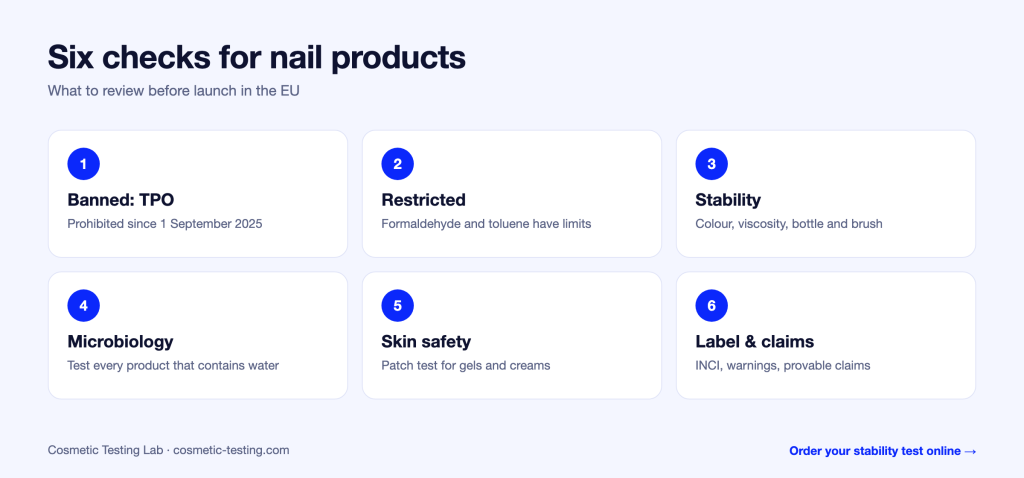
Nail products are cosmetics, so they need a signed CPSR, a product information file and a CPNP notification like any other product. What makes them special is the formula: solvent-heavy lacquers, reactive gels, a few tightly controlled ingredients (formaldehyde, toluene) and one substance that is now banned (TPO). Typical testing covers stability and packaging compatibility, microbiological quality for anything that contains water, and a skin safety review. A patch test is a strong addition for gels and nail-care creams.
Which rules apply to nail products?
Nail polish, base and top coats, gel polish, nail hardeners, strengtheners, removers and cuticle oils all fall under the Cosmetics Regulation. That means a responsible person established in the EU, a safety assessment before placing on the market, good manufacturing practice (ISO 22716 is the usual reference), a product information file kept for ten years after the last batch, notification in the CPNP and compliant labelling.
Artificial nail systems sold to professionals are generally still cosmetics when they are applied to the nail. If your product is used on people, assume the Cosmetics Regulation applies and ask your safety assessor if you are unsure.
Read also Toothpaste Cosmetic Regulation: Testing and Compliance Guide
Which ingredients are banned or restricted in nail products?
Nail chemistry is where many launches run into trouble. The points below are the ones brands meet most often. Always check the current annexes, because they change.
- TPO (trimethylbenzoyl diphenylphosphine oxide). This photoinitiator, common in gel polishes, was classified as a reproductive toxicant (CMR 1B). It is prohibited in cosmetics in the EU since 1 September 2025, and the European Commission has stated that no sell-off period applies. Reformulate and check the supplier’s photoinitiator list.
- Formaldehyde. Allowed as a nail hardener only within a set limit and with a mandatory warning on the label; as a preservative it has its own rules and labelling threshold. Many brands avoid it altogether.
- Toluene. A common solvent, restricted in nail products to a maximum concentration and for a defined type of use.
- CMR substances in general. Under Article 15 of the Regulation, substances classified as carcinogenic, mutagenic or toxic for reproduction (CMR 1A or 1B) are banned unless a specific exemption exists. A new classification can make a once-legal raw material illegal.
- Phthalates and similar plasticisers. Several are CMR substances and are banned; always ask your raw material supplier for confirmation.
Marketing terms such as “3-free” or “10-free” are not legal categories. If you use them, you must be able to prove each statement, and the list must not mislead about what the product does contain.
What does the CPSR need for a nail product?
The CPSR has two parts. Part A collects the data: formula, physical and chemical properties, stability, microbiological quality, impurities and packaging information. Part B is the safety assessment signed by the qualified assessor. For nail products the assessor will typically look at exposure through the nail plate and surrounding skin, accidental contact with the eyes, ingestion by children, and the use of the product by professionals versus consumers. An incomplete file delays the signature, so gather your test reports early. You can read the details in our CPSR service.
Stability and packaging compatibility
A lacquer must look and behave the same in month 24 as on day 1. A stability and compatibility test usually checks:
- colour and gloss, including pigment settling or flocculation;
- viscosity and flow, which affect application;
- solvent loss through the closure and thickening over time;
- interaction with the glass or plastic bottle, the brush and the cap liner;
- behaviour at higher and lower temperatures, since parcels sit in warm vans and cold warehouses.
Gel formulas add curing performance and the stability of the photoinitiator system. Report the results in a way your assessor can use for the shelf life or period after opening statement.
Read also Wet Wipes Regulation in the EU: Tests and Rules for Cosmetic Wipes
Microbiological quality: when does it matter?
A pure solvent-based lacquer is a hostile environment for microorganisms and is usually considered low risk under the ISO 29621 approach. The picture changes when water enters the formula: water-based or peel-off polishes, nail-strengthening creams, cuticle gels and some removers. For those, run a microbiological specifications test on the finished product and, for water-containing products, a challenge test according to ISO 11930. Do not copy the low-risk argument from a solvent lacquer to a water-based product.
Skin safety and patch testing
Allergic contact dermatitis around the nail is a known issue with some acrylate-based gel systems. Cosmetic safety assessment relies on ingredient data, but a 48-hour patch test on volunteers gives real evidence for finished products that stay in contact with skin or are applied close to the nail fold. It does not replace ingredient restrictions, but it supports the safety statement and any “dermatologically tested” claim, provided the study design supports it.
Labelling and claims
Check the label before the print run: full ingredient list (INCI), batch number, function, nominal content, responsible person name and address, precautions, and a period after opening or a date of minimum durability where relevant. Claims such as “long-lasting”, “strengthening” or “vegan” must follow the common criteria of Regulation (EU) 655/2013 and be backed by evidence you can show an inspector. Flammable lacquers also have transport and storage rules, and distributors often request a safety data sheet.
Read also Intimate Hygiene Products Regulation: Testing and Borderlines
Gels, hardeners and professional products
Gel polish and builder systems cure under a lamp, so the formula includes monomers, oligomers and a photoinitiator. These are the ingredients most often linked with sensitisation, which is why safety assessors look at them closely. Nail hardeners and strengtheners deserve the same attention because they may contain restricted actives. If a product is meant for salons only, say so clearly on the label and in the instructions, and keep the professional-use conditions consistent with what your assessor evaluated.
Nail product testing checklist
- Check every ingredient against Annexes II to VI, with TPO, formaldehyde, toluene and CMR substances first.
- Confirm raw material specifications and supplier statements.
- Run stability and packaging compatibility on final packaging.
- Assess microbiological risk and test the water-containing products.
- Consider a patch test for gels, hardeners and creams.
- Collect everything in the PIF and request the CPSR.
- Notify in the CPNP and finalise the label.
Common mistakes with nail products
- Selling a gel polish formula that still contains TPO.
- Testing a bulk sample instead of the final bottle with its brush and closure.
- Treating a water-based product as low risk without a challenge test.
- Using “free-from” lists that cannot be backed with supplier data.
- Forgetting that a reformulation, even a small pigment change, requires updating the CPSR.
Frequently asked questions
Do nail polishes need a CPSR?
Yes. Every cosmetic placed on the EU market needs a CPSR signed by a qualified assessor, including nail polish, gels and removers.
Is a challenge test required for nail polish?
Not for a solvent-based lacquer that the risk assessment shows to be low risk. It is advisable for water-based nail products and creams.
Can I still sell gel polish with TPO in the EU?
No. TPO has been prohibited in EU cosmetics since 1 September 2025. Reformulate and update your documentation.
Key takeaways
- Nail products follow Regulation 1223/2009: CPSR, PIF and CPNP are all required.
- TPO is banned; formaldehyde and toluene are tightly restricted.
- Test stability in the final packaging and test microbiology wherever water is present.
- A patch test strengthens the safety file for gels and nail-care creams.