
Brands that want a clean, plant-based image often ask the same question: which natural cosmetic preservatives actually protect a product, and which only look good on a label? The honest answer is that nature offers few ready-made solutions, that the law has its own view on what counts as a preservative, and that only a test can tell you whether your system works. This guide separates what is realistic from what is marketing.
Contents
- The short answer
- What does “natural preservative” mean in practice?
- Which listed preservatives are considered nature-identical?
- Why most natural extracts fall short
- What does work: building a hostile formula
- What about multifunctional and booster ingredients?
- How to prove that a natural system works
- Claims: what you may and may not say
- Common mistakes with natural preservation
- Frequently asked questions
- Key takeaways
The short answer
There is no legal category of “natural preservative” in the EU. A substance used to preserve a cosmetic must be on the Annex V positive list of Regulation (EC) No 1223/2009, and some of those listed substances, such as sorbic acid, benzoic acid and their salts, are nature-identical and accepted by many natural standards. Plant extracts and essential oils rarely protect a water-based product on their own, so a natural-leaning system is built from a listed preservative, a hostile formula and good packaging, and it must be proven in a challenge test.
What does “natural preservative” mean in practice?
The expression is used loosely. It can mean a substance found in nature, a substance made to match one found in nature, or simply an ingredient with a green image. For the regulation none of this matters: what counts is the function. If an ingredient is added mainly to stop microbial growth, it is a preservative and must be listed in Annex V, with its limits, product types and warnings. Our guide to the challenge test shows how the result is demonstrated.
Read also EU Approved Preservatives for Cosmetics: Annex V Explained
Which listed preservatives are considered nature-identical?
Several Annex V substances occur in nature but are produced industrially for consistency. They are the usual choice for brands that want a natural positioning:
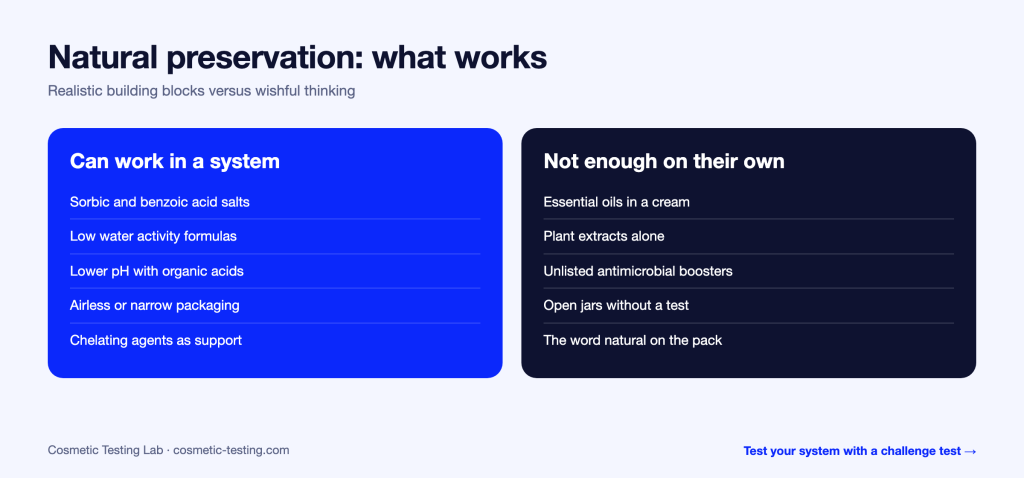
- Sorbic acid and its salts, effective mainly against yeast and mould.
- Benzoic acid and its salts, which also work better in acidic formulas.
- Salicylic acid, which has use restrictions and is not suitable for every product type.
- Dehydroacetic acid and its salt, common in natural-oriented products.
- Benzyl alcohol, which is found in some plants but is made synthetically for cosmetics.
Natural and organic certification schemes set their own lists, and some allow only a short group of preservatives, mostly organic acids, their salts and benzyl alcohol. If you plan to certify, check the current standard first, because the permitted list belongs to the scheme, not to the law.
Why most natural extracts fall short
Many essential oils and plant extracts show antimicrobial activity in a laboratory dish. In a finished cosmetic the picture changes. To protect a product with water, you need broad activity against bacteria, yeast and mould at a concentration that is safe on skin and acceptable in smell and colour. Essential oils would often have to be used at levels that irritate, smell strong or sensitise, and some contain fragrance allergens that must be declared on the label under Regulation (EU) 2023/1545, so your safety assessment has to cover them. Their composition also varies with harvest and supplier, which makes protection less predictable from batch to batch.
What does work: building a hostile formula
The most reliable natural-leaning strategy is to make the product hard for micro-organisms to grow in, then add a listed preservative at a sensible level. The elements you can use:
- Low water activity. Anhydrous products such as balms, oils and powders carry far lower risk than creams and lotions.
- pH control. Organic acid preservatives are most active at a lower pH, so a slightly acidic formula often needs less preservative.
- Humectants and polyols. Glycerin and glycols bind water and add to the hurdle, within what the skin feel allows.
- Chelating agents. They weaken microbes by binding metal ions and can boost the effect of other components.
- Packaging. Airless pumps and narrow openings reduce contamination in use compared with open jars.
- Hygienic manufacture. Clean equipment and water under good manufacturing practice reduce the load the preservative has to handle.
Combining several hurdles is often called a “hurdle” or “multi-hurdle” approach. It does not remove the need for preservation of water-containing products, but it can lower what is needed.
Read also Nanomaterials Cosmetics Regulation: Rules and Notification
What about multifunctional and booster ingredients?
Ingredients such as certain glycols, glyceryl esters and organic acid derivatives are sold as moisturisers, solubilisers or boosters that also support preservation. They are legitimate when they have a real other function and the whole formula is shown to be protected. They cannot replace a listed preservative if the purpose is preservation, and a supplier’s brochure does not decide this for you. The responsible person has to justify the function, and the finished formula has to pass its tests. When in doubt, ask your safety assessor before you build the formula around a booster.

How to prove that a natural system works
A challenge test is the way to show it. Our test follows ISO 11930:2019 or USP 51: the product is inoculated with five reference microorganisms and the decline is followed over 28 days. For natural systems, plan for these points:
- Test the final formula in its final pack, not a lab sample in a different container.
- Test a worst-case variant if you have a range, for example the one with the highest water content or the highest pH.
- Repeat the test after any change of supplier, extract or concentration.
- Support it with microbiological quality of the finished batch and a stability test, since pH drift can reduce preservation over time.
Under ISO 11930 the test can be passed under criterion A or under criterion B, which is usually less strict, and the report states which one applies. Ask what criterion your report used and what that means for your product and your market.
Claims: what you may and may not say
“Natural” and “preservative-free” are claims, so Regulation (EU) No 655/2013 applies: they must be truthful, supported by evidence and not misleading. A product that contains a synthetic-identical preservative should not be described as having no preservatives. A product protected by a hostile formula and listed preservative can still be called gentle, but the wording must match the ingredient list. Check any “natural” wording against the formula, the certification standard you refer to and the expectations of your retailer.
Read also CMR Substances in Cosmetics Explained: What Is Banned
Common mistakes with natural preservation
- Relying on essential oils or extracts alone for a cream or lotion.
- Copying the preservative system of a different formula without testing.
- Ignoring the pH, which can cancel the effect of organic acids.
- Selling in open jars while the test was done in a closed container.
- Declaring “preservative-free” when a listed preservative is in the formula.
- Skipping the challenge test because the ingredients are plant-based.
Frequently asked questions
Can I preserve a cosmetic with only essential oils?
For water-containing products this is rarely successful and can raise skin safety and allergen concerns. For anhydrous products the risk is much lower, but you still need to confirm the quality of the finished product.
Is a natural preservative safer than a synthetic one?
Not automatically. Safety depends on the substance, the concentration and the use. A listed preservative has been assessed at its limit, while an unlisted natural substance may not have been assessed for this purpose.
Do natural products need a challenge test?
Yes, if they contain water. The challenge test shows whether the system works, regardless of where the ingredients come from.
Key takeaways
- The EU has no category of natural preservative; the Annex V positive list decides what may preserve.
- Nature-identical organic acids and their salts are the realistic natural-leaning choice.
- Extracts and essential oils rarely protect water-based formulas alone.
- Build a hostile formula, choose suitable packaging and prove the result with a challenge test.