

Hyaluronic acid is on thousands of labels, from serums and sheet masks to lip balms and shampoos. For a brand, hyaluronic acid in cosmetics looks like an easy, low-risk choice, and in many ways it is. Still, the form you buy, the way it behaves in water, the claims you attach to it and the product it ends up in all need decisions. This article shows what to check about safety, what you can and cannot claim, and which tests are worth doing before launch. Hyaluronic acid is a well-established cosmetic ingredient with a good safety record, but each finished product still needs its own safety assessment, preservation proof, stability data and claims that match the evidence.
Contents
- The short answer
- What is hyaluronic acid, and what will you see on the label?
- Why molecular weight matters
- Is hyaluronic acid safe?
- What should be in the supplier documentation?
- How hyaluronic acid affects the formula
- Does it need a challenge test?
- Products and uses that need extra care
- Which claims are realistic?
- Is a patch test needed?
- Pre-launch checklist
- Frequently asked questions
- Key takeaways
The short answer
Hyaluronic acid and its salts are widely used as skin-conditioning and moisture-binding ingredients, and safety reviews of the ingredient have been favourable when it is used topically. That does not make your product automatically safe or compliant. Hyaluronic acid gels are rich in water and make a good home for microbes, thickened formulas can change over time, and claims such as “plumps” or “penetrates deep” can go beyond what topical use supports. A CPSR, a challenge test and a stability test cover these points.
What is hyaluronic acid, and what will you see on the label?
Hyaluronic acid is a long sugar-based molecule (a glycosaminoglycan) that binds large amounts of water. Cosmetic grades are mostly produced by microbial fermentation, although animal-derived sources have been used historically. On an ingredient list you will see several INCI names:
- Hyaluronic acid: the acid form, rarely used on its own.
- Sodium hyaluronate: the salt, by far the most common.
- Hydrolyzed hyaluronic acid or hydrolyzed sodium hyaluronate: the molecule broken into smaller pieces.
- Sodium acetylated hyaluronate and other modified forms with different feel and behaviour.
Use the exact INCI name of the material you buy, and keep the supplier’s specification in your file.
Read also Vitamin C Serum Stability and Safety: Testing Ascorbic Acid
Why molecular weight matters
Suppliers sell hyaluronic acid in different molecular weights, from large chains to small fragments. High-molecular-weight material mainly forms a hydrating film on the skin surface and thickens the product. Low-molecular-weight material is marketed for deeper effects, but the evidence that topical products deliver meaningful amounts into the living skin is limited and depends on the exact material and formula. That is why you should be careful with wording about depth or penetration. Many brands combine several weights; if you do, record each one and the reason in the product information file.
Is hyaluronic acid safe?
The Cosmetic Ingredient Review (CIR) expert panel assessed hyaluronic acid and its sodium and potassium salts in a report published in 2009 and concluded that they are safe for cosmetic use as described there. The review reported low toxicity, no sensitisation concerns and no genotoxicity for topical use. Check the CIR database for any newer assessment. In the EU, we are not aware of an Annex II to VI entry for hyaluronic acid or sodium hyaluronate, but always confirm the current annexes and the CosIng entry for the exact material. A good safety record for the raw material is only the start. Your safety assessor still evaluates the finished formula: the level, the other ingredients, the product type, the area of use and who will use it.
What should be in the supplier documentation?
- Specification with INCI name, molecular weight range and typical use level.
- Origin and production method, which matters for vegan or animal-free claims.
- Microbiological limits and, where relevant, residual protein or endotoxin information.
- Impurity data and the safety data sheet for the raw material.
- Confirmation of the batch-to-batch consistency of the grade.
Supplier documents are evidence for your file, but they do not replace testing of your own finished product.
Read also Margin of Safety (MoS) in Cosmetics: How It Is Calculated
How hyaluronic acid affects the formula
Even small amounts raise viscosity, so hyaluronic acid shapes how a serum or gel feels and flows. It is also sensitive:
- Heat and low pH can break down the chains and thin the product over time.
- Electrolytes and some charged ingredients reduce viscosity.
- Microbial contamination is a real threat, because some microbes produce enzymes that degrade hyaluronic acid, and a watery gel feeds growth.
- Mixing is tricky, since the powder clumps if added too fast.
Viscosity, appearance and pH should therefore be monitored in your stability study, in the final packaging.
Does it need a challenge test?
Almost always when the product contains water. Gels, serums, mists and masks are classic examples. Hyaluronic acid itself is not a preservative, and its water-binding properties do not protect the formula. A challenge test shows that your preservative system works against five reference microorganisms over 28 days, and a microbiological specifications test shows the quality of the finished product. Repeat the challenge test when you change the preservative, the pH or the packaging in a significant way.

Products and uses that need extra care
- Eye and lip products: sensitive areas where the assessor will look closely at irritation potential.
- Baby and sensitive-skin products: apply the extra caution your assessor asks for.
- Sheet masks and impregnated wipes: a lot of liquid, a lot of preservation challenge.
- Injected, implanted or ingested products: these are not cosmetics. Injectable hyaluronic acid fillers are normally regulated as medical devices, and ingested products as food or supplements. Do not describe a cosmetic as a filler or an injection alternative.
Read also Water Activity and pH: Formulating for Microbial Safety
Which claims are realistic?
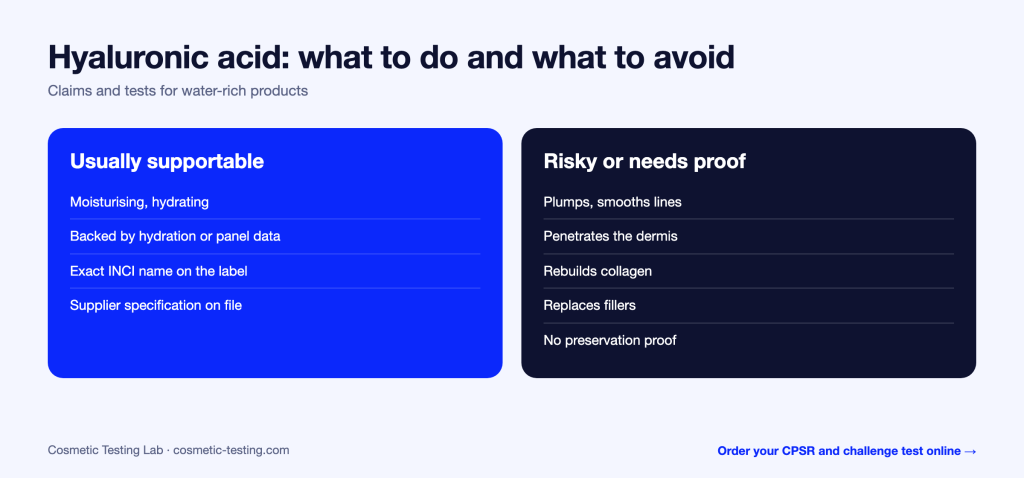
Claims must meet the common criteria of Regulation (EU) 655/2013: legal compliance, truthfulness, evidential support, honesty, fairness and informed decision-making. Typical hyaluronic acid claims sort like this:
- Usually supportable: “moisturising” or “hydrating”, with evidence from a hydration measurement or a consumer or expert evaluation of the finished product.
- Needs strong evidence: “plumps”, “smooths fine lines” or “visibly firmer”, because you must show the effect on the actual product and describe it as temporary where that is the case.
- Risky: “penetrates the dermis”, “rebuilds collagen” or “replaces fillers”, which suggest medical or deep-tissue effects.
A mention of hyaluronic acid on the front of the pack should also be true in practice: if the level is negligible, the name may mislead consumers.
Is a patch test needed?
Hyaluronic acid itself has a low sensitisation profile, but the finished product may contain fragrance, preservatives and plant extracts that do not. For leave-on products aimed at sensitive skin, or when you plan a “hypoallergenic” or “dermatologically tested” claim, a patch test on the finished product gives you support for the claim and for the CPSR. Whether it is needed for a given product is your safety assessor’s decision.
Pre-launch checklist
- Record the exact INCI name, molecular weight range, origin and supplier documents.
- Define the level and the claim, and check that the evidence matches.
- Run a stability study in the final packaging, watching viscosity and appearance.
- Prove preservation with a challenge test and check the finished product.
- Have the CPSR signed before placing the product on the market.
Frequently asked questions
Is hyaluronic acid banned or restricted in the EU?
We are not aware of a specific restriction for the common cosmetic forms, but check the current annexes of the Cosmetics Regulation and the CosIng entry for your material.
Does low molecular weight hyaluronic acid work better?
Not necessarily. Evidence for deeper effects from topical products is limited, so claim only what your own data supports.
Do I need a CPSR for a product with only a few ingredients?
Yes. Every cosmetic placed on the EU market needs a CPSR, however simple the formula is.
Key takeaways
- Hyaluronic acid has a good safety record, but each finished product needs its own assessment.
- Water-rich hyaluronic acid products need preservation proof and stability data.
- Claim hydration with confidence, but be careful with plumping, penetration and filler-like wording.
- Injected or ingested hyaluronic acid products are outside cosmetics law.