

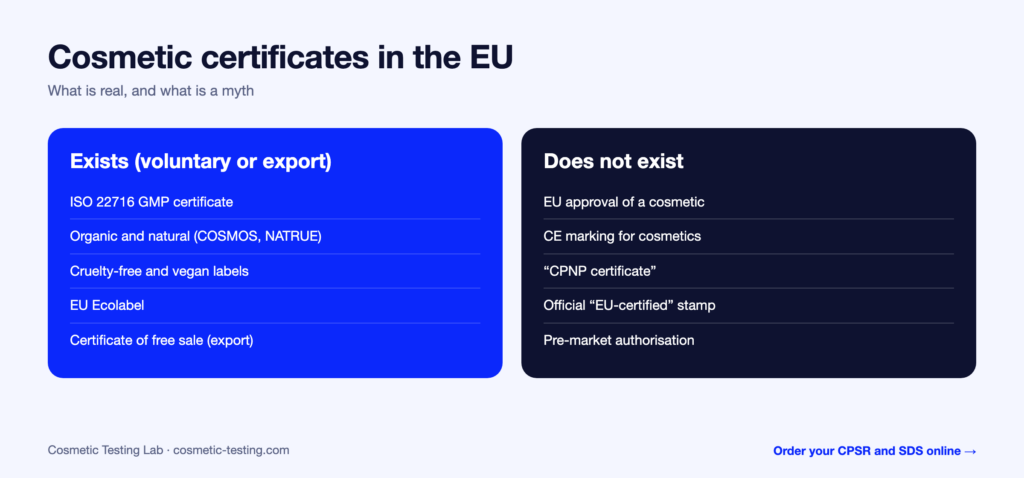
Buyers, marketplaces and even some consultants talk about “EU certification” for cosmetics as if a single official stamp existed. It does not. Understanding cosmetic certification in the EU starts with one fact: no EU authority approves or certifies a cosmetic before it is sold; the responsible person declares compliance based on a signed safety report (CPSR), a Product Information File and a CPNP notification. The certificates that do exist are either voluntary (GMP, organic, cruelty-free, EU Ecolabel) or export documents such as a certificate of free sale. This guide sorts the real certificates from the myths, so you know what to prepare and what to ignore.
Contents
- The short answer
- Why there is no official EU cosmetic certificate
- What takes the place of a certificate
- CE marking does not apply to cosmetics
- ISO 22716 GMP certification: useful, but voluntary
- Certificate of free sale: an export document
- Voluntary labels and private schemes
- Test reports and lab accreditation are not product certificates
- What buyers and marketplaces usually ask for
- What about the UK and other markets?
- Checklist: what to prepare instead of a certificate
- Red flags
- Frequently asked questions
- Key takeaways
The short answer
To sell a cosmetic in the EU you need a responsible person established in the EU, a CPSR signed by a qualified safety assessor, a Product Information File, GMP-compliant manufacturing, correct labelling and a CPNP notification. None of these is a certificate issued by an authority. If someone offers you an “EU cosmetic certificate” or a “CE certificate for cosmetics”, treat it as a red flag.
Why there is no official EU cosmetic certificate
Regulation (EC) No 1223/2009 is built on responsibility, not pre-approval. Unlike medicines, cosmetics do not need a marketing authorisation. The responsible person must make sure the product is safe and compliant before it is placed on the market, and national authorities check this afterwards through market surveillance: inspections, sampling and requests for the Product Information File. The proof of compliance is therefore the documentation you keep, not a certificate on the wall.
Read also EU Cosmetics Regulation 1223/2009 Explained in Plain English
What takes the place of a certificate
- The CPSR. The safety assessment in two parts: Part A with the data, Part B with the assessor’s conclusion, signature and qualifications.
- The Product Information File (PIF). The CPSR plus the product description, manufacturing method and GMP statement, proof of any claimed effects and data on any animal testing.
- CPNP notification. An online notification to the Commission’s portal before launch. It gives authorities and poison centres the information they need; it is not an approval, and the notification reference is not a certificate.
Together, these documents are what an inspector will ask to see. Keep them current: update the CPSR and PIF when the formula, a supplier, the packaging or the law changes, and keep the PIF for ten years after the last batch was placed on the market.
CE marking does not apply to cosmetics
CE marking is used for products covered by specific EU harmonisation laws, such as toys, electrical equipment and medical devices. The Cosmetics Regulation is not one of them, so a cosmetic must not carry a CE mark. If your product is actually a medical device, for example because it is intended to treat a condition rather than to cleanse, care for or beautify, it falls under different rules altogether; your safety assessor or regulatory adviser can help you decide where the line falls.
ISO 22716 GMP certification: useful, but voluntary
Article 8 of the Regulation requires cosmetics to be manufactured in line with good manufacturing practice, and compliance with the harmonised standard ISO 22716 is presumed to meet that requirement. A manufacturer can choose to have an accredited certification body audit it and issue an ISO 22716 certificate. That certificate is a strong sign of a well-run plant and many retailers ask for it, but the law requires GMP itself, not the certificate. Small producers can comply with documented procedures and no external certificate.
Read also Cosmetic Responsible Person (RP): Who Needs One and What They Do
Certificate of free sale: an export document
Some countries outside the EU ask importers for a certificate of free sale, a document confirming that the product is legally sold in the EU. Depending on the member state, it is issued by the competent authority or by an organisation such as a trade association or chamber of commerce; in Ireland, for example, the HPRA offers this service. It is not needed to sell inside the EU. We do not issue certificates of free sale, but the CPSR and test reports are usually part of the file the issuing body or the importing country wants to see.
Voluntary labels and private schemes
- Natural and organic: private standards such as COSMOS and NATRUE, with audits by approved certification bodies. ISO 16128 gives guidelines for calculating natural and organic indexes, but it is not a certification scheme.
- Cruelty-free and vegan: schemes such as Leaping Bunny or vegan trademarks, which check supply chains beyond the legal animal testing ban.
- Religious and other labels: halal and similar certifications run by private bodies.
- EU Ecolabel: the EU’s own voluntary environmental label. Commission Decision (EU) 2021/1870 sets criteria for rinse-off and leave-on cosmetic products, focusing on ingredients, biodegradability and packaging.
All of these are optional. Whatever logo you use, your claims must still meet the common criteria for cosmetic claims and be supported in your PIF.

Test reports and lab accreditation are not product certificates
A signed report from a stability test, a challenge test or a microbiological test proves a result for a specific sample and method. ISO 17025 accreditation describes the laboratory’s competence, not your product. A manufacturer’s certificate of analysis confirms one batch met its specification. All of these are evidence that feeds into the CPSR; none of them certifies the cosmetic as a whole.
Read also CPNP Notification: How to Register a Cosmetic Product
What buyers and marketplaces usually ask for
- CPNP notification reference and the responsible person’s details.
- The CPSR, or a confirmation that one exists.
- A safety data sheet, often requested for warehousing and transport even though finished cosmetics for consumers are exempt from the REACH SDS obligation.
- Test reports, an ISO 22716 certificate from the manufacturer, and the labels.
What about the UK and other markets?
Great Britain follows the same logic after Brexit: no pre-market approval, but a UK responsible person, a safety report and notification in the UK portal. The UKCA mark does not apply to cosmetics either. Many markets outside Europe do have registration or licensing systems, so check the rules of each destination country; an EU CPSR and signed test reports are typically the starting point for those files.
Checklist: what to prepare instead of a certificate
- Appoint a responsible person established in the EU.
- Confirm the formula complies with the Annexes and the packaging is final.
- Run stability, microbiological and, for water-based products, challenge tests.
- Get the CPSR signed by a qualified safety assessor.
- Assemble the PIF, including GMP evidence and proof for every claim.
- Notify the product in the CPNP before the first sale.
- Prepare an SDS and a short document pack for buyers who ask.
Red flags
- “EU-approved” or “EU-certified cosmetic” claims on labels or offers.
- A CE mark on a cosmetic.
- A “CPNP certificate” presented as an approval.
- A safety report without the assessor’s name, qualifications and signature.
Frequently asked questions
Do I need a certificate to sell cosmetics in the EU?
No official certificate is required. You need a responsible person, a CPSR, a PIF, GMP manufacturing, compliant labels and a CPNP notification.
Is the CPSR a certificate?
No. It is a safety assessment signed by a qualified person. It is often what buyers really mean when they ask for an “EU certificate”.
Is organic certification required for a natural claim?
No, but the claim must be truthful and supported. A recognised standard makes it easier to substantiate.
Key takeaways
- There is no official EU certificate or approval for cosmetics.
- Compliance rests on the CPSR, PIF, GMP and CPNP notification.
- CE marking does not apply to cosmetics.
- GMP, organic, cruelty-free and Ecolabel certificates are voluntary; a certificate of free sale is for export.