

Every cosmetic sold in the EU has to pass a cosmetic safety assessment before it reaches the shelf. Most brands only see the end result, a signed PDF, and wonder what happens in between. In short, a qualified safety assessor collects data on the formula, the ingredients and the finished product, works out how much of each ingredient reaches the consumer, compares that exposure with known toxicological limits and signs a conclusion. This guide follows a product from the first formula sheet to the signed report, step by step, so you know what to prepare and where delays usually come from.
Contents
- The short answer
- Who does what?
- Step 1: The full quantitative formula
- Step 2: Raw material documents and regulatory checks
- Step 3: Tests on the finished product
- Step 4: Normal and foreseeable use
- Step 5: Exposure calculation
- Step 6: Toxicological profile and margin of safety
- Step 7: Undesirable effects and other information
- Step 8: Part B, the signed conclusion
- After the signature
- Where assessments usually stall
- How long does it take?
- Frequently asked questions
- Key takeaways
The short answer
A cosmetic safety assessment is the scientific evaluation required by Article 10 of Regulation (EC) No 1223/2009. Its written result is the Cosmetic Product Safety Report, or CPSR, built according to Annex I of the regulation. Part A gathers the data; Part B contains the assessor’s reasoning and conclusion. The assessment must be carried out by a person with a university qualification in pharmacy, toxicology, medicine or a similar discipline, and the responsible person must keep it up to date for as long as the product is on the market.
Who does what?
- The responsible person (the brand, importer or an appointed company in the EU) is legally accountable. They make sure the assessment exists and keep it in the Product Information File.
- The manufacturer or formulator provides the exact formula, the raw material documents and manufacturing information.
- The laboratory tests the finished product: stability, microbiology, preservation and sometimes skin compatibility.
- The safety assessor evaluates everything and signs Part B. They do not need to be your employee, but they must be qualified and independent in their judgement.
Read also What Is a CPSR? Cosmetic Product Safety Report Explained
Step 1: The full quantitative formula
Everything starts with a complete formula: every ingredient by INCI name with its exact percentage, adding up to 100%. Fragrance compounds and botanical extracts need their own breakdown, because a single “parfum” line can hide allergens and restricted substances. The assessor also needs the function of each ingredient and the supplier’s trade name, so the right documents can be matched.
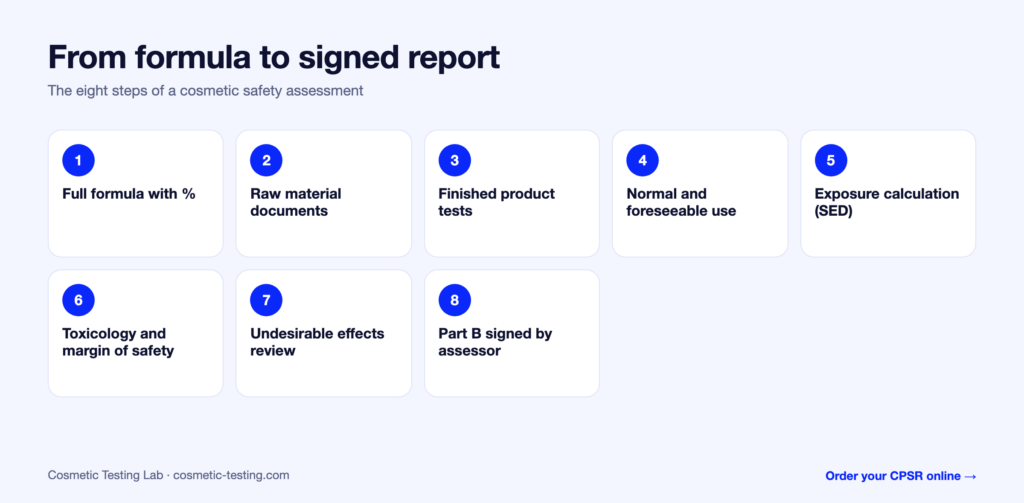
Step 2: Raw material documents and regulatory checks
For each ingredient the assessor looks at supplier data: technical data sheets, specifications, certificates of analysis, safety data sheets and, for fragrances, the allergen declaration and IFRA certificate. Each ingredient is checked against the annexes of the regulation: prohibited substances (Annex II), restricted substances with limits and conditions (Annex III), and the positive lists of colorants, preservatives and UV filters (Annexes IV to VI). Impurities and traces, for example heavy metals in mineral pigments, are considered here too.
Step 3: Tests on the finished product
Ingredient data cannot show how your finished mixture behaves. That is why Annex I asks for information on the stability and microbiological quality of the product itself, and for water-based products the result of a preservation test. In practice the assessor works with:
- a stability and compatibility test that supports the shelf life or period after opening and checks the packaging;
- a microbiological specifications test showing that the product is clean;
- a challenge test, usually to ISO 11930, showing that the preservative system works in use.
Products considered microbiologically low risk, such as anhydrous oils or high-alcohol perfumes, may not need a challenge test, but the assessor documents why.
Read also CPSR Annex I Checklist: Every Element a Safety Report Must Contain
Step 4: Normal and foreseeable use
The assessor defines how the product is used and by whom: a rinse-off shampoo used daily, a leave-on face cream applied twice a day, a lip balm that may be partly swallowed, a body lotion spread over a large skin area. Reasonably foreseeable misuse counts too. Products for children under three, products near the eyes or on mucous membranes and products for damaged skin receive extra attention.
Step 5: Exposure calculation
From that use pattern, the assessor estimates how much product reaches the skin per day and, for each ingredient, the systemic exposure dosage (SED). The calculation combines the daily amount of product, the ingredient’s concentration, how much of it is absorbed through the skin and the consumer’s body weight. The SCCS Notes of Guidance give default values for many product types, which keeps assessments comparable.
Step 6: Toxicological profile and margin of safety
Next, each relevant ingredient’s toxicological profile is reviewed: irritation, sensitisation, systemic toxicity and other end points, using published data, SCCS opinions and supplier information. For substances with a threshold effect, the assessor divides a reference dose from toxicity studies by the SED to obtain the margin of safety (MoS). Under the SCCS approach a MoS of at least 100 is generally considered acceptable. Where data is missing, the assessor may rely on read-across, history of safe use or a more conservative assumption, and explains the choice.

Read also CPSR Example: What a Finished Cosmetic Safety Report Looks Like
Step 7: Undesirable effects and other information
For an existing product, reported undesirable effects and serious undesirable effects are reviewed. The assessor also considers any other useful information: a patch test on volunteers, compatibility studies, data from similar products already on the market. For a brand-new product this section is usually short, but it must be updated once the product sells.
Step 8: Part B, the signed conclusion
Part B brings it together in four elements: the assessment conclusion (is the product safe under normal and foreseeable use?), the warnings and instructions that must appear on the label, the scientific reasoning that leads to the conclusion, and the assessor’s identity, qualifications, date and signature. Warnings in Part B are binding in practice: if the assessor requires “avoid contact with eyes”, it belongs on your label.
After the signature
- The CPSR goes into the Product Information File together with the product description, manufacturing method, proof of claimed effects and animal testing information.
- The responsible person notifies the product in the CPNP before it is placed on the market.
- The PIF is kept for ten years after the last batch was placed on the market.
- The CPSR is updated whenever new information appears: a formula change, new packaging, a change in an ingredient’s legal status or new reports of undesirable effects.
Where assessments usually stall
- A fragrance listed as one line without an allergen breakdown.
- Percentages that do not add up to 100% or trade names without INCI names.
- Tests run on an older formula or in a different package.
- Supplier documents missing for restricted ingredients, preservatives or colorants.
How long does it take?
The writing itself is rarely the slow part. Product tests take time (a challenge test alone runs for 28 days), and missing supplier documents are the most common cause of delay. At Cosmetic Testing Lab, a CPSR is delivered in about 10 business days once all data is complete. The report is prepared in one of three tiers by formula complexity: Simple (up to 10 ingredients), Standard (11–25) and Complex (26 or more, or containing a fragrance).
Frequently asked questions
Can I do the safety assessment myself?
Only if you hold the qualifications required by Article 10. You can, however, prepare most of Part A yourself, which speeds up the work of the assessor.
Does every shade or scent need its own assessment?
Variants that share a base can often be covered in one report when the differences are clearly described, but each variant must be assessed.
Is a safety assessment the same as a safety data sheet?
No. The assessment covers consumer safety under the Cosmetics Regulation; an SDS covers handling and transport hazards for professional users.
Key takeaways
- A cosmetic safety assessment follows Annex I: data in Part A, conclusion in Part B.
- Formula, raw material documents and finished product tests are the three pillars.
- Exposure and margin of safety calculations turn data into a conclusion.
- The signed report must be kept in the PIF and updated over the product’s life.