
Few phrases on a pack reassure shoppers as quickly as a dermatologically tested claim. It is also one of the claims brands get wrong most often, because the words sound official while the law does not define them. This guide shows what the claim means, what evidence regulators and retailers expect, and how to back it up in a way that stands up to a challenge.
Contents
- The short answer
- Is “dermatologically tested” regulated?
- What does the claim promise the consumer?
- What counts as dermatological supervision?
- Which tests can back the claim?
- Ethics and volunteers
- Match the test to the exact claim
- Which product do you test?
- What a good report contains
- Common mistakes to avoid
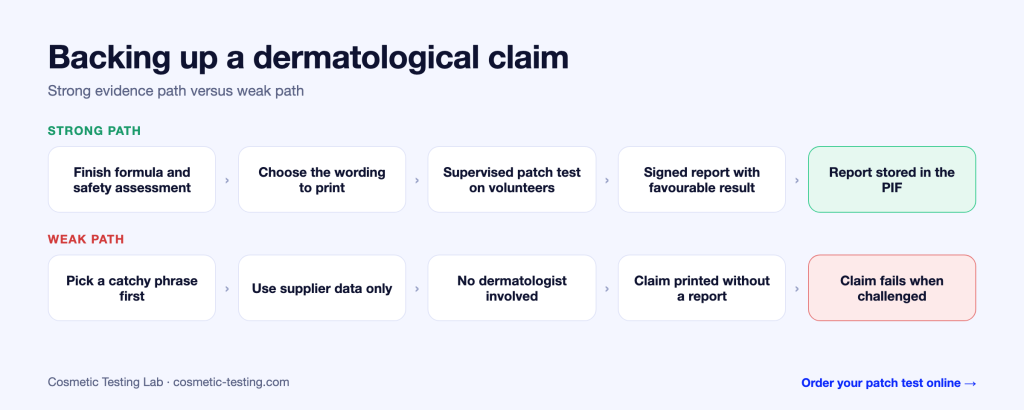
- Step by step: from idea to claim
- Frequently asked questions
- Key takeaways
The short answer
To back up a “dermatologically tested” claim you need a documented skin-compatibility study on the finished product (or a representative formula), planned and assessed under dermatological supervision, with a written protocol, informed volunteers and a signed report whose result is favourable. The claim must be true, specific and supported by evidence that you can show to an authority on request. A patch test report is the most common and most practical piece of that evidence.
Is “dermatologically tested” regulated?
There is no legal definition of the phrase in EU law. Two pieces of legislation still apply. Article 20 of Regulation (EC) No 1223/2009 forbids text, names, trademarks and images that imply characteristics or functions the product does not have. Regulation (EU) No 655/2013 then sets six common criteria for every claim: legal compliance, truthfulness, evidential support, honesty, fairness and support of informed decision-making. For this claim the third criterion matters most: the claim must be supported by adequate and verifiable evidence, taking the state of the art into account.
The responsible person is accountable for this. If a market surveillance authority, a retailer or a competitor asks for proof, the evidence has to be in the product information file (PIF), not “somewhere at the supplier”.
Read also Hypoallergenic Claims: What the Law Says
What does the claim promise the consumer?
Consumers read it as “a skin specialist checked this and it was fine for skin”. That is why the wording is a trap. “Tested” alone says only that a test took place, yet shoppers understand a good outcome. A claim is misleading if the test showed irritation, if it was done on a different formula, or if no dermatologist was involved. So you need three things: a real test, a favourable result and a dermatologist’s role that you can document.
What counts as dermatological supervision?
The study should be designed, supervised or at least assessed by a qualified physician with dermatological competence, or by a clinical team working under one. In practice that means a named dermatologist or a recognised testing institute signs the protocol and the report. Reading the skin reactions after patch removal is done by trained staff using a standard scoring scale. Check that the report states who assessed the reactions and with what qualification. An unsigned summary or a sales email is not evidence.
Which tests can back the claim?
- Single-application closed (occlusive) patch test. The product sits on the skin of volunteers under a patch for a set time, usually 48 hours, and reactions are scored afterwards. It shows whether the product is irritating on healthy skin under exaggerated conditions. Our patch test follows this approach.
- Repeated-application patch tests. The product is applied several times over weeks. They are used when the claim is about sensitisation potential, so they go beyond the basic claim.
- Use test under dermatological control. Volunteers use the product in real life while a dermatologist examines their skin. It supports claims about tolerance in everyday use or on sensitive skin.
Cosmetics Europe publishes product test guidelines for the assessment of human skin compatibility, and many protocols are modelled on them. Ask your laboratory which guideline its protocol follows.
Read also “For Sensitive Skin” Claims: How to Substantiate
Ethics and volunteers
Tests on people must be ethical. Volunteers receive information, give written consent, may leave at any time, and are screened so that people with relevant skin conditions or known allergies to the ingredients are excluded. Products must also already be safe: a finished formula should have passed a toxicological assessment before it touches a volunteer. This is one reason the safety work comes first. Your CPSR covers the safety assessment, and a patch test then confirms tolerance on real skin. Do not run human tests on a formula that has no safety assessment.
Match the test to the exact claim
The most common mistake is claiming more than the study shows. Use this as a guide:
- “Dermatologically tested”: a supervised skin-compatibility study with a favourable result.
- “Suitable for sensitive skin”: tolerance data, ideally in people with sensitive skin, from a use test or a study designed for it.
- “Hypoallergenic” or “non-irritating”: stronger wording that needs dedicated, well-designed evidence; a single patch test rarely carries it alone.
- “Dermatologist recommended” or “approved”: a different claim that needs evidence of real recommendations, not only a test.
- “Clinically proven”: efficacy claims need efficacy studies, not a tolerance test.
When in doubt, use the simplest wording the report supports and put the details in the file.
Which product do you test?
Test the finished product in its final formula, or a formula that is clearly representative of a range. If you change the formula in a way that may affect skin tolerance, for example a new preservative, fragrance or active, the old report may no longer cover the product. Variants that differ only in colour are often covered by one report, but this is a judgement the responsible person must justify in the file. Products that are not stable or contaminated also cannot support a skin-safety statement, so make sure stability and microbiological quality are in order before you test.
Read also Ophthalmologically Tested: Claim Requirements Explained
What a good report contains
- Product name, batch and full formula reference.
- Protocol: method, application, duration, scoring scale.
- Panel description and inclusion and exclusion criteria.
- Name and qualification of the dermatologist or assessor.
- Raw results and the overall conclusion in plain words.
- Date, laboratory and signature.
If your report is only a certificate with the words “passed”, ask for the full version before you print anything on a label.
Common mistakes to avoid
- Printing the claim before the report exists, or because a competitor does.
- Using an ingredient supplier’s data for the finished product.
- Using a favourable test of one product for a different formula.
- Ignoring a mild reaction in the report and still claiming the product is gentle.
- Making the claim larger on marketing material than on the pack.
- Not updating the evidence after a reformulation.
Step by step: from idea to claim
- Finish the formula and confirm its safety assessment.
- Decide the exact wording you want to print.
- Choose the test design that supports that wording.
- Run the study with a qualified laboratory and keep the signed report.
- Store the report in the PIF and link it to the claim.
- Review the evidence whenever the formula changes.
Frequently asked questions
Can I use the claim after only one patch test?
For the basic wording “dermatologically tested”, a properly supervised patch test with a favourable result is a common and reasonable basis. For stronger wording such as hypoallergenic you will usually need more.
Does the claim have to be on the label?
No, it is voluntary. But if you use it anywhere, on the pack, on a web shop or in an advert, the same evidence requirements apply.
Do the rules differ outside the EU?
Yes, other markets have their own claim rules and expectations, so check the target market before you reuse the wording on export packs.
Key takeaways
- The phrase has no legal definition, but it must be true and backed by verifiable evidence.
- A dermatologist-supervised patch test with a favourable result is the practical baseline.
- Match the wording to the study: stronger claims need stronger evidence.
- Keep the signed report in the PIF and refresh it after reformulations.