

If you want to sell US cosmetics in the UK, your FDA compliance and MoCRA listings do not cover you. Great Britain has its own cosmetics regulation, its own notification service and its own requirement for a Responsible Person with a UK address. The good news for US brands is that much of the technical work, such as formulas, stability and microbiology data, can be reused. This guide explains what is new, what you can carry over and what to prepare first.
Innehåll
- The short answer
- What is different from the US system?
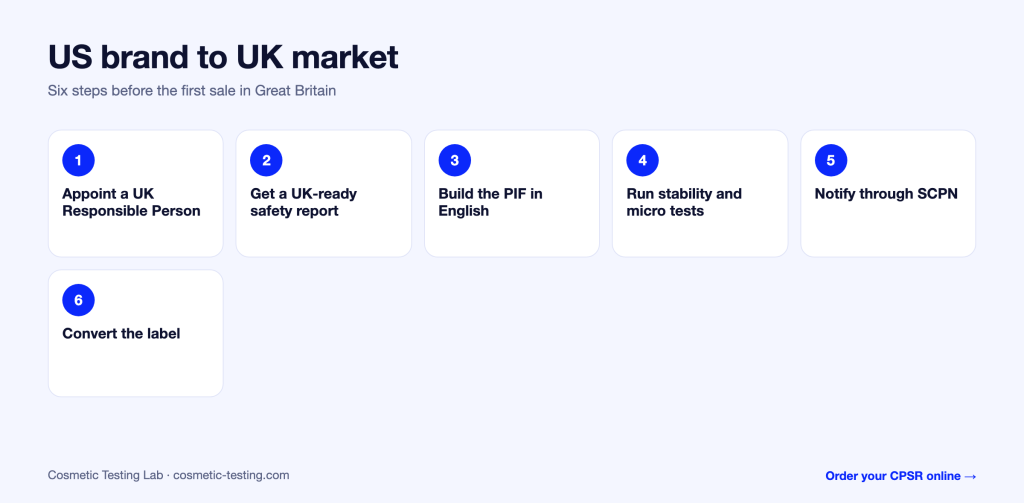
- Step 1: Appoint a UK Responsible Person
- Step 2: Get a UK-ready safety report
- Step 3: Build the PIF in English
- Step 4: Generate the data behind the report
- Step 5: Notify through the SCPN service
- Step 6: Convert the label
- What about Northern Ireland and the EU?
- Common mistakes US brands make
- Frequently asked questions
- Key takeaways
The short answer
To place a cosmetic on the market in Great Britain, a US brand needs a UK Responsible Person with a genuine UK address, a product safety report (the UK equivalent of the CPSR) signed by a qualified safety assessor, a product information file (PIF) kept in English, a notification through the UK’s Submit cosmetic product notifications service (SCPN) before the product is made available, and a label that carries the Responsible Person’s details. MoCRA facility registration and product listing with FDA are separate and do not replace any of these steps. If you also sell in Northern Ireland or the EU, different rules apply there, as explained below.
What is different from the US system?
In the US, cosmetics are not approved before sale. MoCRA added facility registration, product listing, safety substantiation and adverse event reporting, but FDA does not issue a license for each product. Great Britain is also a self-declaration system, with no approval of products, but it is more document-driven: the Responsible Person must hold a signed safety assessment and a full PIF before the first sale, and must notify the product to the authorities (the Office for Product Safety and Standards, OPSS).
- Safety substantiation: MoCRA requires adequate substantiation of safety, but the UK expects a formal, structured safety report with a named assessor and qualifications.
- Responsible Person: MoCRA has a “responsible person” (the manufacturer, packer or distributor named on the label), who does not need to be in the UK. The UK Responsible Person must be established in the UK.
- Ingredient lists: The UK has its own lists of prohibited and restricted substances, colourants, preservatives and UV filters, which differ from FDA rules on color additives and prohibited ingredients.
Läs också Brittiska kosmetikaregler: SCPN och brittisk ansvarig person
Step 1: Appoint a UK Responsible Person
The Responsible Person can be a business or an individual, and must have a UK address. According to the UK government guidance, a UK established address does not include mail-forwarding or PO box addresses. For a brand outside the UK, the options are an importer into the UK, or a company or person that you name in writing and who accepts the role. The Responsible Person is legally accountable for the product’s compliance, so choose a party that actually reviews your documents rather than a name on a label.
Step 2: Get a UK-ready safety report
Before the product is made available, a qualified safety assessor must evaluate it. The UK guidance describes the assessor as a qualified professional, for example someone with a university degree in pharmacy, toxicology, medicine or a similar discipline, and Part B of the report must include the assessor’s name, address and proof of qualifications. Because requirements and acceptance of qualifications can differ between the UK and the EU, ask your assessor to confirm that the report meets the UK regulation, not only the EU one. A CPSR with Part A (safety information) and Part B (safety assessment) is the usual route, and many brands use one report prepared to satisfy both the UK and the EU.
A US safety substantiation summary, or a MoCRA file, is a useful start but rarely has the structure the report needs: formula with concentrations, physical and chemical properties, microbiological quality, impurities, exposure and toxicological profile of each ingredient, and undesirable effects.
Step 3: Build the PIF in English
The PIF must be kept in English for all products, and it should be held for 10 years after the last batch is made available. It typically contains the product description, the product safety report, evidence of good manufacturing practice (ISO 22716 is a recognized way to show this, though not the only one) and evidence for any claimed effects. If your manufacturer already works to FDA cosmetic GMP expectations, use that as supporting material, but check that it demonstrates the same points.
Läs också Sälja kosmetika i Turkiet: ansvarig person och ÜTS-anmälan
Step 4: Generate the data behind the report
The safety assessor needs data on the finished product. Typically this means:
- stability and compatibility data, which supports the shelf life and the period-after-opening symbol;
- a microbiological quality test of the finished product;
- a challenge test for water-containing products, to show the preservative system works.
Data produced for the US market is often reusable, if it was generated on the final formula and packaging with a recognized method. Check dates, batch and packaging match what you will sell.

Step 5: Notify through the SCPN service
The Responsible Person must submit the product details through the Submit cosmetic product notifications service before the product is made available in Great Britain. The notification typically includes the product name and category, the Responsible Person’s details, the country of origin for imports, the formulation and, where relevant, nanomaterials. Nanomaterials not covered by the relevant annexes need a separate nanomaterial notification. Serious undesirable effects must be reported to OPSS without delay.
Step 6: Convert the label
A US label usually needs changes before it can be used in the UK. The UK guidance lists these items on the container and packaging:
- the Responsible Person’s name and address;
- the country of origin, if the product is imported;
- the weight or volume (not always required for very small contents, under 5 g or 5 ml);
- a use-until date;
- precautions for use;
- an identification number, such as a batch number;
- what the product does;
- the ingredients, which may appear on the packaging only, with “(nano)” after nanomaterials.
US-specific elements such as Drug Facts panels, or “Distributed by” lines that do not show a UK address, should be replaced or supplemented.
Läs också Ansvarig person för kosmetika (RP): vem behöver en och vad gör den?
What about Northern Ireland and the EU?
The guidance for Great Britain does not cover Northern Ireland, where the Responsible Person must be established in Northern Ireland or the EU, and the EU system applies. A product sold in both GB and the EU therefore usually needs a UK Responsible Person plus an EU Responsible Person, a SCPN notification plus a CPNP notification, and a label with both addresses. A single well-prepared safety report can usually serve both markets. Read more in our guide to the UK and EU CPSR.
Common mistakes US brands make
- Using a mail-forwarding address as the UK address.
- Selling on UK marketplaces before the SCPN notification is complete.
- Keeping the PIF only in the original language of the manufacturer.
- Assuming an FDA-compliant ingredient or colorant is automatically allowed in the UK.
- Making disease claims that turn a cosmetic into a medicine in the UK.
Frequently asked questions
Does a US brand need a UK Responsible Person?
Yes. A product made available in Great Britain needs a Responsible Person with a UK address, who can be an importer or a company or person you appoint.
Can I use my EU CPSR in the UK?
Often the technical content can be reused, but the report should be checked against the UK regulation and the assessor’s qualifications confirmed for the UK. Ask your assessor to confirm both.
Is there an approval process for cosmetics in the UK?
No. There is no product approval, but notification through the SCPN service is required before the product is made available.
Key takeaways
- FDA compliance and MoCRA listing do not replace UK requirements: you need a UK Responsible Person, a PIF in English and an SCPN notification.
- A signed safety report from a qualified assessor must exist before the first sale.
- Stability, microbiology and challenge test data are mostly reusable if produced on the final product.
- If you also sell in the EU or Northern Ireland, plan for the EU Responsible Person and CPNP as well.