

Glitter lip gloss, peel-off nail polish, face paint and “make your own perfume” kits sell well, and parents expect them to be at least as safe as adult products. There is no separate EU law for kids’ products, but children’s cosmetics regulation is stricter in practice than many brands think. A product a child applies to their skin, lips, nails or hair is a cosmetic and needs a full safety assessment that considers the child’s age, while the toy parts around it, and some play kits, also fall under toy safety law. This guide explains where the two rulebooks meet and which tests a children’s cosmetic needs.
Contents
- The short answer
- Cosmetic, toy or both?
- Why age changes the safety assessment
- Microbiological quality: the strict limits
- Colourants and glitter
- Impurities, heavy metals and talc
- Presentation: when a cosmetic looks like food
- Face paint and special-effect products
- Packaging and stability
- Claims for children’s products
- Common mistakes
- A practical checklist
- Frequently asked questions
- Key takeaways
The short answer
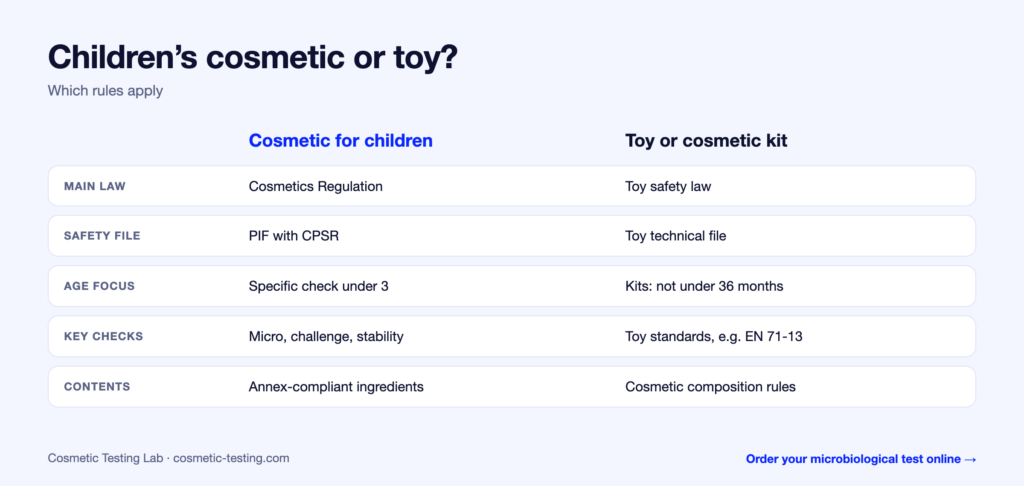
Children’s makeup, nail polish, bath products and face paints are cosmetics under Regulation (EC) No 1223/2009. They need a responsible person, a Product Information File, a CPSR signed by a qualified safety assessor, CPNP notification and correct labelling. The assessment must reflect that children have different exposure and sensitivity, and Annex I requires a specific assessment for products intended for children under three. If the product comes in a toy, or is a kit for making cosmetics, the Toy Safety Directive 2009/48/EC applies as well.
Cosmetic, toy or both?
- Kids’ lip gloss, nail polish, face paint, glitter gel, bubble bath: cosmetics.
- Play cosmetics for dolls: the Toy Safety Directive calls these cosmetic toys and requires them to meet the compositional and labelling requirements of cosmetics law.
- Cosmetic kits that teach a child to make cosmetics: toys with their own rules, including that they are not for children under 36 months, specific warnings and fragrance allergen labelling. The harmonised standard is EN 71-13.
- Makeup sets in a toy case: the cosmetic contents follow cosmetics law; the case, mirror or accessories follow toy safety law if they are designed for play.
The toy rules are changing. The new Toy Safety Regulation (EU) 2025/2509 was published on 12 December 2025 and will replace the directive from 1 August 2030, with stricter rules on chemicals. If you sell kits or play sets, plan for it now.
Read also Toothpaste Cosmetic Regulation: Testing and Compliance Guide
Why age changes the safety assessment
A safety assessor cannot simply reuse an adult assessment. Children have a larger skin surface relative to body weight, their skin barrier is still developing in the first years, and they use products in unexpected ways: on the whole face, several times a day, or in the mouth. The Commission’s CPSR guidelines (Implementing Decision 2013/674/EU) and the SCCS Notes of Guidance both ask the assessor to consider these factors.
Some ingredients carry age conditions in the Annexes. Salicylic acid, for example, must not be used in products for children under three, except shampoos, and talc powders for young children must carry a warning to keep the powder away from the child’s nose and mouth. Products for children three and older are not exempt from scrutiny: the realistic way a seven-year-old uses play makeup is part of the assessment.
Microbiological quality: the strict limits
ISO 17516 and the SCCS Notes of Guidance place products for children under three, the eye area and mucous membranes in a stricter category: no more than 100 colony-forming units per gram, against 1,000 for other cosmetics, with specified pathogens absent. Kids’ products are often shared, used with fingers and left open, so a clean batch matters. A microbiological specifications test checks each batch against the limit your assessor sets, and water-based products such as face paints, creams and bubble baths also need a challenge test to prove the preservative system.
Colourants and glitter
Only colourants listed in Annex IV may be used, and many entries restrict where they can go, for example not in products applied to mucous membranes. That matters for lip glosses, which touch the lips and are partly swallowed, and for eye makeup. Check every pigment against its Annex IV conditions for the exact product type.
Glitter needs extra attention. Under the EU microplastics restriction (Regulation (EU) 2023/2055), loose plastic glitter has been restricted since October 2023, and cosmetics containing plastic glitter follow transition periods that depend on the product type. Biodegradable or mineral alternatives are worth considering for new products.
Read also Nail Polish Regulation EU: Testing Requirements for Nail Products
Impurities, heavy metals and talc
EU law does not set general heavy-metal limits for cosmetics. Traces of prohibited substances are only accepted when they are technically unavoidable and the product remains safe, so the assessor relies on raw material specifications and, where needed, analysis. Pigments and mineral powders are the usual focus. For talc-based powders, ask suppliers for documentation on asbestos-free sourcing.
Presentation: when a cosmetic looks like food
Strawberry-shaped lip balms, candy-scented glosses and cupcake soaps appeal to children, and that is exactly the risk. The Cosmetics Regulation requires the safety assessment to consider the product’s presentation, including the rules on products that imitate food. Those rules now sit in the General Product Safety Regulation (EU) 2023/988, and in July 2026 the Commission published guidance on food-imitating toys and other products. If a child could mistake your product for something to eat, rethink the shape, scent or pack.
Face paint and special-effect products
Face and body paints for parties, carnival and sports events are cosmetics too, even when they are sold in toy shops or as part of a costume. They cover large areas of the face, often around the eyes and lips, and stay on for hours. That puts the colourants, the binder and the preservation under close review. Water-activated cake paints and cream paints are frequently shared between children with the same sponge or brush, which makes preservation and batch hygiene especially important. Temporary tattoos, glitter gels and coloured hair sprays deserve the same care: check whether each product is a cosmetic and assess it for the age group that will really use it.
Read also Wet Wipes Regulation in the EU: Tests and Rules for Cosmetic Wipes
Packaging and stability
Children drop, squeeze and open things. Small caps can be a choking hazard, and glass breaks. A stability and compatibility test shows that the formula stays stable in its real pack and supports the period after opening. If the pack is a toy, its safety is assessed under toy rules.
Claims for children’s products
“Gentle”, “tear-free”, “dermatologically tested” and “made for kids” are claims and need evidence under Regulation (EU) No 655/2013. “Tear-free” in particular is hard to support and is better avoided unless you hold specific data. Keep marketing honest: a cosmetic for children must not exaggerate safety.
Common mistakes
- Reusing an adult formula and CPSR for a kids’ version.
- Choosing pigments without checking their Annex IV conditions.
- Forgetting that a play kit is also a toy.
- Food-like shapes and scents without a risk assessment.
- Skipping batch microbiological testing for small runs.
A practical checklist
- Define the age group and decide whether any part is a toy.
- Check every ingredient and colourant against the Annexes for that use.
- Run challenge, microbiological and stability tests on the final product.
- Have the CPSR signed with an assessment for the target age.
- Check toy requirements for any kit, case or accessory.
- Notify the cosmetic in the CPNP and finalise labels and warnings.
Frequently asked questions
Is children’s play makeup a toy or a cosmetic?
The makeup itself is a cosmetic. Play cosmetics for dolls and cosmetic-making kits are toys that must also meet cosmetic composition rules.
Do products for older children need the strict microbiological limit?
The strict category covers children under three, the eye area and mucous membranes. For older children, the assessor decides; lip and eye products often fall into it anyway.
Does the new Toy Safety Regulation apply now?
It is published and in force, but it applies from 1 August 2030. Until then the Toy Safety Directive applies.
Key takeaways
- Kids’ makeup is a cosmetic and needs a full, age-specific CPSR.
- Play cosmetics for dolls and cosmetic kits also fall under toy law.
- Strict microbiological limits apply to products for under-threes and eye or lip use.
- Check colourants, glitter and food-like presentation before launch.